
Fairy Tales
The Song the Bird Would Not Sing Twice for Nothing
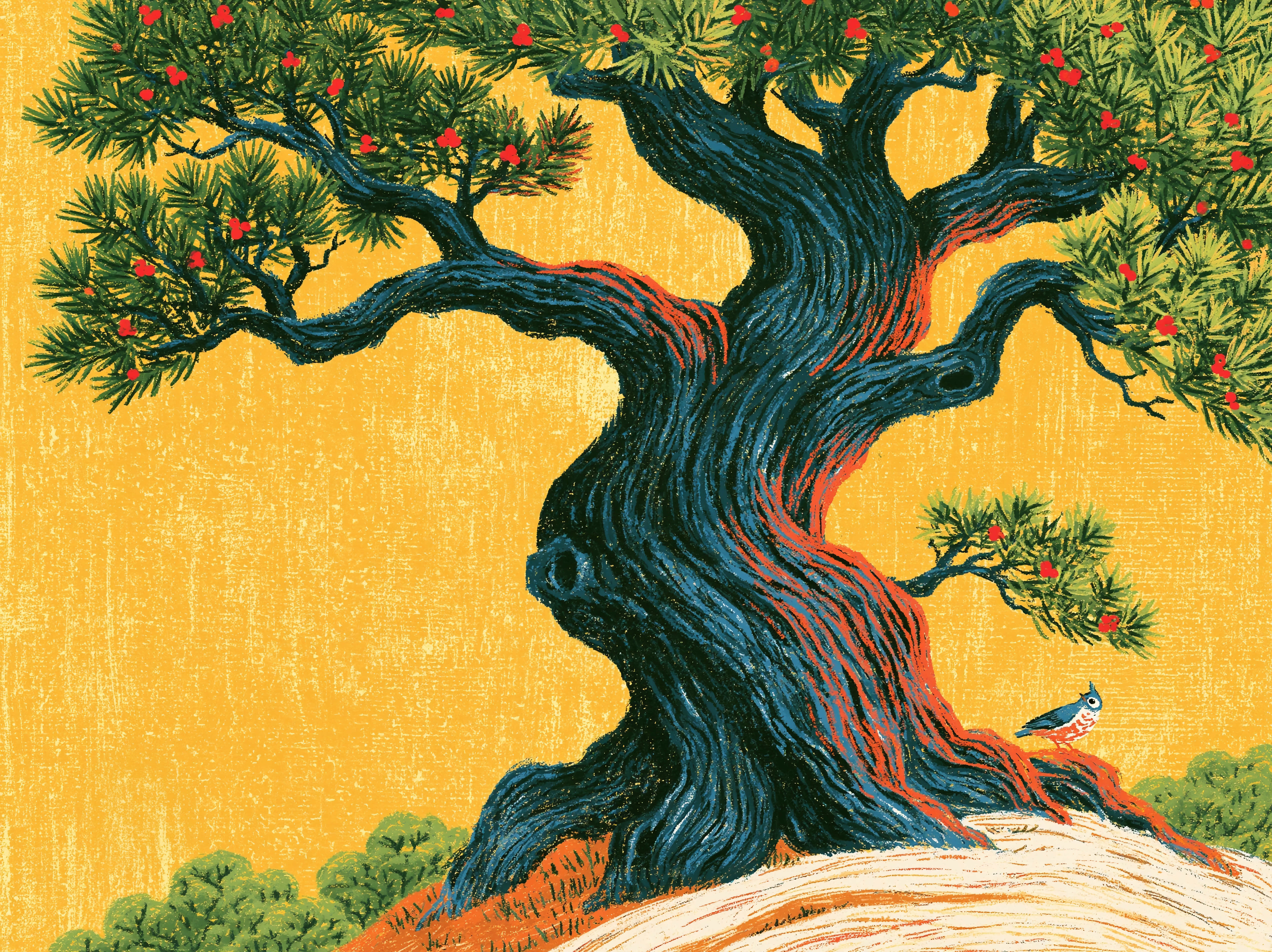
In the Grimms' "The Juniper Tree" (KHM 47), a murdered boy returns as a bird and sings the story of his own death, first to strangers and then under his family's windows. This feature follows that seven-line song through the tale, and through the painter Philipp Otto Runge's part in writing it down, to show how a song can carry a story of murder toward judgement, restitution and return.
Orientation
At a Glance
- The tale, with its endingBecause the story is darker than most readers expect of the Grimms, a summary with spoilers is worth giving.
- A painter's text, not a peasant'sIt is easy to imagine a tale like this passing unchanged from grandmother to grandchild until the Grimms caught it.
- What the song doesThe first thing the song does is tell the truth that nobody in the house can tell.
- The tree and the bonesThe song's own content points to the other two agents of the tale.
Seven lines, sung by a bird from a rooftop:
My mother she killed me, My father he ate me, My sister, little Marlinchen, Gathered together all my bones, Tied them in a silken handkerchief, Laid them beneath the juniper-tree, Kywitt, kywitt, what a beautiful bird am I!
This is the song at the centre of "The Juniper Tree," number 47 in the Brothers Grimm's Kinder- und Hausmärchen, quoted here in Margaret Hunt's English translation of 1884. It is one of the most unsettling things in the whole collection, and not only because of what it reports. The dead child speaks in the first person, he names the three people in his house and says exactly what each of them did, and then, in the last line, he breaks into birdsong and boasts of his own beauty. The song is sung whole five times in the tale, to a goldsmith, a shoemaker, a crew of millers, and at last to the family itself. By following it from one audience to the next, we can see what the tale uses it for: the song is at once a testimony, a price, and a way home.
The Tale, With Its Ending
Because the story is darker than most readers expect of the Grimms, a summary with spoilers is worth giving. Hunt's version opens with a distance that J. R. R. Tolkien later singled out: "It is now long ago, quite two thousand years, since there was a rich man who had a beautiful and pious wife." The couple are childless. In winter the wife stands under the juniper tree in their courtyard, cuts her finger while peeling an apple, sees blood fall on the snow, and wishes aloud: "Ah, if I had but a child as red as blood and as white as snow!" Through the months of her pregnancy the tree marks time with her, until "the seventh month she snatched at the juniper-berries and ate them greedily," and in the eighth she asks, "If I die then bury me beneath the juniper-tree." The child is born, "and when she beheld it she was so delighted that she died." Her husband buries her beneath the tree.
He remarries, and his second wife bears a daughter, Marlinchen. The stepmother comes to hate the boy, whom she sees as standing between her daughter and the inheritance. She offers him an apple from a heavy chest and, as he stoops for it, slams the lid: "his head flew off and fell among the red apples." She props the body in a chair with a handkerchief tied round the neck, tricks Marlinchen into striking the head off so that the girl believes herself the killer, and then cooks the boy in a stew. The father, told that his son has gone away to his mother's great-uncle, eats it with appetite ("It seems to me as if it were all mine") and throws the bones under the table. Marlinchen, weeping, takes "her best silk handkerchief out of the bottom drawer," gathers the bones, and lays them under the juniper tree.
Then the tree moves. Its branches part and come together "just as if some one was rejoicing and clapping his hands"; "a mist seemed to arise from the tree, and in the centre of this mist it burned like a fire, and a beautiful bird flew out of the fire singing magnificently." The bones are gone, and Marlinchen is "as gay and happy as if her brother were still alive." The bird sings its song to a goldsmith and receives a gold chain; to a shoemaker and receives red shoes; to twenty millers and receives their millstone, which it wears round its neck "as if it were a collar." It returns home, perches on the juniper tree and sings. The chain falls round the father's neck; the shoes fall to Marlinchen. The stepmother runs out, and the bird drops the millstone on her head, and "she was entirely crushed by it." Smoke, flames and fire rise from the spot, and when they clear, "there stood the little brother," who takes his father and sister by the hand, "and they went into the house to dinner, and ate."
A Painter's Text, Not a Peasant's
It is easy to imagine a tale like this passing unchanged from grandmother to grandchild until the Grimms caught it. The record is more specific. The text came from Philipp Otto Runge, the Romantic painter from Pomerania, who wrote it down in Low German and sent it, together with the story that became "The Fisherman and His Wife," in a letter of 24 January 1806 to the Heidelberg publisher Johann Georg Zimmer; according to the German encyclopedia account of the tale's transmission, Runge said he had kept to the oral telling as he had heard it. Achim von Arnim printed Runge's text in his Zeitung für Einsiedler in 1808. Johann Gustav Büsching reprinted it in 1812, and the Grimms took it into the first volume of their collection the same year, with a note calling it "written down by Runge from oral tradition." Runge's own manuscript is lost; what survives is a copy.
The tale is therefore one of the Grimms' literary acquisitions, shaped by an artist with a painter's eye for colour (red apples, white handkerchiefs, a gold chain, red shoes), and it was revised again in later editions, which followed a version adjusted by Runge's brother Daniel. One small detail of the later printings tells us something about the song. In the text as the Grimms finally printed it, the prose is Low German but the song stands in High German, until its last line drops back into dialect: "Kywitt, kywitt, wat vör'n schöön Vagel bün ik!" Whatever the reasons for that editorial choice, it has the effect of setting the song off from the story around it, as if it were a thing quoted rather than narrated.
What the Song Does
The first thing the song does is tell the truth that nobody in the house can tell. The stepmother lies about where the boy has gone; the father does not know what he has eaten; Marlinchen believes she is guilty of a death she did not cause. The song corrects all three misunderstandings in six lines, and it does so in the voice of the only person who knows everything. It is a murder ballad sung by the victim.
The second thing it does is make the crime public before it makes it domestic. The bird does not fly straight home. It sings first to people with no stake in the matter, a goldsmith at his work, a shoemaker and his household, the millers at their stone, and each of them is stopped by the song and wants to hear it again. The tale dramatises that stopping most carefully at the mill. Twenty men are hewing "hick hack, hick hack," while the mill goes "klipp klapp," and as the bird sings line by line the workers fall silent in groups, one, then two, then four, until the last man puts down his tool. Before the family hears a word, the world outside has listened and been arrested by the story.
The third thing the song does is earn. To each craftsman who asks for an encore the bird gives the same answer, "I'll not sing it twice for nothing," and demands a particular object. The objects are not random. Each one turns out to be meant for a member of the household, and each suits the part that member played. The father receives a gold chain, the ornament of an honoured man, and it falls round his neck from the tree. Marlinchen receives red shoes, and she "danced and leaped into the house." The stepmother receives the millstone. The song is paid for in the currency of the ending: the stranger's admiration is converted into the instruments of reward and justice.
Finally, the same seven lines, sung on the juniper tree outside the house, are heard in three different ways. The father feels "so truly happy," as if he were "about to see some old friend again," and notices a smell like cinnamon. Marlinchen weeps and then goes out "light-hearted." The stepmother hears "a roaring in her ears like the most violent storm," says she feels "as if the world were coming to an end," and goes out anyway. The song does not change; the hearers do. It works as a kind of verdict that each listener reaches by hearing it, which is why the tale can dispense with a judge.
The Tree and the Bones
The song's own content points to the other two agents of the tale. Its fourth to sixth lines are not about the crime at all; they are about Marlinchen's care for the remains, and they end with the place where she laid them. The juniper tree has been present from the first page. It is where the first mother made her wish, whose berries she ate, and under which she asked to be buried. When the bones are laid there, it is the tree that responds, clapping as if rejoicing, releasing mist and fire, and producing the bird.
What the text states is limited: it never says that the dead mother acts through the tree, and it does not explain the mist or the fire. What it does show is a pattern. Mother and son are both laid beneath the same tree; the transformation from bones to bird happens there; and the ending repeats the imagery of the beginning, "smoke, flames, and fire" rising where the stepmother dies, and the boy standing whole when they clear. The sister's handkerchief, the tree and the fire together perform a burial that becomes a return.
The last sentence adds something easy to miss. The restored family goes indoors "to dinner, and ate." The tale's central horror was a meal; its closing image is another one. The article's own reading is that the ending deliberately repairs the table as well as the family: the house in which a child was served as food becomes, again, a house in which a father and his children sit down to eat together.
Where the Readings Begin
Beyond what the tale says, interpretations divide by evidence. Folklorists place it in tale type ATU 720, named for the song itself in older indexes ("My Mother She Killed Me, My Father He Ate Me"), and point to relatives such as the English "Rose-Tree," which reverses the sexes of the children. Michael Belgrader's study of the type in 1980 found no version older than the eighteenth century, but noted its overlap with the "singing bone" tales (the Grimms' "The Singing Bone," KHM 28, is one), in which a victim's remains accuse the murderer; he connected the gathering of bones beneath a tree to older ideas of tree burial. Walter Burkert saw behind it the Greek myth of Procne, who served her son to his father and was turned into a bird. These are historical proposals about origins, not facts the tale itself supplies.
Psychological readers have concentrated on the family. Walter Scherf described a murderess taking the place of a loving mother, with redemption bringing the child back to his parents' house; Nicole Belmont read the tale as an initiation story for children of roughly eight to twelve; Jack Zipes has stressed how far its theme of child abuse pulls it toward an adult audience. Religious and esoteric readers go further. Almut Bockemühl compared the tale with the nightingale myth, with the dismemberment and rebirth of Dionysus-Zagreus, with shamanic motifs of bones and renewal, and with the Easter pattern of death and resurrection. The text gives such readings real footholds, since the bones are gathered, laid under a living tree, and the dead child returns whole, but it names no god, no rite and no doctrine, and the reader who follows these comparisons is following an interpretation rather than a statement of the tale.
Two literary witnesses show how the song escaped the story. Goethe gave a version of it to Gretchen in the dungeon scene at the end of Faust, Part One, where the condemned woman sings "Meine Mutter, die Hur, / Die mich umgebracht hat," ending "Fliege fort, fliege fort!"; the Grimms mentioned the passage in their notes. And Tolkien, in "On Fairy-Stories," remembered "the gay and vengeful bird-spirit coming out of a mist that rose from the tree," and defended the stew and the bones against softened versions: "Without the stew and the bones... that vision would largely have been lost."
Kywitt, Kywitt
Return to the song, then, and its strange last line. The first six lines are an indictment and a record of care; the seventh is pure bird, a nonsense call followed by a boast. That line is the sign that the dead boy is not only a victim describing his death. He has become something new, beautiful and free, who can turn the story of his murder into a song that strangers pay for, and who spends what he earns on his father, his sister and his killer. The tale's answer to its own horror is not an explanation. It is this song, sung until everyone who needs to hear it has heard it, after which it stops, the fire dies down, and a boy walks back into his house.
For a reader who wants to go on, the best next step is the tale itself in Hunt's translation, read aloud, since the song is meant to be heard, followed by "The Singing Bone" (KHM 28), its nearest neighbour in the collection.
Source ApparatusNotes7 notes
- ↩
Jacob and Wilhelm Grimm, "The Juniper-Tree," in Grimm's Household Tales, trans. Margaret Hunt (London: George Bell, 1884), tale 47. Consulted at SurLaLune Fairy Tales (surlalunefairytales.com/oldsite/authors/grimms/47junipertree.html) and at AmericanLiterature.com (americanliterature.com/author/the-brothers-grimm/fairy-tale/the-juniper-tree). All English quotations from the tale are from this translation.
- ↩
Grimm, "Von dem Machandelboom," Kinder- und Hausmärchen, KHM 47, German text at SAGEN.at (sagen.at/texte/maerchen/maerchen_deutschland/brueder_grimm/vondemmachandelboom.html), for the song's final line in Low German. The observation that the later editions print the song in High German amid Low German prose is from Märchenbrause (maerchenbrause.de/maerchen/von-dem-machandelboom) and the German Wikipedia article.
- ↩
"Von dem Machandelboom," German Wikipedia (de.wikipedia.org/wiki/Von_dem_Machandelboom; also consulted in the dewiki.de mirror), for Runge's letter of 24 January 1806 to Zimmer, Arnim's printing of 1808, Büsching's 1812 reprint, the later adoption of Daniel Runge's revision, and the summaries of Scherf, Burkert, Belgrader, Bockemühl and Belmont.
- ↩
"The Juniper Tree (fairy tale)," English Wikipedia, for the ATU 720 classification, the English "Rose-Tree," and the summary of Zipes's view.
- ↩
D. L. Ashliman, "The Juniper Tree," Folklore and Mythology Electronic Texts, University of Pittsburgh (sites.pitt.edu/~dash/grimm047.html), for Runge's dates and the 1808 and 1812 printings.
- ↩
J. R. R. Tolkien, "On Fairy-Stories" (1947), consulted in an online PDF of the essay; quotations are short and are given for comment.
- ↩
Goethe, Faust, Part One, "Kerker" (dungeon scene), lines 4412–4420, as cited in "wir lesen faust: Kerker" (wirlesenfaust.blogspot.com); the opening line also as given in the title of a Springer chapter on the passage.
Test your understanding
Question 1 of 3
Why does the article describe the bird’s song as something that “earns” rather than merely recounts the murder?
Guided Inquiry
Questions for Socrates
Explore these questions with Socrates, with this Feature as your reading context.
- The song remains unchanged, yet the father, Marlinchen, and the stepmother hear it differently. What does this suggest about whether judgment comes from the song itself, from each listener’s conscience, or from both?→
- Why might the bird make the murder public among strangers before returning to the family? How does that sequence affect the song’s roles as testimony, payment, and a way home?→
- The article distinguishes what the tale explicitly states from later historical, psychological, and religious interpretations. What standards of evidence should readers use when deciding whether an interpretation illuminates the tale or imposes too much upon it?→