
Fairy Tales
The Fifth String
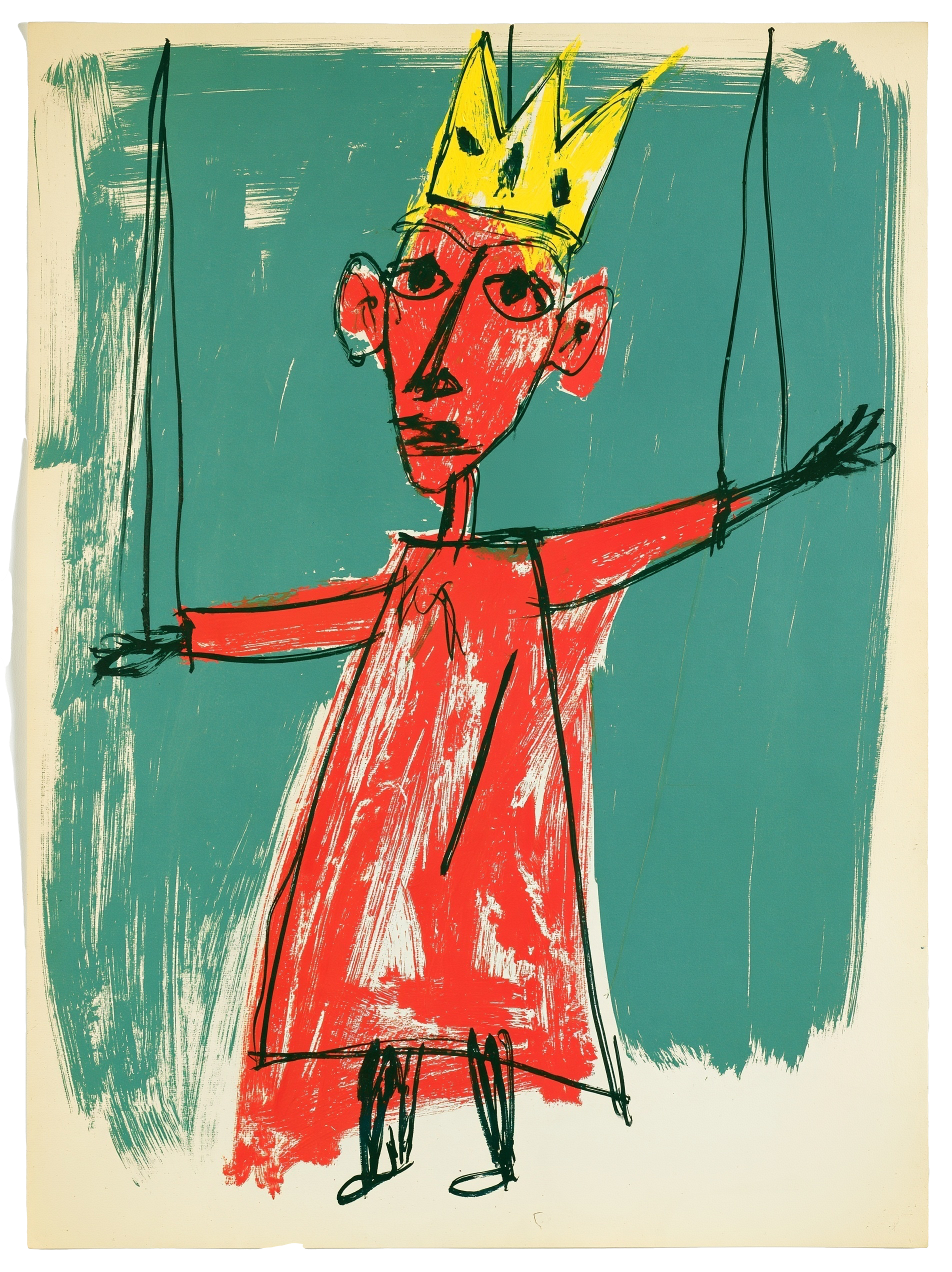
An original fable, told the way the old literary fairy tales are told: a puppet king in a toyshop window wants to stand up without strings, and learns, after a flood and a fisherman's daughter and a one-eyed gull, that there was a fifth string all along, too fine to see, which does not pull.
Orientation
At a Glance
- The FableIn a harbour town where the wind blew so hard that the people leaned forward even indoors, there was a toyshop on the quay, and in the window of the toyshop there was a king.
- What This Is Made OfA Diotimos Fable is an original tale, and this one was built on a single passage of Plato, which is quoted here so that the reader can see what the fable did with it.
- A Closer LookHe was a puppet king, you understand, with a wooden crown painted gold and a red coat with a bit of rabbit fur at the collar, and he hung from four strings, two to his hands and tw
- The Wider ViewNow the king had one wish, and it was this: to stand up by himself.
The Fable
In a harbour town where the wind blew so hard that the people leaned forward even indoors, there was a toyshop on the quay, and in the window of the toyshop there was a king.
He was a puppet king, you understand, with a wooden crown painted gold and a red coat with a bit of rabbit fur at the collar, and he hung from four strings, two to his hands and two to his knees; and the four strings ran up to a little wooden cross, which puppet-makers call the control, and whoever held the control was king of the king. When the shop-boy held it, the king danced a jig for the children at the window, and the children laughed, and their mothers came in and bought a bag of marbles, which is what a jig is for. When the big boys got hold of it after school, the king fought the tin soldier, and always lost, because the boys preferred it so. And when nobody held it at all, which was most of the time, the king lay in the window in a heap with his crown over one eye, and the china doll beside him looked the other way, as china dolls do.
Now the king had one wish, and it was this: to stand up by himself. "If I could stand," he said to the china doll one night, "with no string at all, I should be a proper king and not a jig." The doll, who was made in one piece and had never moved in her life, said that she was sure she could not think what he meant, and she meant it kindly.
You will say that a king on strings is a sad thing; but the town was full of them, and nobody thought it sad. The harbour-master ran to the pastry-cook's window whenever the wind brought the smell of buns, and ran away from the dentist's whenever the wind brought the sound of the drill, and everybody did the same, so it was not thought odd; and if you had told the harbour-master that he was worked from a cross of sticks, he would have been very much offended, and then he would have gone for a bun.
There was one more string, and nobody knew about it: not the shop-boy, not the big boys, not the doll, and not the king himself. It was finer than a hair and the colour of nothing at all, and it ran from the very top of his crown straight upward, and where it went to nobody could have said, because nobody had ever looked. The old woman who made him had put it there, up in her workshop on the hill, with her little glasses on the end of her nose; and when her apprentice asked what it was for, she said, "For the day the others are cut," and would not say more; and she was dead now, so there was no asking her again.
In the shop there was also a cockatoo, in a brass cage by the till, which had learned two words from the shop-boy and used them on everybody. "Dance! Dance!" it said, when the door opened; "Dance! Dance!" when the door shut; and the customers said what a clever bird it was, and the king, who could not help dancing when the shop-boy took the control, hated it more than anything in the world, and would have told it so if a puppet could.
Outside the window, on the lamp-post at the corner of the quay, there sat most nights an old grey gull with one eye. The other gulls said she had been foolish ever since the great storm, for she did nothing but sit and look at the sky when there were perfectly good fish-heads to be quarrelled over; and it is true that she looked at the sky a great deal. But at night, when the shop was dark and the street was empty, she would come down to the sill and look in through the glass at the king, and the king, who was lying in his heap, would look back with the eye that was not under the crown.
"What holds you up?" said the gull one night, through the glass.
"The strings," said the king.
"And when nobody holds the strings?"
"Nothing. I lie like this."
"Then what is it you want?"
"To stand," said the king, "with no strings at all."
"Hm," said the gull. "I have never seen anything stand up with nothing," and she flew back to her lamp-post and looked at the sky; which was not at all what the king had wanted to hear, and he lay in his heap and thought her a very stupid bird.
Then, in the autumn, the sea came into the town.
It came at night, on the top of a gale, over the quay wall and along the street and under the toyshop door, and it lifted the shelf in the window as easily as you would lift a tray, and carried the tin soldier and the marbles and the china doll and the king, control and all, out through the broken glass and into the harbour. The doll sank at once, being made in one piece, and that is all I know about the doll. The king floated, because he was wood, and his four strings floated behind him like the legs of a jellyfish; and the tide took him out among the boats, and the weed took hold of the strings, and a crab climbed onto the control.
I should like to tell you that the crab did not know what it had got. But it found out very quickly, as crabs do, and for the rest of that night the king bowed to the fishes, and bowed, and bowed, because the crab liked the feeling of the sticks; and the fishes said he was a very civil sort of king, and swam on.
In the morning the tide went out and left him on the mud at the foot of the fishermen's steps, with the weed knotted round his strings and the crab gone about its business. A fisherman's daughter called Nell came down the steps to look for what the storm had left, which is what fishermen's daughters do after a storm, and she found a king in the mud with a bit of rabbit fur at his collar, and took him up. The strings were past saving, so she cut them with her father's knife, all four, close to the hands and the knees, and threw the control back into the harbour, where I suppose the crab has it still. Then she carried the king home and set him on the windowsill in the kitchen to dry, with his crown straightened and his coat pulled down, and went to help with the nets.
And there the king lay, with no strings at all, which was what he had wished for; and he found that it was exactly the same as before, except that now nobody could make him dance even if they wanted to. He lay in his heap on the sill and looked at the ceiling. "I wanted to be free of the strings," he thought, "and I am only free of the jig." It is a thing a great many people find out, and most of them later than he did.
The gull, as it happened, lived on that roof.
She came down to the sill in the afternoon and looked at him with her one eye. "Well," she said. "You have no strings now."
"I have no strings," said the king, "and I cannot stand."
"You have one."
"I have none. She cut them all. I counted."
"You counted four," said the gull.
The king did not answer, for he was busy feeling something he had never felt before, because until that afternoon there had always been so much else to feel. At the very top of his crown there was a thread. It did not tug at him, the way the others had tugged; it did not jerk him this way and that, or make him bow, or make him dance. It did nothing at all except tell him, very quietly, which way was up. "Something is holding my crown," he said.
"Nothing is holding it," said the gull. "It is only showing you. It is too fine to lift you; if you wait to be lifted you will lie there till you rot. The standing is yours."
So the king pushed with his wooden knees, which nobody had ever asked him to do, and leaned, a very little, the way the thread showed him, and fell on his face. He tried again and fell on his side. He tried a great many times, all that afternoon, while the gull looked at the sky and said nothing, which was the kindest thing she could have done; and towards evening, when the kitchen was going red with the sunset, the king of the toyshop window got his knees under him, and leaned along the thread, and stood.
He did not stand by himself. He knew that quite well. And he found, to his surprise, that he did not mind it in the least.
Nell came in with the lamp and saw a puppet standing on her windowsill with no strings, and she looked at him a long moment, and then she set the lamp down and went on with the supper. Her father, when he came in, said the salt water must have swelled the joints. The neighbours, when they came in, said he must be glued. Nell said nothing at all, and dusted his crown on Saturdays; and whether she could see the thread I do not know, but I notice that she never once tried to make him dance.
The toyshop was mended by the spring, with a new window and a new tin soldier, and the cockatoo, which had been rescued from the top of its cage, was hung up by the till again, and says "Dance! Dance!" to everybody who comes in, and most of them do. The harbour-master still runs for buns. The gull still sits on Nell's roof and looks at the sky, and the other gulls still say she is foolish, and perhaps she is.
But there is a king on a windowsill in that town who stands up with no strings that anybody can see; and if you go there and ask him how it is done, he will tell you that it is not done by himself, and that is more than most kings will tell you.
What This Is Made Of
A Diotimos Fable is an original tale, and this one was built on a single passage of Plato, which is quoted here so that the reader can see what the fable did with it. In the first book of the Laws, the Athenian Stranger, trying to explain what it means to be "superior to oneself", proposes a picture. In Benjamin Jowett's translation: "May we not conceive each of us living beings to be a puppet of the Gods, either their plaything only, or created with a purpose-which of the two we cannot certainly know? But we do know, that these affections in us are like cords and strings, which pull us different and opposite ways, and to opposite actions". Among these cords, he goes on, there is one "which every man ought to grasp and never let go, but to pull with it against all the rest; and this is the sacred and golden cord of reason, called by us the common law of the State; there are others which are hard and of iron, but this one is soft because golden". And then the sentence the fable turns on: "For inasmuch as reason is beautiful and gentle, and not violent, her rule must needs have ministers in order to help the golden principle in vanquishing the other principles." R. G. Bury's version of the same lines calls the golden cord a "leading-string" that is "gentle rather than forceful" and so "needs helpers" (Laws 644d–645b).
That is the whole of the fable's machinery. The four strings to the hands and knees are the hard cords of pleasure and pain, and the control is whoever happens to be pulling them, the shop-boy for profit, the big boys for sport, and, in the harbour, a crab. The fifth string is the golden cord, and the fable keeps to Plato's two remarks about it: that it is soft and gentle, so that it cannot lift the king but only show him which way is up, and that being gentle it "must needs have ministers", which is why the king cannot stand until a fisherman's daughter has cut the other four and an old gull has asked him the right questions and then, more usefully, kept quiet. The king's wish to stand "with no strings at all" is the wish the passage denies; what he gets is the thing the passage offers instead, to be led by the one cord that does not force, and to find that he does not mind.
The rest is furniture from the fairy tale's own cupboard, and the reader may take or leave what is under it. The maker on the hill who put the thread in and is dead before the story starts; the town of people run by the wind; the cockatoo that says "Dance!"; the gull the other gulls call foolish because she looks at the sky; the flood that takes the king out of the window and leaves him on the mud, which is where the standing happens. The fable does not settle where the fifth string goes, and neither does Plato, who says of the puppets only that whether they are the gods' plaything or made for some purpose "we cannot certainly know".
Source ApparatusNotes1 note
- ↩
Plato, Laws I, 644d–645b, trans. Benjamin Jowett, MIT Internet Classics Archive (https://classics.mit.edu/Plato/laws.1.i.html); the same passage in R. G. Bury's translation (Loeb, 1926), Perseus Digital Library, sections 644d, 645a and 645b (https://www.perseus.tufts.edu/hopper/text?doc=Perseus%3Atext%3A1999.01.0166%3Abook%3D1%3Asection%3D644d).
Test your understanding
Question 1 of 3
What does the king’s disappointment after Nell cuts the four visible strings reveal about his original idea of freedom?
Guided Inquiry
Questions for Socrates
Explore these questions with Socrates, with this Feature as your reading context.
- Why does the king initially believe that standing properly requires having “no strings at all”? How does his final acceptance of the fifth string revise his understanding of independence?→
- The gull says that the fifth string is “only showing” the king which way is up and that “the standing is yours.” What distinction does this draw between guidance and control, and where else does the fable illustrate that distinction?→
- Why might the gull’s silence during the king’s repeated failures be described as “the kindest thing she could have done”? What does this suggest about the proper role of a teacher or helper?→