
Ancient Greek & Latin
The Arrow Herodotus Would Not Talk About
Abaris’s arrow and the northern Apollo the Greeks made their own.
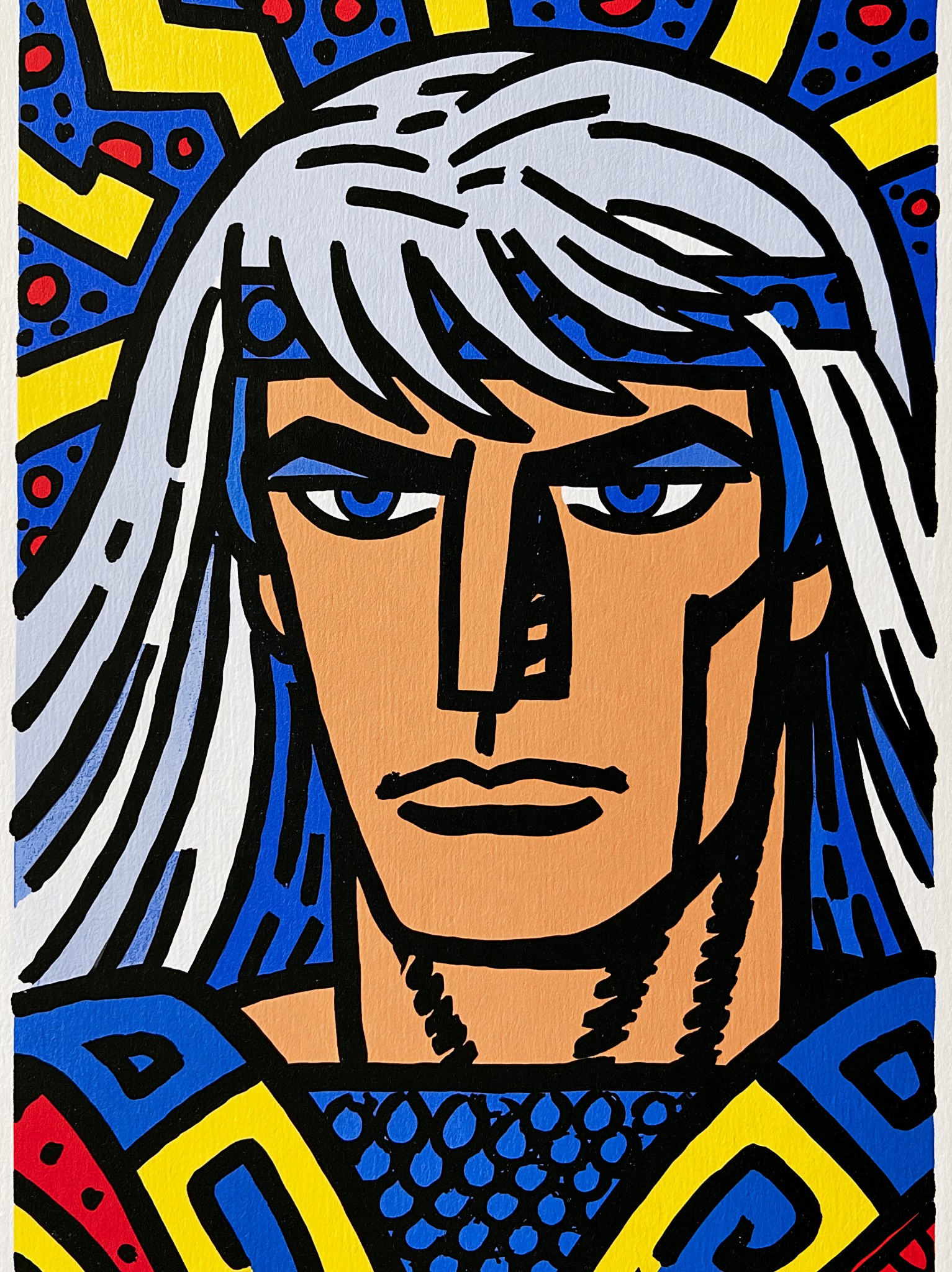
Abaris the Hyperborean is a man about whom Herodotus declines to tell the story, and the one sentence of refusal is almost everything solid we have: a priest from beyond the north wind who carried, or rode, the arrow of Apollo around the world without eating. This feature follows that arrow through the ancient sources, from Plato's Socrates to Iamblichus's scene in which Abaris hands it to Pythagoras and is shown a golden thigh in return, and then through the modern readings that have made him a Scythian shaman, a Mongolian visitor, or a fiction generated by his own books, to ask what the Greeks were doing when they invented him.
Orientation
At a Glance
- A priest from beyond the north windThe Hyperboreans, "those who live beyond Boreas," the north wind, are a Greek idea rather than a Greek discovery.
- What the arrow didThe arrow is the detail that grew.
- Made by his booksThe sharpest recent reading of the evidence is the classicist Peter Gainsford's, and it turns the usual question round.
- The arrow againWhat were the Greeks doing when they made Abaris?
Herodotus is quoted in the English of G. C. Macaulay (1890), Plato in Benjamin Jowett's, Strabo in H. L. Jones's Loeb (1924), Pausanias in W. H. S. Jones's (1918), Iamblichus in Thomas Taylor's (1818), and the Suda in Anne Mahoney's Suda On Line translation (1998); all but the last are public domain.
In the fourth book of his Histories, having described the gifts that arrive on Delos every year from a people in the far north, wrapped in straw and passed from nation to nation, Herodotus stops to say what he will not do. He will not tell "the tale of Abaris, who is reported to have been a Hyperborean," and specifically the part about "how he carried the arrow about all over the earth, eating no food." Then he moves on, with a joke at the expense of geographers: "If however there are any Hyperboreans, it follows that there are also Hypernotians," and "I laugh when I see that, though many before this have drawn maps of the Earth," none of them makes any sense.
That is the first appearance of Abaris in surviving Greek literature, and it is a refusal. Herodotus has heard a story that is too much for him, and he records only enough of it for the reader to know what he is declining: a name, a nationality that may not exist, an arrow, and a fast. Everything later writers add, and they add a great deal, has to be measured against this sentence, which is the oldest and the most sceptical, and which, as it turns out, already contains the two details that matter most. The arrow is Apollo's. And the man who carries it does not eat.
A Priest From Beyond the North Wind
The Hyperboreans, "those who live beyond Boreas," the north wind, are a Greek idea rather than a Greek discovery. Pindar sent Perseus to them and described a people without sickness or old age, and Herodotus, in the chapters before the Abaris sentence, tells how their offerings reached Apollo's island of Delos and how the two maidens who first brought them, Hyperoche and Laodice, never went home; Apollo himself was said to winter among them. They were the people of Apollo's other country, and Abaris is their priest. Later writers, trying to fix him in time, could not agree: Pindar, in a lost poem known through the lexicographer Harpocration, placed him in the days of Croesus, around the middle of the sixth century; the Byzantine lexicon called the Suda, drawing on Harpocration, says he "came as ambassador of the Hyperboreans in the third Olympiad," which would be the 760s, when a plague covered "the entire inhabited world" and Apollo's oracle told the nations that "the Athenian people should make prayers on behalf of all of them"; a third tradition gave the fifty-third Olympiad, the 560s. The Suda also makes him "Scythian, son of Seuthes," which is a different country, and gives him a bibliography: "the so-called Scythinian Oracles," a "Marriage of the river Hebros," "Purifications," "a Theogony in prose," and an "Arrival of Apollo among the Hyperboreans in meter."
Two Athenian witnesses of the fifth and fourth centuries show how a cultivated Greek used the name. In Plato's Charmides, Socrates, pretending to have a cure for the young man's headache, says he learned a charm "from one of the physicians of the Thracian king Zamolxis," and then tells Charmides that if he already possesses temperance "you have no need of any charms, whether of Zamolxis or of Abaris the Hyperborean." Abaris here is a byword for a northern healer who works by incantation, paired with Zalmoxis, the Thracian god-king. The orator Lycurgus, in a lost speech, told of his embassy to Athens during the plague, and Pausanias, walking round Sparta five centuries later, records a sanctuary of the Maid Saviour of which "some say that it was made by Orpheus the Thracian, others by Abaris when he had come from the Hyperboreans." Strabo, the geographer, puts him in company that tells us what the Greeks valued in such figures: "Anacharsis, Abaris, and other men of the sort" were "in fair repute among the Greeks, because they displayed a nature characterized by complacency, frugality, and justice."
So the Abaris of the classical city is a visiting holy man from the north, a purifier in time of plague, a singer of charms, an author of oracles, and a founder of shrines. The arrow is still there, but it is Herodotus who insists on it.
What the Arrow Did
The arrow is the detail that grew. Herodotus says Abaris carried it. Heraclides of Pontus, a pupil of Plato, said something stranger, which Eratosthenes preserved in his book on the constellations: the arrow in the sky is the one with which Apollo killed the Cyclopes, Apollo hid it among the Hyperboreans, and Abaris "went around riding on it." By the time the Neoplatonist Iamblichus wrote his life of Pythagoras, around AD 300, the arrow had a full job description. Abaris, in Thomas Taylor's English, "was carried by it, in passing through inaccessible places, such as rivers, lakes, marshes, mountains," and with it "expelled pestilence and winds from the cities."
Iamblichus's scene is the great set piece of the legend, and it deserves to be told whole. Abaris, "being a priest of the Apollo who is there worshipped, an elderly man, and most wise in sacred concerns," is on his way home from Greece "in order that he might consecrate to the God in his temple among the Hyperboreans, the gold which he had collected." In Italy he meets Pythagoras, and, believing "he was truly Apollo," gives him the dart. Pythagoras takes it, "neither being astonished at the novelty of the thing" nor asking why it is offered, and in return "he showed him his golden thigh," the proof, in several ancient accounts, that the philosopher was more than a man. He explains that he has come "for the purpose of remedying and benefiting the condition of mankind," and that he wears a human shape so that people will not be frightened off by his superiority. Then he keeps Abaris, shares out the gold among his followers, and teaches him, replacing the old priest's divination by the entrails of animals with "the art of prognosticating through numbers," which Iamblichus calls purer and more divine.
Read as a story about Apollo rather than about Abaris, the scene is transparent. The priest of the northern Apollo arrives carrying the god's own weapon, recognizes the god in a Greek philosopher, surrenders the weapon, and is taught arithmetic. It is a transfer of authority from the barbarian north to Pythagorean Italy, and the arrow is the thing transferred. Aristotle, in a fragment, already knew of the golden thigh and of Pythagoras being called the Hyperborean Apollo, and Walter Burkert's warning stands over all of it: "There is not a single detail in the life of Pythagoras that stands uncontradicted." The same is true of Abaris, with the difference that in his case there may never have been a life to contradict.
Made by His Books
The sharpest recent reading of the evidence is the classicist Peter Gainsford's, and it turns the usual question round. Instead of asking who Abaris was, it asks where his story came from, and answers: from the books that bore his name. Archaic Greece produced poems attributed to Orpheus, Musaeus, Linus, and Epimenides, authors who were partly or wholly invented after the fact to give the poems a pedigree, and Abaris, on this view, belongs with them. Somebody around 530 to 510 BC wrote oracles, purifications, a theogony, and a poem on Apollo's arrival among the Hyperboreans, and ascribed them to a Hyperborean priest; the priest then acquired, from the poems and from the needs of their readers, a date, an embassy, a plague, a Scythian costume, a temple at Sparta, and an arrow, which was probably in the poem about Apollo's arrival. The oddest entry in the Suda supports this. Its grammatical note declines the name in the plural, "Abarises," as though quoting a line of verse in which Sparta, or someone, needed no more of them. A man who has become a common noun has been a literary figure for some time.
That reading is a reading, and the article presents it as one; it explains the contradictions in the dates, which are what one expects when several authors invent independently, and the strange fact that the earliest witness is already a sceptic. It does not explain why the Greeks wanted such a figure, and the other modern readings are attempts at that.
The most famous is the shamanism thesis. In 1935 Karl Meuli proposed that the Scythians practised a form of the ecstatic religion that Siberian peoples call shamanism, and that figures such as Aristeas, who could send his soul out of his body, and Abaris, who flew on an arrow and did not eat, were Greek memories of it; E. R. Dodds took the idea into The Greeks and the Irrational (1951), adding Pythagoras, Empedocles, and Orpheus, "a mythical shaman or prototype of shamans," and using it to explain where the Greek belief in a separable, immortal soul came from; Burkert developed it for Pythagoras. The thesis has the attraction of explaining the fast, the flight, the healing, and the north all at once, and the arrow fits it well, since a shaman's instruments are exactly such objects. Jan Bremmer's survey of the question is the standard reply, and it is severe: "there is no evidence at all in our sources that they were Scythians," the Scythian material in Herodotus shows "no spirits, no drum, and no shaman," Burkert himself conceded that no direct evidence of shamanic practice can be found in the Greek tradition, and shamanism became, in classical scholarship, "a joker that could be put on the table" whenever something could not be explained from inside Greek culture. A reader of the sources will notice that Bremmer is right about the evidence and that the thesis is nevertheless hard to forget, because it names what the Greek texts themselves half-say: that Abaris's power was foreign, bodily, and connected with not eating.
The esoteric readings go further north and further east. Peter Kingsley's A Story Waiting to Pierce You (2010) takes Abaris to have been a visitor from Central Asia, from Mongolia, and argues that the Apollo whose arrow he carried was never the god of light and measure that the classical tradition made him but "a god of plague and purification," and that a Central Asian shamanism therefore lies at the root of Pythagoras and so of Western thought. Theosophy had already claimed the Hyperboreans in a different way: Blavatsky made them the second "root race" of humanity, "non-intelligent ethereal creatures" of a vanished polar continent, and the polar Golden Age has had a long afterlife in esoteric and, lately, in political fantasy. Against the texts, Kingsley's Apollo of plague and purification has real support, since the Abaris of the sources is precisely a plague-priest and purifier, and Apollo in Homer is the god whose arrows bring pestilence; the Mongolian geography has none, and the root race belongs to a different kind of book.
The Arrow Again
What were the Greeks doing when they made Abaris? The reading this feature proposes is that they were thinking about the other Apollo. The god of Delphi and Delos had a northern side that the Greeks knew and did not quite own: the winter residence, the straw-wrapped gifts, the plague-arrows of the Iliad. Abaris is that side given a face and a passport. He comes from where Apollo goes when he is not in Greece, he carries the god's weapon, he cures what the weapon causes, and he does not need the food that mortals need. When Iamblichus has him hand the arrow to Pythagoras, the northern Apollo is being brought home and made Greek, and when Herodotus refuses to tell the story, the first reader of it is already saying that this is a tale about a god, not a report about a man.
That is why the refusal matters more than the legend. Herodotus kept exactly what the legend needed and dropped everything it could do without, and the result is that the oldest sentence about Abaris is also the best. A Hyperborean, an arrow, and no food: a priest who is all Apollo's, and nothing that a historian could check.
Source ApparatusNotes1 note
- ↩
Herodotus, Histories 4.36, is quoted from the English translation printed with the Greek at the Internet Sacred Text Archive (sacred-texts.com/cla/hh/hh4030.htm), which does not name its translator but is G. C. Macaulay's of 1890; the Hyperborean chapters 4.32–35 are summarized from the Wikipedia article "Hyperborea." Plato, Charmides 158b–c, is quoted from Benjamin Jowett's translation at the Internet Classics Archive. Strabo 7.3.8 is quoted from H. L. Jones's Loeb translation (1924) at Bill Thayer's LacusCurtius; Pausanias 3.13.2 from W. H. S. Jones's Loeb (1918) at theoi.com. Iamblichus, Life of Pythagoras, chapter XIX, is quoted from Thomas Taylor's translation (1818), Project Gutenberg ebook 63300. The Suda, entry alpha 18, "Abaris," is quoted from the Suda On Line translation by Anne Mahoney (1998), whose notes cite Harpocration, Hippostratus (FGrH 568 F 4), and Pindar fr. 270 Snell–Maehler. Heraclides of Pontus via Eratosthenes, Catasterisms 29, the Lycurgus fragment (Against Menesaechmus), the dating of the Abaris books to about 530–510 BC (following Ken Dowden's edition of the fragments, 2016), and the reading of Abaris as an invented author are from Peter Gainsford, "Abaris of Hyperborea and his magic arrow," Kiwi Hellenist, 14 March 2020. The Aristotle fragment on the golden thigh and the Burkert sentence are from the Wikipedia article "Pythagoras"; the Wikipedia article "Abaris the Hyperborean," consulted 11 October 2026, supplied the list of sources and the Nonnus and Griffiths references. Meuli, Dodds, and Burkert are summarized and quoted from Jan N. Bremmer, "Shamanism in Classical Scholarship: Where Are We Now?", in Horizons of Shamanism (Stockholm, 2016), pp. 52–78, read in the Semantic Scholar copy. Peter Kingsley, A Story Waiting to Pierce You: Mongolia, Tibet and the Destiny of the Western World (Golden Sufi Center, 2010), is characterized from Sally Dougherty's review at theosophy-nw.org, which quotes p. 43; Blavatsky's root race is from the Wikipedia article "Hyperborea." Modern studies, in copyright: Dodds, The Greeks and the Irrational (1951), ch. 5; Burkert, Lore and Science in Ancient Pythagoreanism (1972); Dowden's "Abaris" in Brill's New Jacoby.
Test your understanding
Question 1 of 3
According to the article, why is Herodotus's refusal to tell the full story especially important?
Guided Inquiry
Questions for Socrates
Explore these questions with Socrates, with this Feature as your reading context.
- How should Herodotus's refusal to narrate the full tale affect the way readers evaluate the much richer accounts supplied by later writers?→
- What standards of evidence does the article implicitly use when distinguishing plausible interpretations—such as Abaris as a literary creation—from more speculative claims about shamanism or Central Asian origins?→
- If Abaris represents Apollo's northern side, what does the transfer of his arrow to Pythagoras suggest about how Greek writers understood and absorbed what they considered foreign sacred authority?→