
Philosophy
Socrates Comes Home from Potidaea
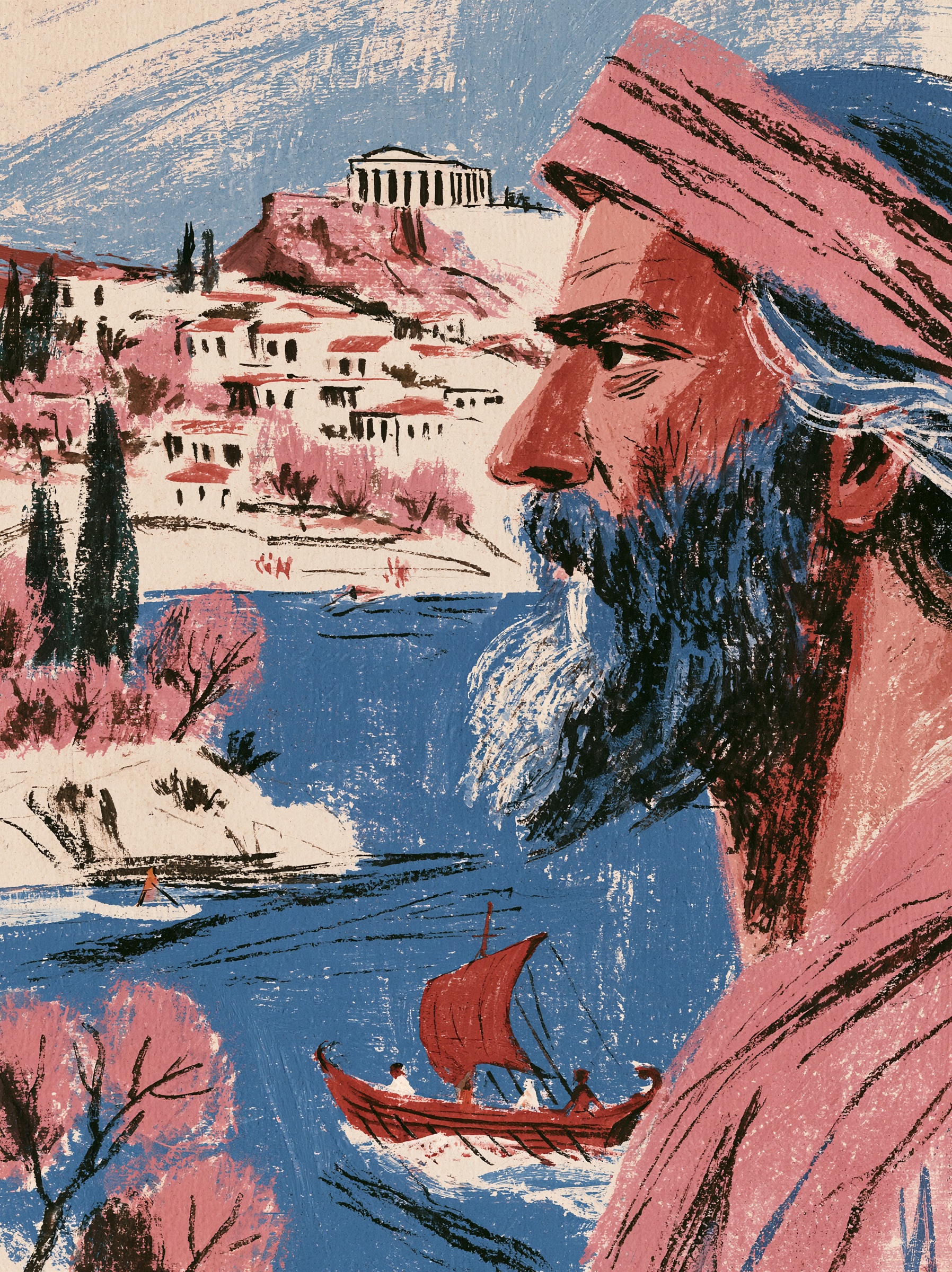
Plato’s Charmides begins with a soldier back from a siege walking into a wrestling school and being asked who died. The siege was Potidaea, one of the sparks of the Peloponnesian War, and following that first sentence outward, into the history it names and the futures of the men in the room, changes how the conversation about self-restraint that follows should be read.
Orientation
At a Glance
- The placePotidaea was not an Athenian city and never had been.
- The manSocrates really served at Potidaea, and Plato tells us elsewhere what kind of soldier he was.
- The roomNow the people. Socrates asks about the youth, and Critias, who is present, names his young cousin: “Charmides, he replied, is his name; he is my cousin, and the son of my uncle Gl
- What the frame doesIt is worth being careful about what can and cannot be claimed here.
“Yesterday evening I returned from the army at Potidaea, and having been a good while away, I thought that I should like to go and look at my old haunts.”1
That is the first sentence of the Charmides, and Socrates, who narrates the dialogue, tells it as a man tells the first ordinary thing he did after getting home. He went to “the palaestra of Taureas, which is over against the temple adjoining the porch of the King Archon,” a wrestling school in the centre of Athens, and found a crowd of acquaintances there. One of them, “Chaerephon, who is a kind of madman, started up and ran to me, seizing my hand,” and asked the first question anyone asks a returning soldier: “How did you escape, Socrates?” The others had heard the news already. Socrates confirms it: “the engagement was very severe, and that many of our acquaintance had fallen.” He gives them the names. Then he asks for the local news in return, about “the present state of philosophy, and about the youth,” and “whether any of them were remarkable for wisdom or beauty, or both.”2
The dialogue that follows is about sōphrosynē, the virtue of soundness of mind, of restraint and knowing one’s place, and its arguments have been treated in an earlier piece in this series. This one stays with the first page. Why does Plato open a conversation about self-control with a man back from a war? What was Potidaea? And what did Plato’s first readers know about the people in that room that the people themselves did not?
The Place
Potidaea was not an Athenian city and never had been. It was a colony of Corinth, planted around 600 BC on the neck of the Pallene peninsula in Chalcidice, in the northern Aegean. After the Persian Wars it had been swept, like most cities of that coast, into the alliance that Athens led and gradually turned into an empire; it paid tribute to Athens. But it kept a tie to its mother city that no other tributary had: Corinth still sent it magistrates every year. A city that paid Athens and was governed by Corinthians was an anomaly that could last only as long as Athens and Corinth were at peace.3
In 433 they stopped being at peace. Athens had intervened in a quarrel between Corinth and Corinth’s own rebellious colony Corcyra, and Athenian and Corinthian ships had fought at Sybota. The next year Athens, fearing that Corinth and the Macedonian king Perdiccas would raise the north against it, sent Potidaea an ultimatum: pull down the wall facing the sea, hand over hostages, dismiss the Corinthian magistrates and receive no more. The Potidaeans sent envoys to Athens to argue and, at the same time, envoys to Sparta to ask what help they could expect. When Athens would not yield, Potidaea revolted, with Corinthian volunteers and Macedonian support. Who started it is a question the sources let one answer either way: Athens made demands that made revolt likely, and Potidaea chose revolt.4
In the summer of 432 an Athenian force under Callias beat the Potidaeans and Corinthians in a battle outside the walls, at a cost of about a hundred and fifty Athenian dead, Callias among them, and then settled down to besiege the city by land and sea. The siege lasted until the winter of 430/429. Thucydides records that it cost Athens some two thousand talents, an immense sum, and that before the surrender the besieged had been reduced to eating one another; the terms allowed them to leave with one garment each, two for the women, and a fixed sum of money.5 It was, together with the Corcyra affair, one of the two grievances that Corinth laid before the Spartan assembly in 432 when pressing Sparta to declare that Athens had broken the peace. Thucydides is careful to say that these were the stated occasions and that the truest cause was Sparta’s fear of Athenian power; but they were the occasions, and the war followed.6
So when Socrates says he has come from “the army at Potidaea” and that “many of our acquaintance had fallen,” the dramatic date is 432 or 431, and the Peloponnesian War, which would last twenty-seven years and end with Athens’ defeat, has either just begun or is about to. The battle whose dead he names is one of the first of that war.
The Man
Socrates really served at Potidaea, and Plato tells us elsewhere what kind of soldier he was. In the Symposium, Alcibiades, drunk and in love, gives the account. He and Socrates were in the same mess at Potidaea; Socrates bore hunger better than anyone and cold better still, going about barefoot on the ice while the others wrapped their feet; he once stood in one place from dawn to the following dawn, thinking, while the other soldiers brought out their bedding to watch him. And in the battle in which Alcibiades won the prize for valour, it was Socrates who had earned it: “he would not leave me when I was wounded, but he rescued me and my arms,” and afterwards urged the generals to give the prize to Alcibiades rather than to himself.7
The Charmides does not mention any of this. Socrates, narrating, says nothing of his own conduct; he confirms the casualties, names the dead, and changes the subject to philosophy and beautiful boys. But Plato’s readers, who had the Symposium, knew what the man asking “whether any of them were remarkable for wisdom or beauty” had been doing a few weeks earlier. The reticence is part of the portrait. The dialogue’s subject is sōphrosynē, and the first exhibit of it is a narrator who has just come from a battle and does not tell war stories.
There is one more trace of the campaign in the scene, and it is easy to miss. When Charmides arrives, complaining of headaches, Socrates claims to know a cure, a leaf with a charm, which he learned “when serving with the army from one of the physicians of the Thracian king Zamolxis.”8 Potidaea lies on the edge of Thrace. Whether or not Socrates met any such physician, Plato has him bring the remedy for the soul home from the front, and the remedy turns out to be the conversation about temperance that fills the rest of the dialogue.
The Room
Now the people. Socrates asks about the youth, and Critias, who is present, names his young cousin: “Charmides, he replied, is his name; he is my cousin, and the son of my uncle Glaucon.” The boy comes in, and “all of them, down to the very least child, turned and looked at him, as if he had been a statue.” Socrates is not immune. He disclaims all judgment (“I cannot measure anything, and of the beautiful, I am simply such a measure as a white line is of chalk”) and then, as the boy sits beside him, “I caught a sight of the inwards of his garment, and took the flame,” and remembers a poet’s warning “not to bring the fawn in the sight of the lion to be devoured by him.”9 The soldier back from the siege is, for a moment, the one in danger, and the danger is to his self-command. The dialogue’s subject has arrived before anyone has named it.
The two people he will talk to are Critias and Charmides, and here the history that matters is not what had happened before the dramatic date but what would happen after it. Both were Plato’s kinsmen: Charmides his mother’s brother, Critias a cousin of his mother’s. When Athens finally lost the war in 404, the Spartans installed a board of thirty men to govern the city, and Critias was their leader. The regime lasted about eight months and killed, by ancient estimates, some fifteen hundred citizens; it is remembered as the Thirty Tyrants. Charmides served among its subordinate officers in the Piraeus. In 403 the democratic exiles fought their way back, and both men were killed in the battle at the Piraeus. Paul Woodruff, in the Stanford Encyclopedia, puts the matter plainly: by the time Plato wrote the dialogue both men were dead, Critias having led “the group known to their enemies as the Thirty Tyrants,” and “the excesses of the Thirty, who had conducted a violent and rapacious reign of terror in 404–03, provide an historical counterpoint to the declared interest of these men in sophrosune almost thirty years earlier.”10
That counterpoint is the reason the opening matters. Plato has chosen to set a conversation about restraint at the start of the war, between the man who would die refusing to escape its aftermath and the two men who would end it as tyrants, and he has framed it with the first casualties. The first readers knew all three deaths. They could not read Critias’ confident definitions of temperance, or Socrates’ gentle testing of the boy, without hearing what was coming.
What the Frame Does
It is worth being careful about what can and cannot be claimed here. The text does not say that the war setting is symbolic, and Plato never comments on it. What can be said is this. The dialogue is a search for a virtue that none of the participants can define. Two of them will go on to display its opposite on a scale that shocked their city; the third will display it in a prison. The war that begins at Potidaea is the frame within which all three of those things will happen. A reader who holds that in mind reads the dialogue’s failure to define sōphrosynē differently: not as a puzzle that happened to go unsolved, but as an unsolved puzzle whose cost is about to be paid.
Whether Plato meant the setting as an indictment of Critias, as a defence of Socrates against the charge of having taught him, or simply as the truth about when these people talked, is disputed, and the dialogue does not settle it. The Wikipedia summary of the dialogue notes only that the later careers of the two men make “the question of their sophrosyne, or moderation, alternatively ironic or pressing,” which is as far as the text licenses one to go.11 My own view, offered as a reading, is that “pressing” is the better word. The dialogue is not sneering at its speakers. It is showing that the question they failed to answer was not academic, and that the man who pressed it hardest had just come back from watching what its absence costs.
Back to the First Sentence
Return, then, to the man who “returned from the army at Potidaea” and went to look at his old haunts. He has come from a siege that will help start a war, into a room containing the boy who will help end it in blood, to talk about the virtue of knowing one’s limits. He does not mention his own courage. He is asked who died and he says. Then he asks who is beautiful and wise now, and the answer walks in, and for one line he loses his composure and gets it back. Everything the Charmides will fail to define in argument is present, in miniature, in the way its narrator handles his first evening home.
Source ApparatusNotes11 notes
Quotations from the Charmides are from Benjamin Jowett’s translation (public domain), MIT Internet Classics Archive (classics.mit.edu/Plato/charmides.html); the quotation from the Symposium is from Jowett’s translation as reproduced at the Full Text Archive (fulltextarchive.com/book/symposium/3/).
- ↩
Charmides 153a.
- ↩
Charmides 153a–d.
- ↩
Wikipedia, “Battle of Potidaea,” which summarises Thucydides’ account (Book 1, chapters 56–65) of Potidaea’s status, the Athenian demands, and the revolt.
- ↩
Wikipedia, “Battle of Potidaea,” which summarises Thucydides’ account (Book 1, chapters 56–65) of Potidaea’s status, the Athenian demands, and the revolt.
- ↩
The cost, the reports of cannibalism, and the surrender terms are in Thucydides 2.70; the figures for the battle of 432 are as given in Wikipedia’s summary.
- ↩
Thucydides 1.23 for the “truest cause,” 1.66–88 for the Corinthian complaints at Sparta.
- ↩
Symposium 219e–221b. Only the sentence about the rescue is quoted; the rest of Alcibiades’ account is paraphrased.
- ↩
Charmides 156d.
- ↩
Charmides 154a–155e.
- ↩
Paul Woodruff, “Plato’s Shorter Ethical Works,” Stanford Encyclopedia of Philosophy (plato.stanford.edu/entries/plato-ethics-shorter/), section on the Charmides.
- ↩
Wikipedia, “Charmides (dialogue).”
Test your understanding
Question 1 of 3
How does the article interpret Socrates’ failure to describe his own conduct at Potidaea?
Guided Inquiry
Questions for Socrates
Explore these questions with Socrates, with this Feature as your reading context.
- If Socrates demonstrates restraint through his actions but cannot arrive at a satisfactory definition of it in conversation, what might that suggest about the relationship between possessing a virtue and explaining it?→
- How should knowledge of Critias’ and Charmides’ later actions affect a reader’s judgment of their earlier search for temperance without reducing the dialogue to simple irony?→
- The article says the failure to define sōphrosynē can be read as “an unsolved puzzle whose cost is about to be paid.” What features of the opening make that interpretation persuasive, and what limits does the article place on it?→