
Philosophy
Reading Spinoza's Ethics: Why a Book About Blessedness Looks Like Euclid
Why Spinoza’s geometric method is part of his path from emotional bondage to freedom.
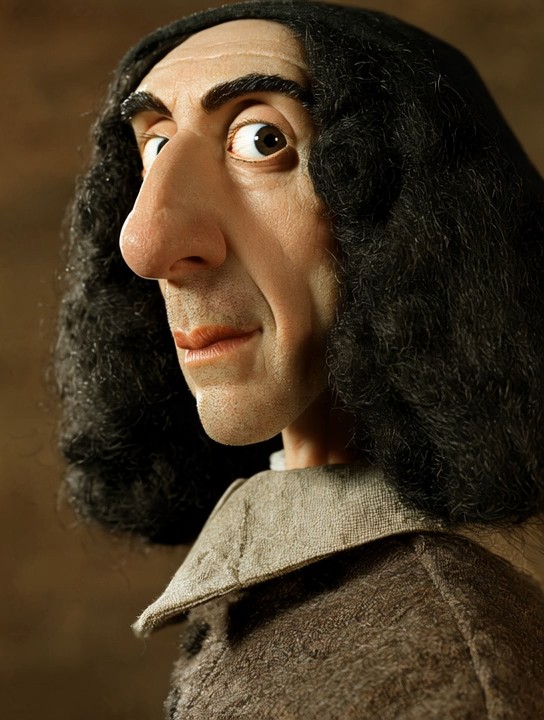
Spinoza's Ethics, written in Latin between 1661 and 1675 and published only after his death in 1677, is laid out like a geometry textbook: definitions, axioms, numbered propositions, each followed by its proof and the letters Q.E.D. Its subject is God, the mind, the emotions, human bondage, and the way to freedom, and its last page is about blessedness. This introduction asks why a book with that subject was built in that shape, shows a new reader how the first definitions carry the whole structure, and argues that the geometry is not a wrapper around the argument but part of the cure the argument prescribes.
Orientation
At a Glance
- The book and its shapeBaruch Spinoza, a Jewish lens-grinder of Amsterdam expelled from his community in 1656, wrote the Ethics over some fourteen years and withheld it; it appeared in the Opera Posthuma
- The first pageThe Ethics begins with eight definitions, and the whole building rests on them, so a new reader should read them slowly and in order.
- The sentence that explains the methodThe defence of the geometry comes at the start of Part III, and a reader who wants to understand the book should read that preface first.
- The climbThe order of the parts is a ladder, and it is worth seeing the rungs before climbing.
Quotations are from R. H. M. Elwes's translation of 1883, public domain, in the text at monadnock.net; the part, proposition, and note numbers are the standard ones.
Open the Ethics anywhere and the page looks like Euclid. "PROP. XI. God, or substance, consisting of infinite attributes ... necessarily exists." Then "Proof." Then a chain of references back to earlier propositions and axioms, then "Q.E.D.," then a "Note" in which, for a paragraph or two, a man seems to be talking. Open it at the end and the subject is not triangles. "Blessedness is not the reward of virtue, but virtue itself," says the last proposition, and the last words of the book, after a short note on how few people find the way it describes, are: "But all things excellent are as difficult as they are rare."
The question a new reader should carry into the book is why those two things belong together: why a work whose final concern is the highest human happiness is written as a sequence of proofs, with no narrator, no persuasion, and no "I" except in the notes. Spinoza never answers it directly. The book, read in the order he arranged it, does.
The Book and Its Shape
Baruch Spinoza, a Jewish lens-grinder of Amsterdam expelled from his community in 1656, wrote the Ethics over some fourteen years and withheld it; it appeared in the Opera Posthuma of 1677, months after his death, and in June 1678 the States of Holland banned his works as "profane, blasphemous, and atheistic." The full title is Ethica, ordine geometrico demonstrata, "Ethics, demonstrated in geometrical order," and the five parts move in a single direction: Part I, "Concerning God"; Part II, "Of the Nature and Origin of the Mind"; Part III, "On the Origin and Nature of the Emotions"; Part IV, "Of Human Bondage, or the Strength of the Emotions"; Part V, "Of the Power of the Understanding, or of Human Freedom." A reader who knows only that the book is "pantheist" will be surprised to find that God occupies one part in five and that the other four are about a human being learning to think.
The method was not new. Euclid had used it for geometry, and Descartes, challenged in 1641 to set out his Meditations in that form, had sketched a "geometrical" exposition of his proofs for God and the soul; Spinoza himself, in 1663, had published Descartes's Principles of Philosophy rewritten as definitions and propositions, the only book he put his name to in his lifetime. What was new was using the method for the whole of philosophy, including the part that deals with love, hatred, hope, fear, and envy, and the reason he did so is stated in the one place where he stops to defend it.
The First Page
The Ethics begins with eight definitions, and the whole building rests on them, so a new reader should read them slowly and in order. Substance is "that which is in itself, and is conceived through itself." God is "a being absolutely infinite—that is, a substance consisting in infinite attributes." And "that thing is called free, which exists solely by the necessity of its own nature." Then the axioms, of which the first is the hinge of everything: "Everything which exists, exists either in itself or in something else." There are, that is, exactly two ways to be: as a substance, or as a mode, a way that a substance is.
The propositions draw the consequence, and they draw it fast. By Proposition XI, God necessarily exists; by XIV, "Besides God no substance can be granted or conceived"; by XV, "Whatsoever is, is in God, and without God nothing can be, or be conceived." Within fifteen propositions the reader has been told that there is one substance, that it is God, and that everything else, every body and every mind, is a mode of it. The famous phrase "God, or Nature," Deus sive Natura, occurs only a few times in the book, but it is what these fifteen propositions mean: Nature is not God's creation, and not God's dwelling, but God, conceived under the two attributes we know, extension and thought.
The appendix to Part I is the first place Spinoza allows himself a voice, and it is worth reading before anything else in the part, because it tells you what the proofs were for. People, he says, "think themselves free inasmuch as they are conscious of their volitions and desires" and ignorant of the causes of them; from that illusion they build a picture of a world made for their use, governed by a God who acts for ends, and so "final causes are mere human figments." The definitions and proofs of Part I are the demolition of that picture, done without raising the voice.
The Sentence That Explains the Method
The defence of the geometry comes at the start of Part III, and a reader who wants to understand the book should read that preface first. "Most writers on the emotions and on human conduct," Spinoza says, "seem to be treating rather of matters outside nature"; they "conceive man to be situated in nature as a kingdom within a kingdom." Against that, "nature is always the same," and its laws hold for the passions as for the planets. And so: "I shall consider human actions and desires in exactly the same manner, as though I were concerned with lines, planes, and solids."
That sentence is the answer to the headline's question, and it has two sides. The first is a claim about the world: emotions have causes as surely as eclipses do, and a method that proves things about eclipses will prove things about emotions. The second is a claim about the reader, and it is the one that makes the Ethics a book about blessedness rather than only about nature. To consider one's own hatred "as though" it were a solid is already to stop being governed by it. The method is not only a way of writing; it is the first exercise in the cure.
Part III then proves the doctrine on which the cure rests. "Everything, in so far as it is in itself, endeavours to persist in its own being," and that endeavour, the conatus, "is nothing else but the actual essence of the thing in question." Desire is this endeavour made conscious, and from it follows the book's most unsettling reversal, in the note to Proposition IX: "we deem a thing to be good, because we strive for it, wish for it, long for it, or desire it," not the other way round. Good and evil, on this account, are not properties that things have and we discover. They are names for what helps and hinders a striving.
The Climb
The order of the parts is a ladder, and it is worth seeing the rungs before climbing. Part II supplies the bridge between the one substance and the single human being. "The order and connection of ideas is the same as the order and connection of things": thought and extension are not two worlds that interact but one world conceived twice, so that the mind is not a ghost in a body; "the object of the idea constituting the human mind is the body." The same part distinguishes three kinds of knowledge, "opinion, or imagination," "reason and knowledge of the second kind," and "a third kind of knowledge, which we will call intuition," and says of the second that "it is in the nature of reason to perceive things under a certain form of eternity," sub quadam aeternitatis specie. That phrase is the hinge between the geometry and the blessedness. To see a thing under a form of eternity is to see it as the proofs have been showing it, as following necessarily from the nature of God.
Part IV names the obstacle. "Human infirmity in moderating and checking the emotions I name bondage," and the part's definitions quietly abolish a whole moral vocabulary: "By virtue and power I mean the same thing," so that virtue is "nothing else but action in accordance with the laws of one's own nature," and "the mind's highest good is the knowledge of God, and the mind's highest virtue is to know God." The free man of this part, in a proposition that has become the book's most quoted, thinks of death least of all things and meditates on life.
Part V is the way out, and its preface says so: "At length I pass to the remaining portion of my Ethics, which is concerned with the way leading to freedom." The remedy is understanding. A passion understood as necessary, as a mode of Nature following from causes, ceases to be a passion and becomes an action of the mind; and the mind that understands in this way comes, through the third kind of knowledge, to "the intellectual love of God," which "is eternal," and which turns out to be the love with which "God loves himself with an infinite intellectual love," now occurring in a human mind. Of this mind Spinoza says something he does not prove and does not need to: "we feel and know that we are eternal." Then the last proposition, and the last words, about the rarity of the excellent.
The Difficulty, and the Tempting Mistake
The interpretive difficulty a new reader will meet is whether the proofs are proofs. Many of them are not, by the standards of a geometry teacher: definitions are stretched, earlier propositions are cited for more than they showed, and the great results of Part I rest on a conception of substance that a reader can decline at the door. Commentators have divided over whether to read the geometry as a failed attempt at Euclidean rigour, as a rhetorical choice for impersonality in a dangerous age, or as something the book's own doctrine requires. The reading this introduction offers is the third, and it follows from the Part III preface. If freedom is understanding, and understanding is seeing things as following necessarily from their causes, then the only honest form for a book about freedom is one in which each thing is shown following from what came before. The proofs do not have to be valid to do their work; they have to be read, in order, by a reader who is thereby practising the only method Spinoza thinks can make anyone free.
The tempting oversimplification is to take the book as a system to be agreed or disagreed with, and so to stop at Part I, where most of the agreeing and disagreeing happens. Spinoza was read that way in his own century, as an atheist, and in the next, after Jacobi set off the pantheism controversy in Germany, as a mystic; Goethe, Hegel, and Schelling admired him, and Schopenhauer complained that he called "God" what is "everywhere called 'the world.'" All of these are responses to Part I. The book itself treats Part I as a foundation, lays it, and climbs off it, and a reader who does the same will find that the real argument is about what it is like to understand one's own emotions, and that the geometry is the training.
Where to Begin
Begin at the end. Read the note to the last proposition of Part V, the page that says the way is hard, "since it is so seldom found," and that it "may nevertheless be discovered." Then read the preface to Part III, where the method is defended. Then go to the first page of Part I and read the definitions and the first axiom as if they were the rules of a game you have agreed to play, and let the propositions run, noticing each time the book cites an earlier one that you are being asked to hold the whole structure in your mind at once, which is what seeing under a form of eternity means. Read the notes and the appendices for Spinoza's voice, and the proofs for his discipline, and do not expect the two to sound alike.
Elwes's translation is free and still readable. Edwin Curley's, in A Spinoza Reader (Princeton, 1994) or his Collected Works, is the scholarly standard; Steven Nadler's Spinoza's Ethics: An Introduction (Cambridge, 2006) is the best companion; and George Eliot's translation of 1856, the first into English and unpublished until Clare Carlisle's edition of 2020, is the one to read for the pleasure of hearing a novelist think through the proofs. The book is five parts long. Its last sentence is also a description of itself.
Source ApparatusNotes1 note
- ↩
The Ethics is quoted from R. H. M. Elwes's translation (1883) in the text at monadnock.net (ethics-1 to ethics-5), which identifies its translator: Part I, Definitions III, VI, VII, Axiom I, Props. XI, XIV, XV, and the Appendix; Part II, Props. VII, XIII, XL note, XLIV cor. II, and the Preface; Part III, Preface, Props. VI, VII, and IX note; Part IV, Preface, Def. VIII, Prop. XVIII note, Prop. XXVIII; Part V, Preface, Props. XXIII and note, XXXIII, XXXV, XLII and note. The composition dates, posthumous publication, the 1678 ban (Jonathan Israel), the five parts, the reception (Jacobi, Goethe, Hegel, Schelling, Schopenhauer's remark from Parerga and Paralipomena), and the Eliot, Curley, Nadler, and Carlisle editions are from the Wikipedia article "Ethics (Spinoza book)," consulted 12 October 2026. Recommended, in copyright: Edwin Curley, Behind the Geometrical Method (Princeton, 1988), on the question this introduction asks; Nadler as above; Clare Carlisle (ed.), Spinoza's Ethics, translated by George Eliot (Princeton, 2020).
Test your understanding
Question 1 of 3
According to the article, why is the geometrical method itself part of Spinoza’s proposed cure for bondage to emotions?
Guided Inquiry
Questions for Socrates
Explore these questions with Socrates, with this Feature as your reading context.
- The article claims that the proofs can do their work even if they are not valid by strict geometrical standards. What kind of “work” can a flawed proof perform on a reader, and what limits should be placed on that claim?→
- How does Spinoza’s reversal—things are called good because we strive for them, rather than being desired because they are already good—change the way virtue and human freedom should be understood within the article’s account?→
- The suggested reading order begins with the end and the Part III preface before returning to Part I. How might this sequence alter a reader’s experience of the definitions and proofs, and what might be lost by not initially reading the book in its formal order?→