
Fairy Tales
Perrault's Morals: A Guide to the Fairy Tale That Explains Itself
In Charles Perrault's collection of 1697, the book that gave the world its Cinderella, Puss in Boots, and Sleeping Beauty, every tale ends with a rhymed "Moral," and the morals are stranger than the tales. This introduction explains where the book came from, why its morals are addressed to a different audience from its stories, and how to read two of them, the one that follows a Red Riding Hood who is never rescued and the pair that follow Bluebeard, so that the gap between the story and its lesson becomes the most interesting thing on the page.
Orientation
At a Glance
- The BookPerrault’s 1697 collection pairs eight prose fairy tales with verse morals written for a worldly audience.
- Two VoicesThe tale tells what happened; its moral can change, sharpen, or even tease the meaning of the tale.
- Red Riding HoodWithout a rescue, the wolf’s victory becomes a warning about the charming human wolves named in the moral.
- BluebeardA second moral undercuts the first, inviting readers to question how solemnly either lesson should be taken.
The tales and their verse morals are quoted from the English translation of Robert Samber (1729), as revised by J. E. Mansion for the Harrap edition of 1922; Perrault's French is quoted from the 1697 text, with translations made for this article.
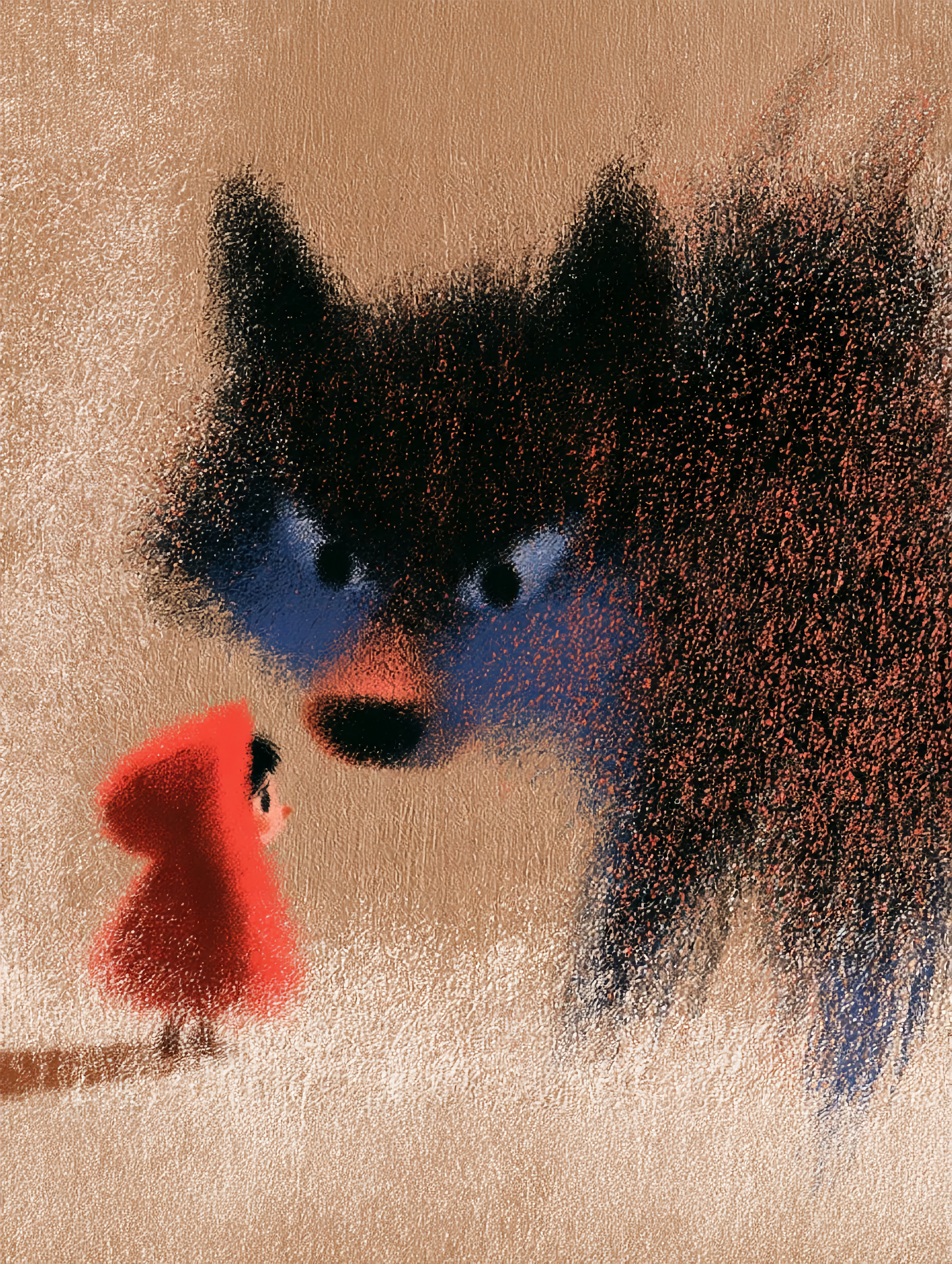
Most people know how "Little Red Riding Hood" ends: a huntsman hears snoring, cuts open the wolf, and out steps the girl. That is the Grimms' version, published in 1812. In the earliest printed version, the one that gave the tale its name, there is no huntsman. The wolf gets into bed, the child gets in beside him, the famous questions are asked about the size of his arms and legs and ears and eyes and teeth, and then: "And, saying these words, this wicked Wolf fell upon poor Little Red Riding-Hood, and ate her all up."1
That is the end of the story. It is not the end of the page. Underneath, set off in verse and headed "Moral," comes a second voice:
From this short story easy we discern What conduct all young people ought to learn.1
And the voice goes on, for twenty more lines, to say something that is not quite what the story said. The reader who wants to understand Perrault has to learn to read the two voices together, and the gap between them. This guide is about how.
The Book
The collection appeared in Paris in 1697 under the title Histoires ou contes du temps passé, avec des moralités, "Stories or Tales of Past Times, with Morals," published by Claude Barbin.2 It contained eight prose tales: "The Sleeping Beauty," "Little Red Riding Hood," "Bluebeard," "The Master Cat, or Puss in Boots," "The Fairies," "Cinderella," "Riquet with the Tuft," and "Hop o' my Thumb."2 Its title page named the author as "P. Darmancour," which was the name of Charles Perrault's nineteen-year-old son Pierre; the volume was dedicated to the king's niece, Élisabeth Charlotte d'Orléans.2 Modern scholars doubt that Pierre wrote the stories; Jack Zipes says plainly that there is "little evidence" for it.2 The dedication in a young man's name was probably a way of introducing him to society, and, not incidentally, of allowing his father to publish nursery tales without signing them.
That father was not a nursery writer. Charles Perrault had been secretary to Colbert, Louis XIV's great minister, for some twenty years, had helped to found and run royal academies, and was a leader of the "Moderns" in the literary quarrel of the 1680s and 1690s over whether the writers of the present could rival those of antiquity.2 He was in his late sixties when the tales appeared, retired from public life, and writing for the fashionable salons of Paris, where the telling of old wives' tales in an elegant manner had become a game for adults.2 Keep that audience in mind. The tales are told as if to children. The morals are addressed to the people in the room.
The Rule of Reading
Here is the rule this guide proposes. Each tale is in prose, plain and quick, in the voice of an old nurse. Each moral is in verse, polished and worldly, in the voice of a courtier. The prose tells you what happened. The verse tells you what it meant, and it often tells you something the prose did not say, or says it with a raised eyebrow. Read the tale, then read the moral, then ask what the tale would have meant without it. Wikipedia's summary of the collection describes the morals as "rhymed, well-defined and cynical,"2 and the third adjective is the one to test.
First Case: The Wolves Who Are Not Wolves
Perrault's Red Riding Hood is eaten because she talks to a stranger in the wood and tells him where her grandmother lives. The tale draws no conclusion. The moral does. In the French, it begins by observing that "young children, especially young girls, pretty, well made, and sweet, do very wrong to listen to all sorts of people," and that "it is no strange thing if so many of them are eaten by the wolf."3 Then comes the turn:
Je dis le Loup, car tous les Loups Ne sont pas de la même sorte.3
"I say the wolf, for not all wolves are of the same kind." There is a sort, the verse continues, "of agreeable temper, without noise, without gall, and without anger, who, tame, obliging, and gentle, follow young ladies right into their houses, right to the ruelles." And it ends: "But alas, who does not know that these smooth wolves, of all the wolves, are the most dangerous?"3
The word ruelle is the key. Literally it is a little street, but in seventeenth-century French it also meant the space beside a lady's bed, where she received visitors at her morning levee; the salon audience would have caught the double sense at once. Samber, translating in 1729, caught it too, and made it explicit: these gentle wolves "Follow young ladies as they walk the street, / Ev'n to their very houses, nay, bedside."1
So the moral tells us what the wolf is. He is a man of a certain type, quiet and charming, and the wood is Paris. The story of a child eaten by an animal becomes, in fourteen lines, a warning about seduction, addressed not to children but to "young, growing misses fair, / Whose orient rosy blooms begin t'appear,"1 as Samber has it. And once the moral has been read, the absence of a huntsman makes sense. A rescue would spoil the lesson. In Perrault the girl is eaten because in the world the moral describes, there is no huntsman.
Notice, though, what the moral does to the tale. It fixes the meaning of a story that, left to itself, was open. Every child who has heard the Grimms' version knows the pleasure of the questions and the answers; Perrault's moral turns that pleasure into evidence in a case. Whether that is a gain or a loss is the first question a reader of Perrault has to decide.
Second Case: A Moral That Mocks the Moral
"Bluebeard" ends with the heroine rescued by her brothers and remarried to "a very worthy gentleman, who made her forget the ill time she had passed with Blue Beard."1 Then come two morals, not one. The first is what one expects. "O curiosity, thou mortal bane!" it begins in Samber's version, and it calls curiosity "A fleeting pleasure art, but lasting care."1 In the French it is "a pleasure very light; as soon as one takes it, it ceases to be, and it always costs too dear."4 The tale, on this reading, is about the wife who opened the forbidden door.
Then the second moral, headed "Another," takes the first away:
A very little share of common sense, And knowledge of the world, will soon evince That this a story is of time long pass'd; No husbands now such panic terrors cast; Nor weakly, with a vain despotic hand, Imperious, what's impossible, command.1
Modern husbands, it goes on, however jealous, "softly sing," and whatever colour their beards may be, "it is hard to say / Which of the two, the man or wife, bears sway."1 The French is crisper: "one has trouble judging which of the two is the master."4
Two things are happening. The first is a joke at the expense of the first moral. Having solemnly warned women against curiosity, Perrault turns round and says that any sensible person can see that the tale is "a story of time long pass'd," a conte du temps passé,4 which is the title of his own book. The story indicts the wife; the second moral, with a straight face, shrugs and says that these days it is the husbands who are kept in line. The second is that the phrase is a signal about the whole collection. These are tales of past times, the book says on its cover, and the Bluebeard moral says it again with a smile: do not take them too seriously, or rather, take them seriously in a different way from the way they ask to be taken.
What Readers Have Made of the Morals
Interpretations divide along the line the morals themselves draw. One reading, associated with Jack Zipes, takes the morals at their word and finds in them the values of the court: Zipes argues that the tales teach that "girls and women are meant to be passive," while the moral to "Puss in Boots" teaches boys to be "heroic and witty" whatever their station.2 On this reading the cynicism is real, and the book is a manual of aristocratic manners dressed as a nursery.
A second reading treats the morals as irony, a courtier's game with a form he does not respect, and takes the second Bluebeard moral as proof: a man who undercuts his own lesson in the next breath is not a moralist. On this reading the tales themselves, quick and heartless and strange, are the point, and the verses are a wink to the adults who knew that a story about a wolf in a nightcap was not really about wolves.
A reader does not have to choose. The safest thing to say is that Perrault wrote for two audiences at once, and that the morals are the place where the second audience is spoken to directly. What they reveal is less a doctrine than a tone: worldly, amused, unsentimental, and, in the Red Riding Hood moral, sharper than anything the tale says. The word "cynical" fits some of the morals. Whether it fits the man is a question the eight tales do not settle.
Where to Begin
Read the tales first without the morals, as most children have. Then read the morals, and notice how each one changes the story that precedes it. The Harrap edition of 1922, which prints Samber's eighteenth-century verse morals in full, is in the public domain and freely available; its translation is old-fashioned but has the merit of being nearly contemporary with Perrault's own idiom.1 The French of 1697 is short and worth attempting with a dictionary, if only for the morals, which are plainer than the English and funnier.34 Among modern versions, Christopher Betts's translation for Oxford World's Classics (2009) keeps the morals in verse and annotates them; Zipes's translations and commentary give the case for reading them as ideology.
The one thing not to do is skip the verses because they look like an appendix. In Perrault the moral is not the summary of the tale. It is the second half of it.
Source ApparatusNotes4 notes
- ↩
Charles Perrault, The Fairy Tales of Charles Perrault, trans. Robert Samber (1729), revised by J. E. Mansion, with an introduction by Thomas Bodkin and illustrations by Harry Clarke (London: George G. Harrap, 1922; public domain). "Little Red Riding-Hood" and its Moral; "Blue Beard," its Moral and "Another." Project Gutenberg. https://www.gutenberg.org/ebooks/29021
- ↩
"Histoires ou contes du temps passé," Wikipedia, for the publication details, the Darmancour attribution and dedication, the list of tales, Perrault's career and the Quarrel of the Ancients and Moderns, Samber's translation, and the readings of Jack Zipes. https://en.wikipedia.org/wiki/Histoires_ou_contes_du_temps_pass%C3%A9
- ↩
Perrault, "Le Petit Chaperon rouge," 1697, "Moralité," French text as given at bacfrancais.com. English renderings in this article are mine. https://www.bacfrancais.com/commentaire/perrault-petit-chaperon-rouge/
- ↩
Perrault, "La Barbe bleue," 1697, "Moralité" and "Autre moralité," French text as given in a school reader from Landesbildungsserver Baden-Württemberg. English renderings in this article are mine. https://www.schule-bw.de/faecher-und-schularten/sprachen-und-literatur/franzoesisch/texte-und-medien/literatur/fees/barbe-bleue-texte.pdf
Test your understanding
Question 1 of 3
According to the article, how does the verse moral change the significance of the missing huntsman in Perrault's “Little Red Riding Hood”?
Guided Inquiry
Questions for Socrates
Explore these questions with Socrates, with this Feature as your reading context.
- When a moral fixes the meaning of a tale that was previously open, what might readers gain, and what might they lose? Use the article's comparison of Perrault's and the Grimms' “Little Red Riding Hood” to develop your answer.→
- Does the second “Bluebeard” moral invalidate the first moral, or does it make the reader hold two competing lessons at once? What features of the article's account support your view?→
- If Perrault wrote for children and salon adults simultaneously, how should that dual audience affect our interpretation of the contrast between the plain prose tales and the polished verse morals?→