
Journals, Notebooks & Fragments
A Nest Egg for Thoughts
Thoreau’s journal, a strained friendship, and the thought that gives rise to another.
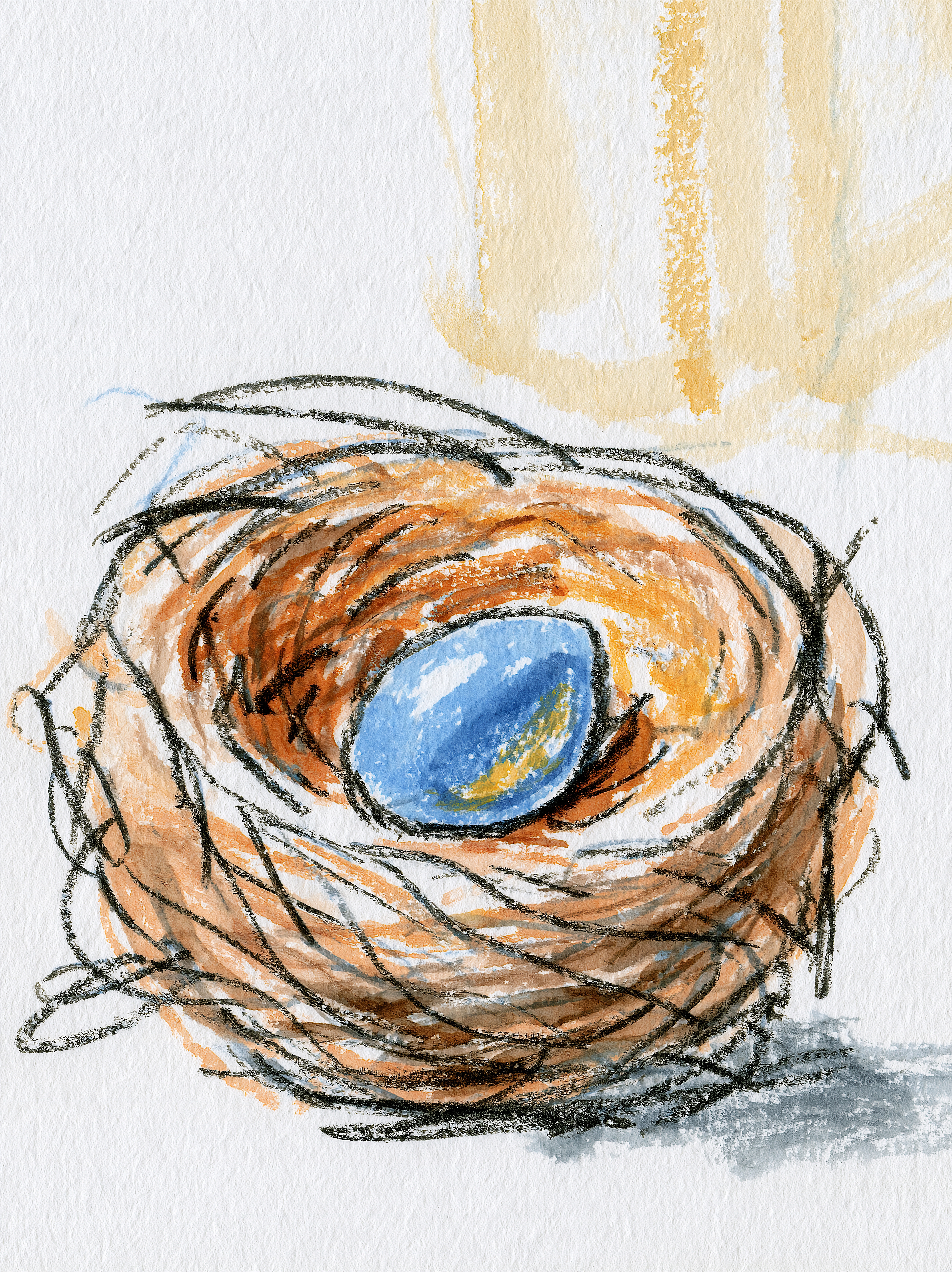
On 22 January 1852, Thoreau wrote about a friend who could not hear him finely, then described how a journal preserves one thought and invites the next.
Orientation
At a Glance
- The night, and the friendThoreau was thirty-four, back in his parents' house in Concord, Massachusetts, surveying for a living and walking every afternoon.
- What follows from that"It is dull work reading to one who does not apprehend you.
- The hensThe image at the centre is homely, and worth taking literally.
- What he did with itHe did what the paragraph says.
To set down such choice experiences that my own writings may inspire me and at last I may make wholes of parts. Certainly it is a distinct profession to rescue from oblivion and to fix the sentiments and thoughts which visit all men more or less generally, that the contemplation of the unfinished picture may suggest its harmonious completion. Associate reverently and as much as you can with your loftiest thoughts. Each thought that is welcomed and recorded is a nest egg, by the side of which more will be laid. Thoughts accidentally thrown together become a frame in which more may be developed and exhibited. Perhaps this is the main value of a habit of writing, of keeping a journal, — that so we remember our best hours and stimulate ourselves. … Thought begat thought. 1
A farmyard nest egg could be a real or imitation egg left in a hen’s nest to encourage more laying. Thoreau uses the word in its farmyard sense. A thought written down is bait for the next one.
The paragraph has been quoted often by people explaining why they keep notebooks, and it earns the use. What is less often noticed is what stands immediately in front of it on the page, which is a complaint about a friend. Read in order, the entry for 22 January 1852 turns out to be about two kinds of listener: the one who has stopped hearing, and the one that a man can build for himself out of paper.
The Night, and the Friend
Thoreau was thirty-four, back in his parents' house in Concord, Massachusetts, surveying for a living and walking every afternoon. The journal he had kept since 1837 had by now become the main work of his life, accumulating many manuscript volumes; the 1906 edition from which the passage is quoted runs to fourteen volumes and was assembled by editors after his death from manuscripts he never prepared for print. 2 So the sentences above were written for no reader but himself, though by 1852 he was already lifting passages from the journal into lectures, and he knew it.
The entry begins with something he had seen on a summer night, which he sets down months later for no stated reason: getting up to light a lamp, he "observed a stream of large black ants passing up and down one of the bare corner posts, those descending having their large white larvae in their mouths, the others making haste up for another load." 1 The entry moves through several other subjects before arriving at a friend:
My friend invites me to read my papers to him. Gladly would I read, if he would hear. He must not hear coarsely but finely, suffering not the least to pass through the sieve of hearing. To associate with one for years with joy who never met you thought with thought! … It is dull work reading to one who does not apprehend you. How can it go on? I will still abide by the truth in my converse and intercourse with my friends, whether I am so brought nearer to or removed further from them. … Even the estrangement of friends is a fact to be serenely contemplated, as in the course of nature. 1
A few sentences later, he turns to the journal: “To set down such choice experiences...”
He does not name the friend here. In the previous day's entry he discusses Ralph Waldo Emerson, who had been his patron and landlord, and writes that he is parting company with his closest friend. Emerson is therefore a plausible identification, though the passage on 22 January leaves it open. 3 The scene gives us an invitation to read aloud, which ought to be a pleasure, and the discovery that the listener hears "coarsely," letting the fine part slip through. "To associate with one for years with joy who never met you thought with thought!" The exclamation mark is his. It is the sound of a man realising that a long friendship has been conducted at cross purposes.
What Follows From That
"It is dull work reading to one who does not apprehend you. How can it go on?" The next sentences answer the question, and the answer is not to find a better friend. He resolves to go on speaking the truth to his friends, whatever it costs, and to contemplate "even the estrangement of friends" serenely, "as in the course of nature," as one might contemplate ants on a post at midnight. Then he turns to the notebook.
Set the two halves beside each other and the logic is plain, though Thoreau never states it. He has just described a reader who cannot hear him. He now describes the only reader who can: himself, later. "That my own writings may inspire me." The journal is the listener who hears "finely," who lets nothing through the sieve, because it holds the thought exactly as it was set down and returns it whole. The reading-aloud that failed with the friend succeeds with the page.
Once that is seen, the details of the famous paragraph read differently. "Rescue from oblivion" is what a good listener does for a remark. "The unfinished picture" that may "suggest its harmonious completion" is the conversation that could not be finished with the friend and can be finished, over months, with the book. "Associate reverently and as much as you can with your loftiest thoughts" has the grammar of advice about company: associate with, keep company with, as one would say of people. Having lost a companion who met him thought with thought, he proposes to keep company with the thoughts themselves.
None of this is confessed. Thoreau writes the complaint, then the theory, and leaves a blank line between them. Whether he saw the connection is not something the entry can tell us. My guess is that he saw it and preferred to let the arrangement speak, since a man who has just praised fine hearing is unlikely to spell out for a coarse one what his own page is saying.
The Hens
The image at the centre is homely, and worth taking literally. The first thought written down, however slight, changes the notebook from an empty place into one where thoughts can gather. That is why the nest egg must be "welcomed and recorded" rather than judged: its value is not its own but what it draws.
"Thoughts accidentally thrown together become a frame." Accidentally is the word to weigh. He is not describing a commonplace book organised by topic, or a plan. He is describing what happens when ants, a friend and a theory of journals are set down on the same page because he recorded them in the same entry: they begin to belong to each other, and something can be built in the frame they make. The entry demonstrates its own claim. The three things thrown together on 22 January 1852 do compose, in the reader's mind, a picture the writer did not draw.
"Thought begat thought." Three words, in the biblical form of the genealogies, and the paragraph stops. It is the only sentence in the passage without a qualifier.
What He Did With It
He did what the paragraph says. The journal grew for ten more years. Its later volumes give extraordinary attention to ants, ice, seeds and the dates of flowering. 2 Walden, published two years later, was built from the journal in exactly the way the paragraph predicts, wholes made of parts, and the last decade of entries, which he never shaped into a book, are now read by many people as the book.
The situation he describes is a common one and has nothing to do with being Thoreau. Anyone who has had something to say and found that the person they most wanted to say it to could not take it in has stood where he stood on that January night, and most have done one of two things: said it more loudly, or stopped saying it. He found a third course, which was to say it to a page that would give it back to him, and to trust that the page, unlike the friend, would go on listening. It is a solitary remedy, and he knew it. But the journal did what he asked of it. The nest egg drew more thoughts for ten years, and readers beyond that room can now hear what he recorded.
Source ApparatusNotes3 notes
- ↩
Henry David Thoreau, Journal, ed. Bradford Torrey and Francis H. Allen, vol. III (September 16, 1851 - April 30, 1852), being vol. IX of The Writings of Henry David Thoreau (Boston: Houghton Mifflin, 1906), entry for January 22, 1852, pp. 216-217. Public domain. Text consulted in the Walden Woods Project's online copy of this edition (Journal III, chapter IV, "January, 1852"): https://www.walden.org/work/journal-iii-september-16-1851-april-30-1852/ . The opening ants passage is on p. 214; the friend and journal passages are on pp. 216–217. The 1906 editors print “larvæ” with a ligature.
- ↩
On the journal's extent and editing: The Writings of Henry D. Thoreau (the Thoreau Edition), "Journals," https://thoreau.library.ucsb.edu/writings_journals.html (forty-seven manuscript volumes, October 1837 to November 1861); and the previous piece in this series on the entry of 19 July 1851, which gives the biographical setting.
- ↩
Thoreau, Journal III, entry for 21 January 1852, pp. 213–214, mentions Emerson and describes a parting from his closest friend. The 22 January entry does not name the listener; the identification remains an inference. https://www.walden.org/wp-content/uploads/2016/02/Journal-2-Chapter4.pdf
Test your understanding
Question 1 of 3
According to the article, how does the complaint about Thoreau’s friend change the meaning of the later passage about journal writing?
Guided Inquiry
Questions for Socrates
Explore these questions with Socrates, with this Feature as your reading context.
- If the journal functions as a listener that “hears finely,” what can a page provide that a human listener cannot—and what might it still lack?→
- The author argues that ants, a disappointed friendship, and a theory of journals form a picture because they were recorded together. How does juxtaposition create meaning even when a writer does not explicitly state the connection?→
- Thoreau’s nest-egg image suggests that an initial thought should be “welcomed and recorded” rather than judged. How might postponing judgment change what a writer notices or develops?→