
Diotimos Library · Renaissance Collection · English Edition
The Renaissance
Studies in Art and Poetry
Swipe or use the arrow keys.
English Edition · Branch 32 of 105
Luca della Robbia · Part 1
The Renaissance
p. 32Luca della Robbia
The Italian sculptors of the earlier half of the fifteenth century are more than mere forerunners of the great masters of its close, and often reach perfection, within the narrow limits which they chose to impose on their work. Their sculpture shares with the paintings of Botticelli and the churches of Brunelleschi that profound expressiveness, that intimate impress of an indwelling soul, which is the peculiar fascination of the art of Italy in that century. Their works have been much neglected, and often almost hidden away amid the frippery of modern decoration, and we come with some surprise on the places where their fire still smoulders. One longs to penetrate into the lives of the men who have given expression to so much power and sweetness. But it is part of the reserve, the austere dignity and simplicity of their existence, that their histories are for the most part lost, or told but briefly. From their lives, as from their work, all tumult of sound and colour has passed away. Mino, the Raphael of sculpture, Maso del Rodario, whose works add a further grace to the church of Como, Donatello even,—one asks in vain for more than a shadowy outline of their actual days.
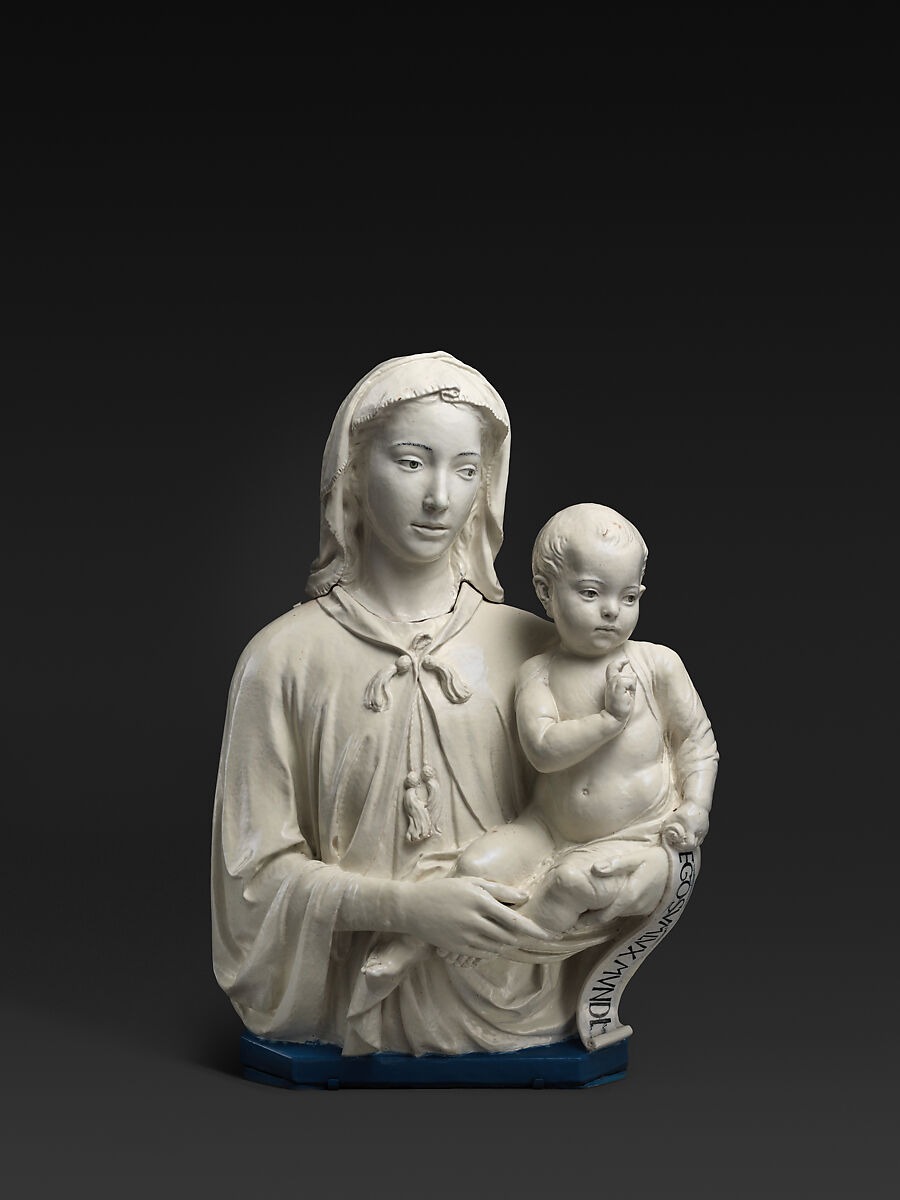
Luca della Robbia, Madonna and Child with Scroll, Metropolitan Museum of Art, New York. The relief illustrates Luca’s glazed terracotta. Collection record
Something more remains of Luca della Robbia; something more of a history, of outward changes and fortunes, is expressed through his work. I suppose nothing brings the real air of a Tuscan town so vividly to mind as those pieces of pale blue and white earthenware, by which he is best known, like fragments of the milky sky itself, fallen into the cool streets, and breaking into the darkened churches. And no work is less imitable: like Tuscan wine, it loses its savour when moved from its birthplace, from the crumbling walls where it was first placed. Part of the charm of this work, its grace and purity and finish of expression, is common to all the Tuscan sculptors of the fifteenth century; for Luca was first of all a worker in marble, and his works in terra cotta only transfer to a different material the principles of his sculpture.
About This Reading Edition
Walter Pater’s studies of art and poetry, from medieval French tales through Botticelli, Leonardo and Winckelmann. This illustrated and annotated edition follows the 1893 fourth edition and includes the original Conclusion of 1873.
Historical Text
Walter Pater, The Renaissance: Studies in Art and Poetry, fourth edition (Macmillan, 1893), with the Conclusion from Studies in the History of the Renaissance (Macmillan, 1873).
About This Edition
Macmillan, fourth edition, 1893; original Conclusion, 1873; Diotimos Editions, 2026
Rights
Walter Pater’s historical text and the five supplied reproductions are in the public domain. Introduction, notes and apparatus © 2026 Diotimos Editions.
- Exact supplied originalComplete annotated edition (PDF)
- Exact supplied originalComplete annotated edition (EPUB)
- Exact supplied originalComplete annotated edition (Word)
- Exact supplied originalComplete annotated edition (Markdown)
- Historical copy-text printingPater’s 1893 fourth edition
- Original Conclusion copy text1873 first edition, facsimile of the Conclusion
- Historical edition chronologyInternational Walter Pater Society chronology