
Diotimos Library · Renaissance Collection · English Edition
The Renaissance
Studies in Art and Poetry
Swipe or use the arrow keys.
English Edition · Branch 29 of 105
Sandro Botticelli · Part 4
The Renaissance
p. 29It is this which gives to his Madonnas their unique expression and charm. He has worked out in them a distinct and peculiar type, definite enough in his own mind, for he has painted it over and over again, sometimes one might think almost mechanically, as a pastime during that dark period when his thoughts were so heavy upon him. Hardly any collection of note is without one of these circular pictures, into which the attendant angels depress their heads so naïvely. Perhaps you have sometimes wondered why those peevish-looking Madonnas, conformed to no acknowledged or obvious type of beauty, attract you more and more, and often come back to you when the Sistine Madonna and the Virgins of Fra Angelico are forgotten. At first, contrasting them with those, you may have thought that there was something in them mean or abject even, for the abstract lines of the face have little nobleness, and the colour is wan. For with Botticelli she too, though she holds in her hands the “Desire of all nations,” is one of those who are neither for Jehovah nor for His enemies; and her choice is on her face. The white light on it is cast up hard and cheerless from below, as when snow lies upon the ground, and the children look up with surprise at the strange whiteness of the ceiling. Her trouble is in the very caress of the mysterious child, whose gaze is always far from her, and who has already that sweet look of devotion which men have never been able altogether to love, and which still makes the born saint an object almost of suspicion to his earthly brethren. Once, indeed, he guides her hand to transcribe in a book the words of her exaltation, the Ave, and the Magnificat, and the Gaude Maria, and the young angels, glad to rouse her for a moment from her dejection, are eager to hold the inkhorn and to support the book. But the pen almost drops from her hand, and the high cold words have no meaning for her, and her true children are those others, among whom, in her rude home, the intolerable honour came to her, with that look of wistful inquiry on their irregular faces which you see in startled animals—gipsy children, such as those who, in Apennine villages, still hold out their long brown arms to beg of you, but on Sundays become enfants du chœur, with their thick black hair nicely combed, and fair white linen on their sunburnt throats.
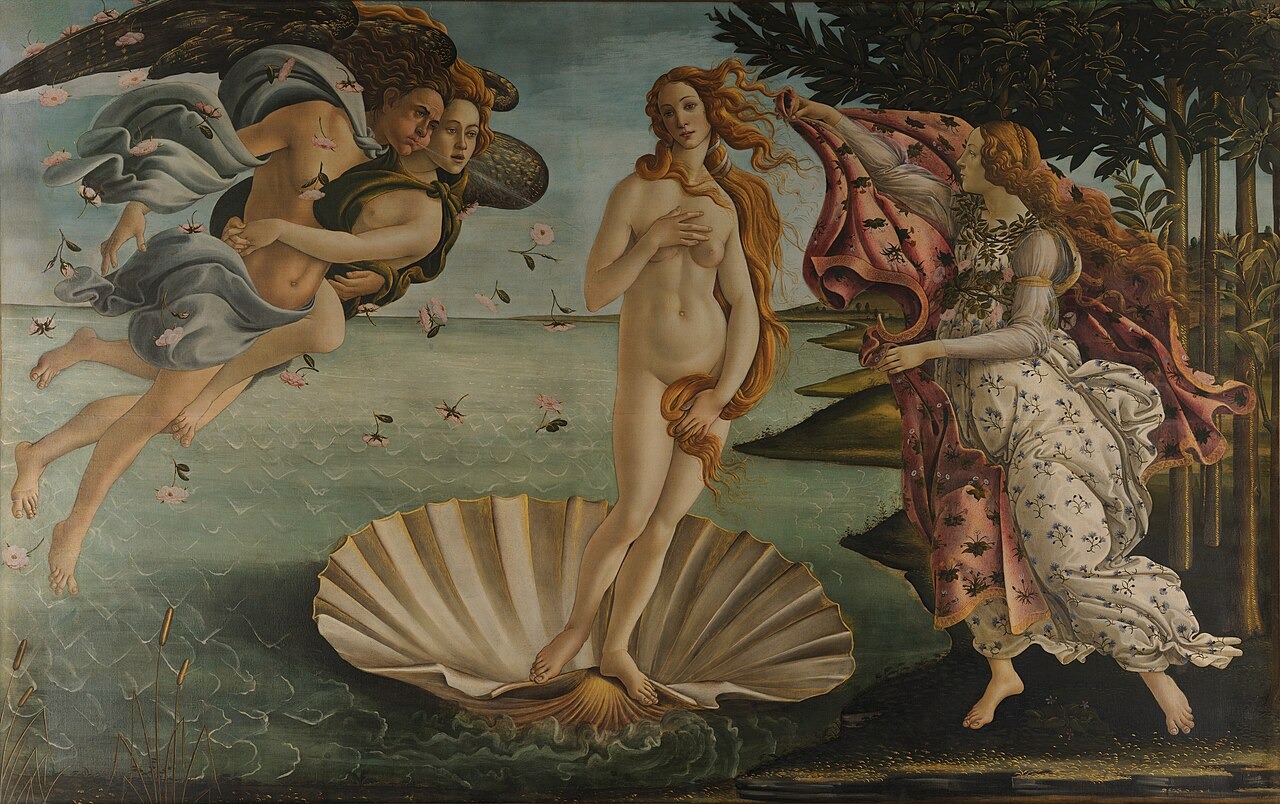
Sandro Botticelli, The Birth of Venus, c. 1485, Uffizi Galleries, Florence. Collection record
About This Reading Edition
Walter Pater’s studies of art and poetry, from medieval French tales through Botticelli, Leonardo and Winckelmann. This illustrated and annotated edition follows the 1893 fourth edition and includes the original Conclusion of 1873.
Historical Text
Walter Pater, The Renaissance: Studies in Art and Poetry, fourth edition (Macmillan, 1893), with the Conclusion from Studies in the History of the Renaissance (Macmillan, 1873).
About This Edition
Macmillan, fourth edition, 1893; original Conclusion, 1873; Diotimos Editions, 2026
Rights
Walter Pater’s historical text and the five supplied reproductions are in the public domain. Introduction, notes and apparatus © 2026 Diotimos Editions.
- Exact supplied originalComplete annotated edition (PDF)
- Exact supplied originalComplete annotated edition (EPUB)
- Exact supplied originalComplete annotated edition (Word)
- Exact supplied originalComplete annotated edition (Markdown)
- Historical copy-text printingPater’s 1893 fourth edition
- Original Conclusion copy text1873 first edition, facsimile of the Conclusion
- Historical edition chronologyInternational Walter Pater Society chronology