Tap the page, move to the top or bottom edge, swipe down, or press Tab to reveal reading controls. Use the arrow keys or swipe sideways to turn pages.
for that reason is imprisoned within the cavities of rocks by its weighty bulk; and, rolling its stone in a continual movement of circulation like another Sisyphus, it is fixed in the form of a perfect metal. What did they mean by Neptune’s trident, Mars’s sword, Venus’s golden girdle, and Vulcan’s tongs, if not the triple substance of mercury, or of this water: its cutting power, its power to dissolve, and finally its capacity to cause germination, represented by Venus’s golden girdle? What do they understand by Vulcan’s tongs, if not a hot instrument with which nature performs everything created in the universe? They have rightly maintained that within the center of the earth it turns into a meteor everything that Jupiter turns into meteors in the heavens, where the first mixtures and marriages of things take place. This is why it attempts to steal Jupiter’s thunderbolt and scepter; but it was swollen with a fire too terrestrial and too dense to receive his impression. What does the blackness or whiteness of its helmet signify, if not mercury’s silvery, volatile, and changeable brilliance, darkened by some blackness? What do they wish to express through the death of watchful Argus,
who had a hundred eyes, if not the mortification of that same trembling quicksilver, which shines on every side like a mirror or an eye? What do they intend to signify by the bird consecrated to Mars, into which the young Gallas was transformed lest the Sun discover the embraces of Mars as he lay with Venus, if not its male and germinative spirit, bringing about not the illicit loves of the Sun and Venus but their chaste loves? What do they mean by the cock, consecrated to him as well as to the Sun, which natural philosophers affirm devours serpents, if not its inward sulfur, which has exceedingly great power to coagulate its moisture? Many seek it: some in plants, others in vegetable things, others in animals, in the midst of the bowels of the earth, and in minerals. Yet no one recognizes your water except one who knows it not by sight but by smell or weight. Is anything more ridiculous than seeking what one holds in one’s hands? Is anything more absurd than failing to see before one’s eyes a spring whose source pours forth crystalline waters
and exceedingly clear streams! Is this madness or blindness? Yet those whom you see within this garden, full of delight and pleasure, seek waters that, so to speak, flee from them and plunge into abysses. As the poet says of Tantalus, he seeks water in the midst of waters and tries to catch apples that escape him. After this water has flowed through several underground channels, which sometimes appear upon the earth’s surface and a moment later disappear, it returns to the earth’s center and casts itself into the deepest recesses of its bowels. It then escapes our eyes, and even the keenest-sighted person, far from being able to enjoy it, cannot so much as perceive it. Chemists have named this serpent’s water, extracted in the alembic—a water of remarkable stench, yet concealing all the others within its bosom—the water of our Sea. It is the water of our Venus, or of the rising dawn, taking many forms of earth or humors, as was said of Achelous. It is the water of our green Quenech, which rises in rivers. O moist greenness, watery form of the growth and nourishment of things, seed
from which everything issues, and without which our gold, or white smoke, cannot be obtained. But why do these waters well up at the foot of this green oak, lifting its shady branches on high? Why these white and red roses, which the waters cause to sprout and which surround the tree, unless to make us apprehend the power of sprouting, multiplying, and bringing the streams to abundant fruition? These streams are our water and our sulfur, represented by the white and red roses. They also convince us of its spirituality, purity, and incorruptibility, which may be perceived through the oak’s incorruptibility in water. Moreover, we have often seen little springs flow from its root; this leads us to say that it must acquire through itself its solidity, incorruptibility, the green shade of its branches, and its pleasant coolness. The poets have compared it to the spring of [Lerne?], guarded by a most watchful dragon. For the water of the Tagus abounds in golden sand, and along this river rises a great evergreen oak, casting deep shade through its many green branches; and since the water of this
The Scene of Herod
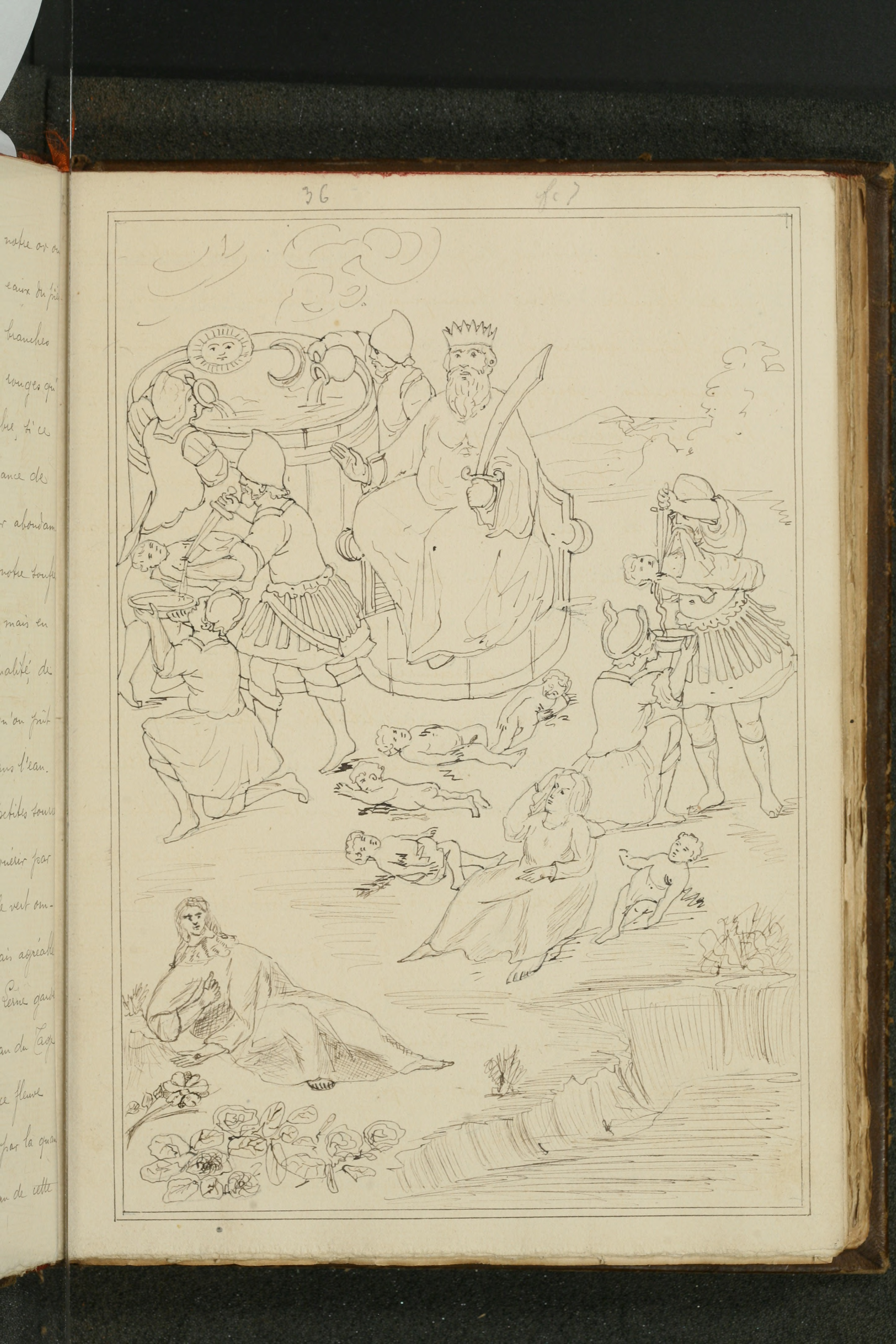
An enthroned ruler above a violent scene with children. The manuscript explains the figure through the reduction of the elements. Scan 95.
spring is viscous, sticky, and heavy, it supplies the tree with viscous, heavy, and solid nourishment and a long life. It is also the bath of the Sun and Moon, in which, they say, Vulcan washed himself; and, enamored of his beloved Narcissus, he plunges into it because of the likeness of that young man which he perceives there.
No one can gather these roses without knowing the entrance to this garden, whose keeping is entrusted to Venus and her beloved Adonis. From his blood the white roses borrow their red color. Only the philosopher who pleases its keeper, among those admitted, can benefit from these waters, through knowledge of this vitriolic cavern.