Tap the page, move to the top or bottom edge, swipe down, or press Tab to reveal reading controls. Use the arrow keys or swipe sideways to turn pages.
stone through Minerva’s mirror, that is, through the power of the congealing water. Who would not understand this mirror as the sulfur or spirit of sulfur so clear and shining that it gleams like a drawn sword, and powerful enough to coagulate all quicksilver and fix it as sulfur? So the poets say of Minerva’s mirror, which Perseus looked upon only by means of reflected rays, and which contains countless further secrets that we must for the present leave unspoken.
Let us now speak of Jason’s company and explain what the poets wish us to understand by that company. By Jason we mean only a similar spirit of sulfur and mercury, yet one very different from the former, both in nature and in effects: this one is as fixed as the other is volatile. Whoever would enjoy it must have recourse to Minerva, mother of Knowledge, and to Medea, companion of experience. For extreme skill is required to unite the spirits and join them in an eternal marriage compact, so that they may be converted into a fixed and permanent matter called the philosophers’ stone, or the Golden Fleece that Jason is about to carry away.
But before this bloodless victory, he consults Medea’s knowledge and art. The furious bulls vomiting fire and flame that he must tame are nothing but vapors rising in the third work of corruption, which must be arrested by a subtle and ingenious practitioner. That is to say, the matter must be cooked until no vapor rises into the alembic’s head to fill the whole vessel.
It is not without reason that he is warned to guard against them, for the philosophers declare them deadly and worse than poison.
Next, the earth of Mars must be opened with the philosophers’ plow and share, and the teeth of Cadmus’s serpent sown. That is, the sulfur spoken of above, which is the earth of Mars, must be opened with the share of the philosophical plow and the teeth sown in it: in other words, it must be corrupted, opened, and torn apart by the mercurial water that remains. We have said enough about this in its place above; therefore by the plowshare and the serpent’s teeth we shall understand the dissolving power of the water;
but what do we understand by Medea and her art?
Finally, by Medea we understand this sulfur of nature, because at that stage it is called a medicine suitable for every disease, and consequently the practitioner of all medicine or natural magic, and the foundation of the religion of the cabala, concerning which we have already said great things several times. We call the mixed juice he made the sleeping dragon swallow the mercurial water that, after sublimation, remains at the bottom of the vessel in which the body of gold has been dissolved and cooked. Thus it is called medicine and a very great theriac, in which the flesh of our serpent, or of vipers purified of their blood, has been dissolved; consequently the philosophers name it enriched vapor and the river of Achelous. Hercules needed extraordinary strength because this river took on a new form from time to time. We shall speak of it more fully in its chapter.
In the second figure of the second group of seven leaves was the form of a serpent crucified with large iron nails. Its head hung from above toward the east, on the right-hand side, and its tail on the left-hand side hung toward the
The Serpent upon the Cross
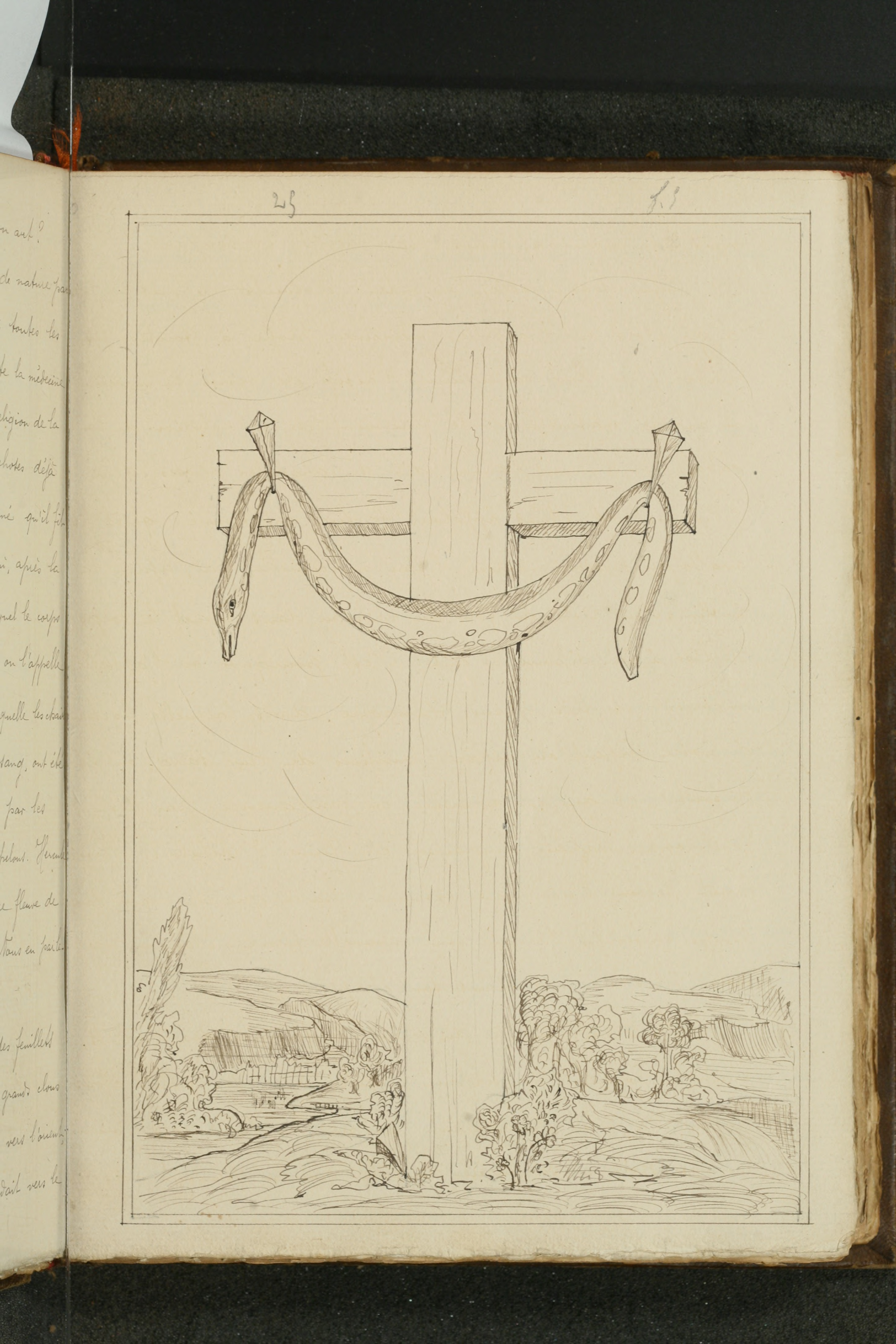
A serpent attached to a cross in a landscape. The following explanation bears the operative subheading Corruption. Scan 69.