Tap the page, move to the top or bottom edge, swipe down, or press Tab to reveal reading controls. Use the arrow keys or swipe sideways to turn pages.
penetrates the metal’s innermost parts. Fixity, its opposite, gives it such incorruptibility that it rejects every kind of fire and even overcomes fire’s strength and violence. Thus these truly and certainly are the qualities of the Arabian elixir: fusibility, subtlety, penetrability, fixity, and brilliance or tincture, which are compared with the subtlety, agility, incorruptibility, and light of glorified bodies. What, I ask you, is fusibility without subtlety, subtlety without permanence, or permanence without tincture? Certainly nothing. Since fusibility belongs to several metals, they cannot all penetrate one another; penetrability and subtlety are therefore required and absolutely necessary to penetrate the smallest parts. The first fusibility is nature’s work, so mingling the elements in mercury; according to art’s rules, an exceedingly subtle, ingenious artist is needed to perfect our matter beyond nature itself. It surpasses nature by penetrating like spirits and passing through bodies
of the greatest solidity. It impresses upon them not only its simple, more perfect metallic form, but raises them to the highest degree of subtlety, purity, and permanence, separated from all materiality and mortal corporeality. Likewise, having imparted a body to their matter, they thought it necessary to purify it of every impurity and make it better—that is, light and volatile—so that this light body might subsequently become fixed. For seeking subtlety and penetrability would be useless without fixity and permanence in fire, which retain the matter there as long as it needs to act. This quality too is the work of nature rather than art: nature, exceedingly prudent and skillful, unites pure, clear sulfur with homogeneous, very subtle mercury so well and according to the rules that once joined they never separate. Without tincture, in which metallic form and luster reside, subtlety, penetrability, and permanence in fire would carry no weight and
be of no use in this work. Great attention is therefore required. Tincture is the work of art and nature: of nature because nature alone knows the elements’ weight and their dispositions to receive forms; and of art because tincture must be multiplied indefinitely in this subject so that it can be communicated indefinitely to others. Thus the subject is sufficient and capable of communicating itself and receiving indefinitely. Finally, everything that animates the perfection of our quintessence, of which we have spoken, comes only from a proper union of the moist and unctuous with the pure and dry. For cold earthiness certainly prevents all fusion, just as volatile humidity resists permanence in fire. We must therefore banish from our work whatever can impart corruption and death to the body; otherwise it would never reach glorification.
Since not everyone will understand these things hidden from ordinary people’s eyes, we must resort to an experiment to overcome whoever would oppose our incontestable demonstrations. Yet how can I know whether it will be believed? That does not prevent me: I know
one thing even if I am not believed, and willingly assert it: those who have performed the experiment greatly deserve belief and are worthy of having accomplished so great a wonder. I swear most religiously that I neither assert nor shall assert anything beyond what I have done with my own hands. Yes, I swear that I made a liquor smelling of amber, resembling oil in color and thickness, a single small drop of which converted four ounces of lead into genuine, very good gold. Because certain philosophers of our cabala doubted it, I entrusted this gold to them for examination that might provide more certain proof; all found it much better than mined gold.
If you do not believe these things, O heretic, which have hitherto been seen even by men from the dregs of society and recorded in writing, you are a heretic in every respect, and it would be better to doubt the Sun’s light. Yet perhaps you do not call into doubt that Almighty God created the entire universe from nothing, still less that everything contains a seminal power to perpetuate its species; and you will not dare
deny the nourishment, preservation, and increase of these species. What, I ask you, are preservation, nourishment, increase, and propagation except a multiplied, extended creation of something once created, without which the species would perish and return to its chaos? Everyone admits it, and there is no disputing it. If you grant this, I hope you will not refuse me what experience can prove. I made a powder and held it in my hands; I also possessed, tested, and repeatedly held in my hands a mercurial liquor that could be multiplied indefinitely, not only in power but even in quantity. By adding mercury it continually regenerated, just as leaven or seeds’ germinative power perpetuates and preserves the species indefinitely through corruption and generation. Do you believe that God granted this privilege to these lowly creatures yet denied it to himself? If you at least admit creation from nothing, why do you not admit the multiplication of his body in different places at the same time—a work of lesser consequence, as we
The Closing Composite Figure
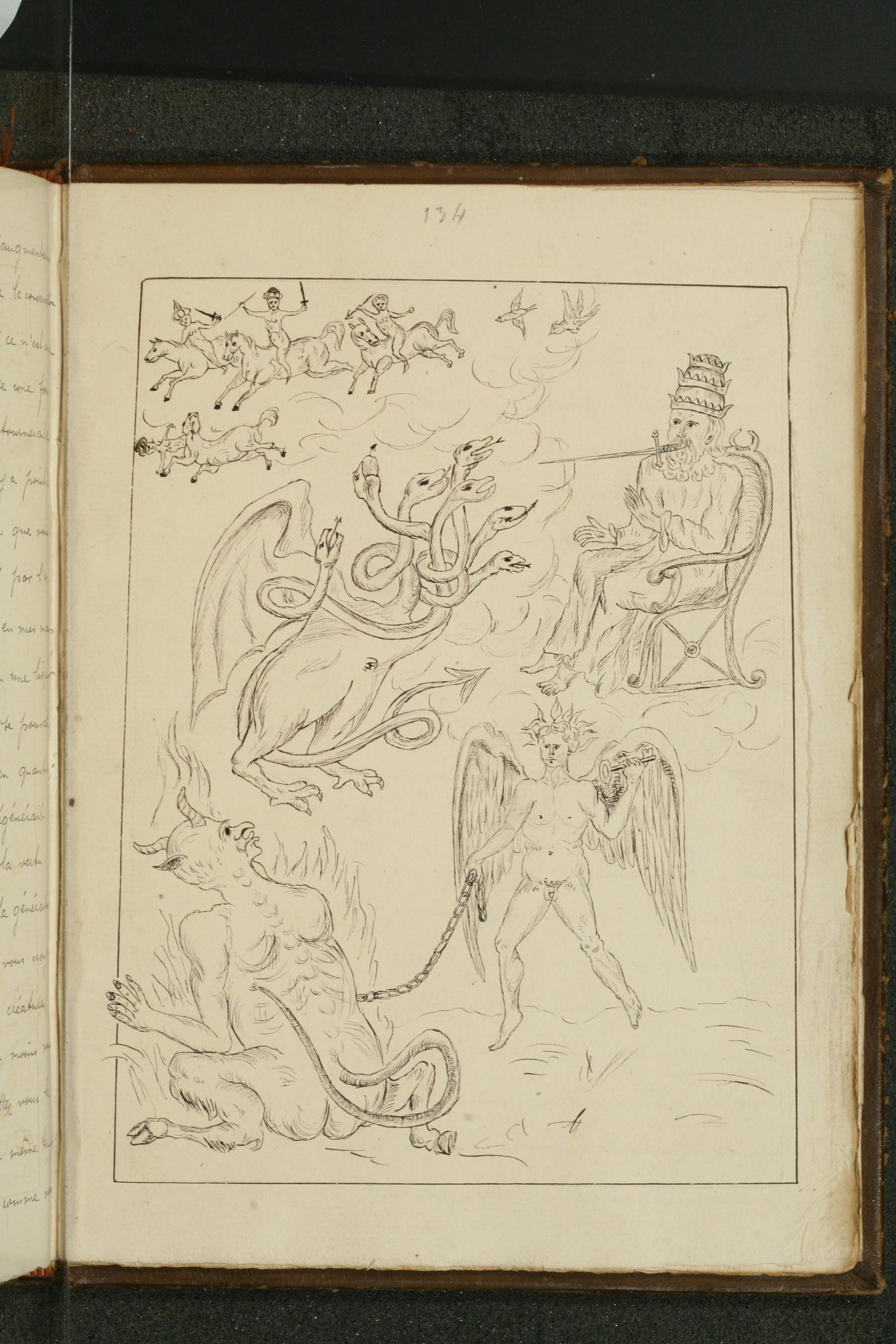
A composite scene of winged, human, and many-headed animal figures. Scan 303.
have just seen in created things. If we wish to dig still deeper and recall what we have said in several places about our stone’s power and multiplication, we shall discover still greater things, as certain as their origin in exceedingly wise authors and their confirmation by sure, evident arguments. These will serve as proofs to demonstrate transubstantiation and multiplication in the Eucharist. Moreover, they let us see everywhere traces and vestiges of Jesus Christ’s death and resurrection imprinted upon almost everything. Who will fail to perceive them traced by nature’s own hand upon things’ brow and within their marrow? Such is a plant containing all the instruments of Jesus Christ’s death, and many other things we pass over to avoid prolixity. This led the divine Trismegistus to say that God created the world only to be seen within it and known through the world itself. Its parts everywhere gleam and shine with divine rays and splendor, making known in some manner
God in every creature.
Some will object, with a certain appearance of reason, that everything I have said rests upon no reasons authorized by the authors and should therefore not be believed. Yet I think they do not know Aristotle’s thought: whoever knows must know that the thing cannot be otherwise. What chiefly concerns the principles of natural philosophy and nature, almost wholly consisting of demonstrations established upon true first principles or proofs established upon those same principles, needs neither authors’ proofs nor their opinions. For we resolved to propose here only what depends upon the senses and art when undertaking to explain certain mysteries of the Catholic faith, which are natural because they must be understood through faith and not through proofs. We therefore reject proofs and resort to the principles and works of nature because of the great correspondence between creatures and the Creator. According to these words of
Trismegistus: ‘The first idea of things is God’; and shortly afterward: ‘This visible, external world was made by the supreme, almighty God according to the divine exemplar of the intelligible, inward world.’ Once nature’s principles, the most secret operations of its power, and art’s productions have been firmly established and demonstrated, nothing will be proved but truth itself. Upon truth’s foundations, as upon nature’s—firm supports that never shake—and upon Jesus Christ’s words, which are the same as his works, according to the saying ‘He spoke, and things were made,’ all faith in our mysteries will be established, together with everything remaining for us to say on this matter.
Who knows whether we should feel more love and joy than fear and humility in contemplating and meditating upon this stone’s magistery, the image and a specimen of the Eucharist? How can I know whether to remain silent or speak of so great a mystery, containing miracle upon miracle, which God wished to perfect so greatly that it might become