Tap the page, move to the top or bottom edge, swipe down, or press Tab to reveal reading controls. Use the arrow keys or swipe sideways to turn pages.
Exposition of the first figure on the fourth page, explaining the first and second agents, with the figure of the first septenary, which contains the preparation
In this first figure the first principle and the first matter of the physical work are openly demonstrated: the heavy, white water of quicksilver, which has been called spirit or vapor, double dragon. Through combination with mineral or celebrated sulfur, all metals are formed in the bowels
of the earth. Although it is very heavy, sticky and viscous, it is nevertheless subtler and lighter than anything else, since it has the power to raise and sublime the earth of sulfur. Once this earth has become heavier, it changes into quicksilver, rightly called metallic water.
For this reason a young man has been depicted upon a cloud, bearing a winged caduceus and wearing winged boots: to indicate that the dissolving power is as mighty as man is superior to the other animals, and to show that its subtlety, signified by the helmet and winged boots, is more vaporous than all other waters. The representation of Saturn is added because, just as water, represented by the young man, is the first principle of all things, the chemists say that it is also the end and final matter of everything. For just as the life of a compound is resolved into moisture through corruption, so it begins from moisture by means of corruption. This is why they have given Saturn a serpent devouring itself as his attribute, to show that the beginning and end of everything
are no different, as is proved by the old man's winged shoulders and the young man's winged feet, which mark their beginning and their end. The poets understood well enough the nature, ministries and good offices of this seminal water when they gave it the name Mercury: messenger of the gods, inventor of the arts, master of merchants and lord of mechanical things. For nothing is more capable of receiving every sort of form than water, which is not only the most powerful cause of generation and multiplication, but also of nourishment and growth. This is why they made the figure of a true old man, holding a scythe and bearing wings at his shoulders, as though he were about to fling himself with gaping mouth upon the young man, devour him and cut off his legs: to indicate that, as the first father of the gods, he contains within himself the first matter of all seeds. He seems to devour these like a cruel father—that is, to corrupt them—through the sharp, dissolving power expressed by the scythe, thus representing that he is the final destroyer of everything, and that none is more
powerful. Furthermore, through this figure one can plainly see two substances in mercury, one rawer, more volatile and more watery than the other. The most fixed and thickest matter is represented by Saturn, clothed in blue down to the knees, by the hourglass half filled with red sand that he wears upon his head, and finally by the scythe. Now, if we consider quicksilver's outward color, can we doubt that it is blue like the starry sun or clear water, or greenish like seawater, especially in fine weather? Likewise, everyone readily discovers its inward color, which changes greatly according to its different preparations. Through the old man's image [reading uncertain] and clothing, tucked up at the top, and because he is naked and wingless in the lower part, it retains no form in its preparation except that of vapor. This is why it is called white smoke. It is impregnated with the spirits of sulfur and is then like the red, sandy earth,
contained in the hourglass. After its preparation it is like heavy, sticky and simple water, as appears in the old man's lower part, which is bare.
This diversity of colors and forms is also signified by the young man's helmet and iron breastplate, whose outward appearance may be compared with the crocus of Mars, or with vermilion if it acquires any rust, or with seeming quicksilver if it becomes polished. This is why the chemists call it their steel or the philosophers' lead—that is, vermilion—or give it the name quintessence or spirit if it is distilled, just as it is signified by the young man striking his helmet with his wand.
To explain the fables fully, one must know that striking means nothing else in the poets than corrupting and resolving into moisture. They sought to represent the same thing through Hercules' club—which was nothing other than the spirit of our sticky water—with which he put to death every
kind of monster, and through the fable of Mercury and Pallas, whom Vulcan caused to emerge from Jupiter's head by striking it with an axe. For this reason they gave Pallas a pike, Mercury a caduceus, Hercules a great club, Perseus a sword, and finally Cadmus a lance fitted with a very sharp steel point. All these instruments signify the power to corrupt, strike and dissolve, which belongs to our water and our physical fire.
The poets elegantly represent its mercurial and solar spirit through the two serpents that Juno sent to Hercules while he was still in the cradle, or through the two serpents entwined around Mercury's wand, which mercilessly devour one another. For just as mercury's cold moisture has the power to dissolve sulfur and make it raw again, so sulfur's hot fixity has the power to hold, imprison and coagulate mercurial water, which is its death.
This is why they expressed these two natures so well through the figure of the old man who flings himself upon the young man to devour him and tear him to pieces.
It is in this connection that they say Vulcan imprisoned Mercury, bound with chains of iron or bronze. For just as it belongs to fire or sulfur to drink up its moisture, so Mercury's moisture acts through the sharp, dissolving violence represented by the sword, saber, spear point, wand and so forth: to pierce its body, penetrate it, corrupt it and dissolve it, as has been seen in the two serpents attached to Mercury's wand. With little difference, this represented Moses' rod, which he changed into a serpent that devoured the others, and with which he drew water from rocks and oil from stones, and performed still other wonders. These two serpents at the top of the golden wand show the first principles and first operations of the work, of which, until now, no author has spoken except beneath the marvelous shadows of enigmas and
figures, and beneath the deceptive mysteries of fables, which no one takes care or pains to explain.
This golden wand is the metallic, fixed spirit of gold, very subtle and very vaporous. Otherwise it would not receive the volatile spirits of quicksilver and vitriol, nor be received by them. Likewise their dissolution, destruction and death are figured by their embraces, because only sulfur can arrest the spirit of quicksilver, and only mercury can separate sulfur from its body. Nothing except mercury can draw out our real tincture, or invisible sulfur, from its extremities—that is, from water or earth. We shall speak of this elsewhere at greater length. This is why the poets have depicted these serpents entwined with one another in this emblem: the fixity of one, mingled with the moisture of the other, makes embraces, but not a true mixture. Consequently they can be separated from one another, because they have no fixed subject to which they can remain
The Caduceus
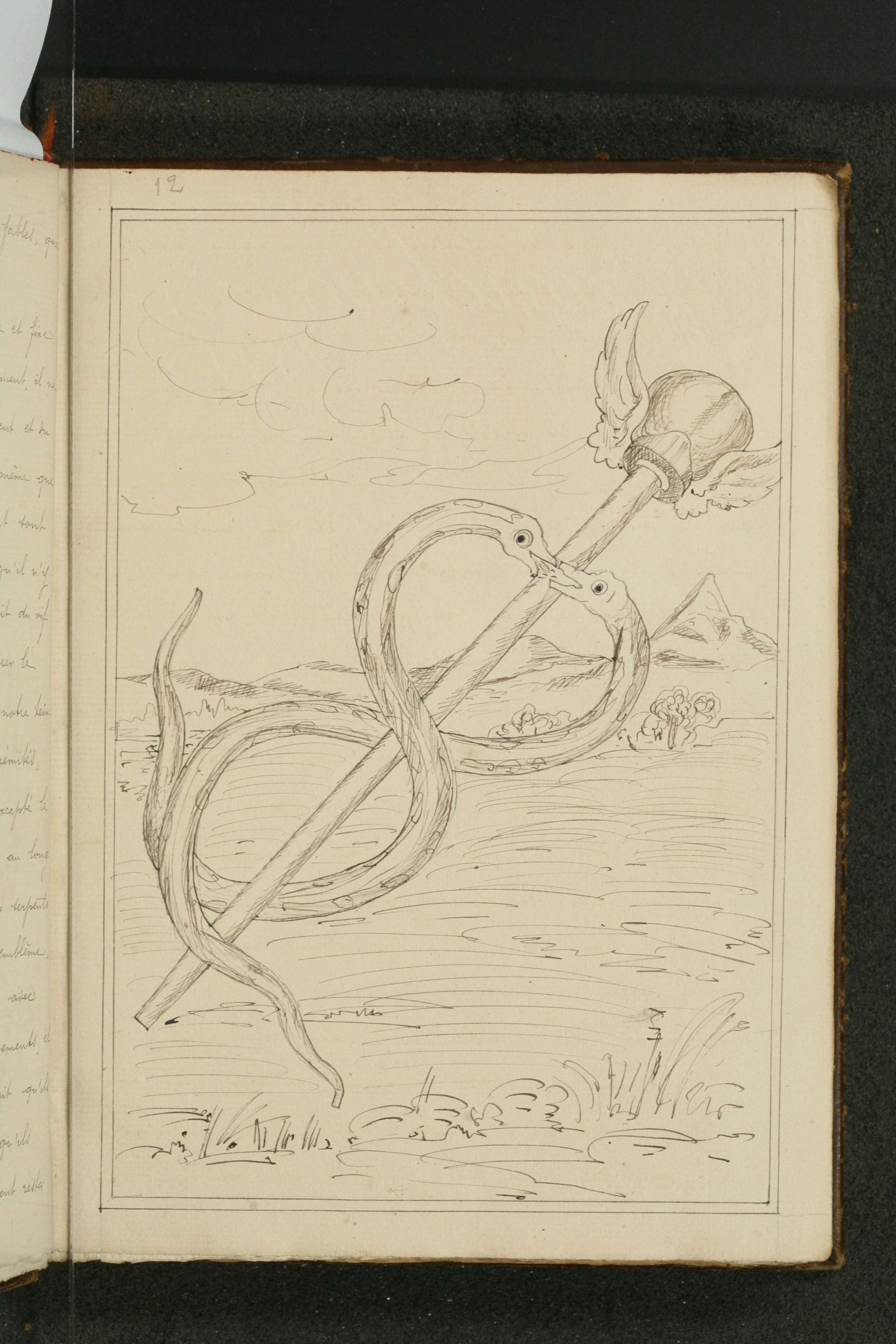
Intertwined serpents around a winged staff. Scan 39.
firmly attached.
Although this volatile sulfur of Venus has gold's tincture, it does not thereby retain its fixity. Likewise the volatile spirit of quicksilver does not retain the permanence of the Moon, whose brilliance it possesses. They must therefore be attached to the golden wand—that is, joined together with the fixed spirit of the Sun and Moon—if you wish to hold them and fix them firmly.
Once the practitioner has thoroughly understood this matter and completed this operation, only the cooking remains: that is, nothing more is needed but fire, time and patience.
The second septenary of pages explains the repeated sublimations of Mercury with vitriol and salt, and the time necessary to extract the quintessence or spirit and to dissolve the solar bodies. This requires seven weeks, according to the number of the seven leaves—that is, forty-nine days. It is taken again, on the seventh page of the third septenary, as the time required