Tap the page, move to the top or bottom edge, swipe down, or press Tab to reveal reading controls. Use the arrow keys or swipe sideways to turn pages.
Model of the hieroglyphic figures
On a thin piece of tree bark he depicted the figure of a young man in a cloud. He was armed with a helmet and an iron breastplate, carrying in his right hand a caduceus encircled and entwined with serpents, with which he struck his helmet, and he had wings at his heels. To the young man's left he depicted a man of very advanced age, likewise in a cloud, but a little below the young man. He was terrible as death and held
in his hand a curved scythe with which he tried to cut off the young man's feet and legs. He was dressed in blue, with his garment tucked up to the knees, and the rest of his body bare. On his head he wore an hourglass, and he had wings at his shoulders, extended in such a way that, with his mouth wide open, he seemed about to fling himself upon the young man to devour him. This was how the Hebrew mecabales were accustomed to represent him in their hieroglyphic figures, to signify Mercury, the messenger of the pagan gods, and the long duration of time, of which we shall speak below in its proper place.
On another page of the fourth leaf he represented, upon the summit of a very high mountain, a very beautiful flower whose stem or plant was an iridescent blue, its leaves studded with golden rays. The north wind blew violently against it. Around this mountain dwell seven dragons, and as many griffins or tigers, one of which has wings while the other has none. The larger winged creature throws itself cruelly upon the smaller wingless one to devour it. The dragons are black; the tigers have a yellowish cast against a pale ground.
On the fifth leaf is the old rosebush flowering with white and red roses, leaning against an oak that stands in the middle of a verdant garden. From its foot sprang a little stream of clear water, which slips beneath the other underground streams, passed among them, and plunged into the abysses. Although many people seek it in the bowels of the earth, although they saw it around them and scooped it up with their hands, no one—so blind were they—could recognize it, except one man, who acquired this knowledge by examining the weight of the water.
On the last page of the fifth leaf was represented the figure of a king, crowned with a golden diadem, seated upon a golden throne, and clothed in purple in the Jewish manner. In his right hand he held a bare, raised sword and commanded two soldiers to kill seven children mercilessly. Two other soldiers receive their blood, and two others put it into a very large vessel in which the Sun and Moon come to bathe
The Winged Figures
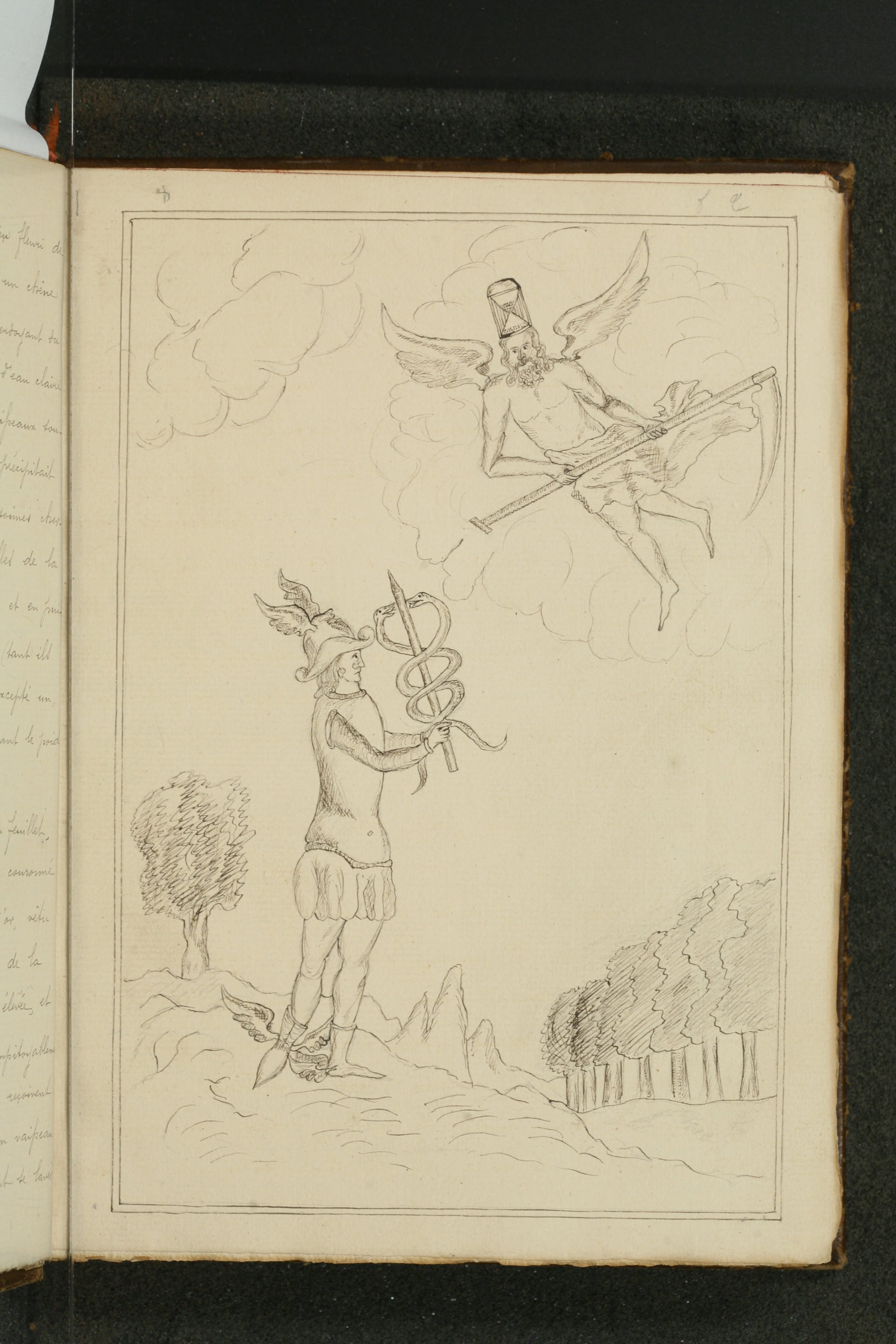
A winged figure with a scythe above a figure carrying a caduceus. The image belongs with the account of the first figure. Scan 29.
as in a bathtub. The children's mothers, prostrate upon the ground at the soldiers' feet, weep and lament.
On the first page of the first gathering, containing seven leaves, was painted a wand surrounded by two serpents that made several coils around one another. Enraged against each other, they twisted about to devour one another. They had several yellow spots tending toward red upon their backs and bellies, and above the top of the wand was a winged helmet, such as we have given to Mercury on the first leaf of the fourth page.