Tap the page, move to the top or bottom edge, swipe down, or press Tab to reveal reading controls. Use the arrow keys or swipe sideways to turn pages.
subject to serving it(?) contain within themselves some seeds of immortality! Can one grant heaven and the stars this spark of incorruptibility, fixity, and permanence, and refuse it to the human soul, created at the source of nothingness to know, honor, and obey God? Can one finally fail to recognize this desire and instinct for immortality and eternity that nature has granted and with which she has filled all things? If we attend at all to the first elements of this art—which, if our eyes are keen, will reveal to us the most hidden secrets for making spirits radiant and essentializing them in all works of art and nature—but also those depicted geographically in the figures that Saint John presents in Holy Scripture, wrought with an art surpassing all that can be said of it. He has not represented things as we have in the first figures of the first, second, and third tables.
In the first he represented seven golden lampstands, and in their midst the likeness of the Son of Man
The Figure among the Lampstands
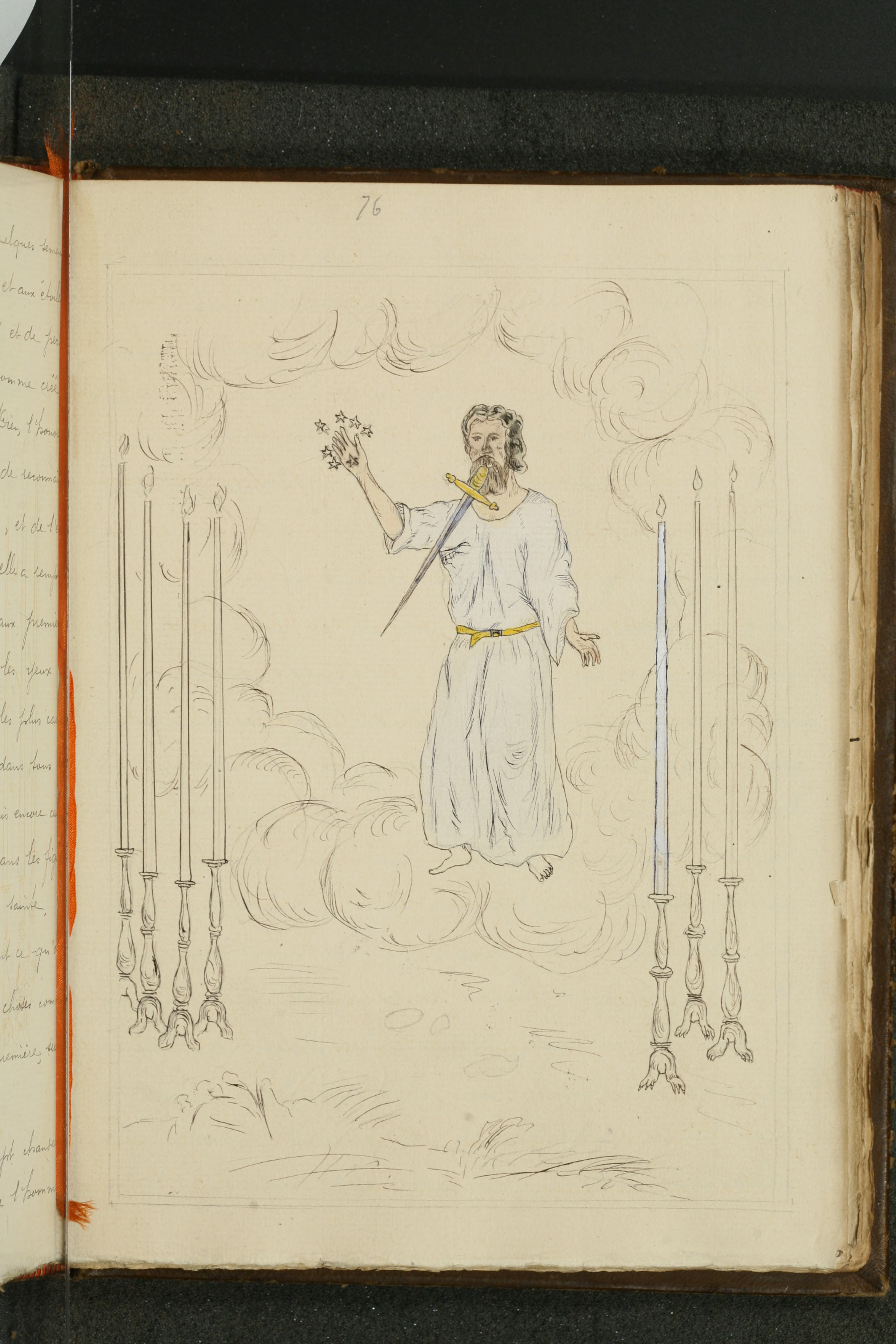
A standing figure surrounded by seven lampstands, with details in color. Scan 179.
clothed in a robe descending to his feet, girded across the breast with a golden belt. His head and hair were white as white wool and snow; his eyes were like a flame of fire; his feet like glittering metal within a burning furnace; and his voice resembled the sound of many waters. In his right hand he held seven stars, and from his mouth issued a sword sharp on both edges; his face shone like the Sun. His power will bring into full daylight not only nature’s most hidden secrets, but also the mysteries of our religion concealed beneath nature’s shadows. The purpose is not to dispute them or labor to find differences within them. By dispelling their shadows we shall remove what causes their obscurity, or casts too deep a shade upon them through the figures’ dark veils. Will anyone therefore be bold enough to say that I give them whatever meaning or explanation pleases me, since their characters and their explanation
are one and the same and cannot be otherwise, since they are of the same nature, as will be sufficiently apparent in what follows. It was fitting to explain them here so that from its beginning our discourse might be sheltered from calumny and free of all suspicion and blame.
In this first figure, with an almost divine intelligence, he has drawn nature’s and art’s first and last principles. These are the same, and cannot be thought different: they have not changed since the world’s creation, nor have others been created, since they are the foundation and support of the whole universe. Upon them the cabalists established the first foundations of their cabala, having found nothing greater in the world. All philosophers valued knowledge of them so highly that not one left it except under the form of models, riddles, characters, and figures. Thus this science has been transmitted to humanity rather than known until now
because it was not right—and was indeed forbidden—to cast these secrets to dogs: that is, to communicate them to the first comer and to the rabble, who would doubtless think little of them or turn them into ridicule, as happened to certain profane poets.
Since the beginning and end of all things are the same matter, first and last, and since the end corresponds to the beginning, all philosophers—of whom, however, we do not intend to speak here—have laid upon this the foundations of things to come. For what lies above us does not concern us. It is enough to explain the things represented in these figures, which explain nature herself alone. Here we do not mean or recognize as the elements’ first principles those subject to nature’s commands rather than art’s precepts, but those that human beings can conceal through the subtlety of their intelligence and through which, guided by nature, they can perform great wonders. These are nothing other
than the metallic spirits, within which the whole science of the ancient sages was contained. Among them, knowledge of the stone was at once the model of Jesus Christ and the foundation of magic and all cabala. Let us therefore have no difficulty, following Solomon, in calling these metallic spirits—after God—the fathers and governors of the world. They create the bodies of atmospheric phenomena in the middle region of the air; those of metals at the earth’s center; animals and plants at the extremities of its earth; gemstones in rivers and the sea’s waters; and finally our Salamander in fire. Let us also compare them with the two cherubim covering the mercy seat with their wings, represented upon the ark of testimony or the tabernacle, because of their double nature flowing from a single source. Although they are numerous according to the diversity of metals and minerals, they belong only to the natures of the fixed and the volatile; no more than these can be admitted in nature. Apart from the fixed spirits of gold and silver, nothing can be called fixed or perfectly incorruptible, and all
the fixity and permanence found in things comes from them. They are the elements and seeds of incorruptibility that Heaven, the Sun, and the Moon—the first fixed bodies—have allowed to spread over the earth, and they take no fewer than a thousand years to form within the earth’s beds. The second spirits, although volatile and always ready to escape, are nevertheless incorruptible. They are the foundations of things’ nourishment, corruption, and generation, because they are composed of homogeneous parts. When nourishment, corruption, or alteration occurs, the parts of the elements do not separate within them or leave their compound. On the contrary, they remain there despite the force of corruption or alteration, endeavoring to preserve life in some manner. Such is the analysis of the elements. The harmonious union of weighty bodies in this compound, in the form of the mercurial spirit that they call double vapor or white smoke, requires at least five hundred years for its formation. This is why they are the first roots of volatile and corruptible spirits, because in less time nature cannot
produce an incorruptible body. One will cease to be surprised that we establish them as the first principles of nature, art, and the whole of religion, according to what is represented in the first table. For what else, in the study of nature, shall we understand by the seven golden lampstands and seven stars in the young man’s hand, if not gold’s fixed spirits? Gold contains within itself, virtually and eminently, the seven metals corresponding to the seven planets and seven stars as their first roots and fathers. What, finally, shall we understand by the figure of the young man clothed in a long robe and girded with a golden belt, whose head and hair are white as snow, eyes like a flame of fire, feet like glittering metal, and voice like the sound of many waters? What shall we understand by the sword sharp on both edges issuing from his mouth, by his face shining and resplendent like the Sun, and by these words: ‘I am the first and the last and the living one; I died, and behold, I am living through the ages.’