Tap the page, move to the top or bottom edge, swipe down, or press Tab to reveal reading controls. Use the arrow keys or swipe sideways to turn pages.
Part Two
Das zweyte Theil
Chapter Outline
The stone’s many names, elemental balance and three-in-one riddles.
Recognising the matter and completing the preliminary work.
The conjunction, governance of fire, colour stages and final fixation.
Signs of failure, remedial preparation, uncertain times and verse summaries.
Isaiah, chapter28. Therefore the Lord GOD says: Behold, I lay in Zion a foundation stone, a tested stone, a precious cornerstone, firmly founded. Whoever has it will not be put to shame.
In their writings the philosophers have been unable to praise this high and noble art sufficiently, either before or after its perfection, or to exalt it with sufficiently magnificent titles. They have therefore indicated it in this way and generally called it the Lapis Philosophorum, or the ancient, hidden, unknown, natural and incomprehensible stone; indeed, the heavenly, blessed and consecrated stone, and also the common, three-in-one universal Stone of the Wise. Among their reasons for calling it a stone, and comparing it to one, the principal reason is that at the beginning its matter, as a mineral from the earth, really is a stone. Afterwards, because it is hard and dry, it can be pounded and ground like a stone. Above all, when it has been divided into its three parts, which nature itself has put together, it must itself be digested artificially, in accordance with nature, wholly and entirely back into these same parts together, until it becomes one stone that remains stable in fire and flows like wax.
The philosophers have repeatedly and emphatically reminded those who desire to obtain this secret philosophical stone how very necessary it is to know its first matter, otherwise called its second matter, and have urged them to heed this. Yet this matter is only one single thing, from which alone the stone must be prepared without any foreign addition, although it is called by a thousand names. They have also described its quality, kind and character wonderfully and have indicated it, in approximate summary, as follows. At the beginning it is composed of three, yet is only one. Again, it is generated and made from one, two, three, four and five; it is also found in one and two, and is everywhere. They call it Magnesia catholica, or Sperma mundi, the seed of the whole world, from which all natural things have their origin. It is of a wonderful and exceptional birth and form, with an indestructible and unfathomable nature and character. Thus it is neither hot nor dry like fire, neither cold nor moist like water, nor cold and dry like earth, but an appropriate, perfect balance of all the elements. It is also an uncorrupted body, which no element can attack. In all its properties it is to be compared to heaven, above the four elements and four qualities, as something indestructible and as the fifth essence.
Again, in outward bodily appearance, figure, form and shape it is a stone, yet no stone, but resembles a white gum or water more closely. They also call it a water of the great sea, a water of life, indeed the purest blessed water. Yet it is neither water from the clouds nor water from an ordinary spring, but something thick, enduring and salty; from another point of view, it is a dry water that does not wet the hand, or a dirty water arising from the salty fatness of the earth. Again, it is a double mercury and azoth, fed and nourished by the vapour, mist and sweat of the uppermost and lowermost, heavenly and earthly globes. It burns in no fire, for it is itself a universal spark of the fire of the light of nature. It also is, or has within it, a heavenly spirit that penetrates everything, with which God originally animated and ensouled it. Avicenna called this the soul of the world and said that, just as the soul is present and moves in every member of the human body, so this spirit is present and moves in all elemental creatures. It is also an inseparable union of body and soul, and the purest and noblest being, in which all secrets lie hidden and all marvellous power and virtue reside.
They also attribute to it unlimited power and a divine force. They say it is the Spirit of the Lord, which has filled the circle of the earth, and that in the beginning it hovered over the waters. They also call it a spirit of truth, hidden from the world, which cannot be grasped or obtained without the inward prompting of the Holy Spirit or instruction from those who know it. It is nevertheless present according to its power in every thing and every place, but is found in its full perfection only in this one thing. In sum, it is a spiritual substance that is neither heavenly nor hellish, but an airy, pure and glorious body, appointed as the middle between highest and lowest and the most choice and precious thing beneath the whole heaven. Conversely, those who do not understand it regard it very poorly, as the least and most contemptible of things, indeed as something rejected. Yet it is sought by many who have understanding and found by few, contemplated from afar and taken close at hand, seen by everyone and recognised by the smaller number. This is also neatly indicated in the German verses placed here.
A good is found divided into three, Yet it is only one—believe me freely. A thing the world holds in no great esteem And therefore scarcely seeks. It has it before its eyes, often at hand, Yet in its blindness does not know it. Those who do not understand it Think so little of it that they walk over it. Yet it is the greatest treasure To be found upon the whole earth. Whoever knows it and has the mediating word Can become rich here and there.
A Philosophical Riddle. In it the first-material subject of the wise art, called the philosophers’ phoenix, is to be found fully divided, three times three, by its names. If I name it and tell you openly All three parts belonging to it, Why then will you complain so much? Look, trust me: I speak the truth. You must have a little plant called trifolium; See to it—ask God for it. Seek one in three and three in one; You can go far, well a thousand, in secret. Body, soul and spirit they call it, Salt, sulphur and also mercury. But take care, trust me, to understand The little plant called trifolium alone. Once you have understood both the tone and song, You are truly a wise person.
Another, Much More Explicit. There is a thing in this world To be found everywhere, And that without especial effort. Its colour is grey, green, red and white. It comes and flows readily like water, Yet does not wet; it weighs light and heavy. I could name it a thousand times, Yet outwardly people do not recognise it, Because it seems so very insignificant, Though it is the most precious thing. Whoever can freely dissolve it in the middle And then, in the third, Close it up again, Has the right subject.
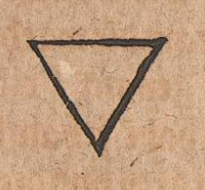
The original inverted triangle. 1619, p. 27.
Stiftung der Werke von C. G. Jung, Zürich · e-rara · DOI 10.3931/e-rara-8968 · Public Domain Mark.
Riddle. The kindred of this stone is everywhere. Its conception takes place in hell. It has its birth upon the earth. It finds its life in heaven. It draws out its dying in time; Afterwards it attains blessedness.
Once you have this exceptional matter at hand—partly heavenly and partly earthly, and at first properly a confusion or mingled being that cannot be described by any entirely discernible colour—and have also recognised it rightly and well, you must diligently give it its due, meeting what further belongs to it and is required in its preparation. The philosophers have always regarded this recognition as the principal element in the work. But before any manual labour is begun or undertaken with it, the God-fearing artist must again be diligently reminded and admonished to heed the foregoing teaching. He must also be faithfully warned not to engage with this secret work and the indestructible spirit concealed within it unless he has first rightly and thoroughly recognised and learned that spirit’s deeply grounded qualities and properties in accordance with nature.