Tap the page, move to the top or bottom edge, swipe down, or press Tab to reveal reading controls. Use the arrow keys or swipe sideways to turn pages.
Section IX
Historical thematic sequence · Brunschvicg edition
B589
On Christianity’s not being unique.—Far from being a reason to believe it is not the true religion, this is, on the contrary, what shows that it is.
B590
Concerning religions, we must be sincere: true pagans, true Jews, true Christians.
B591
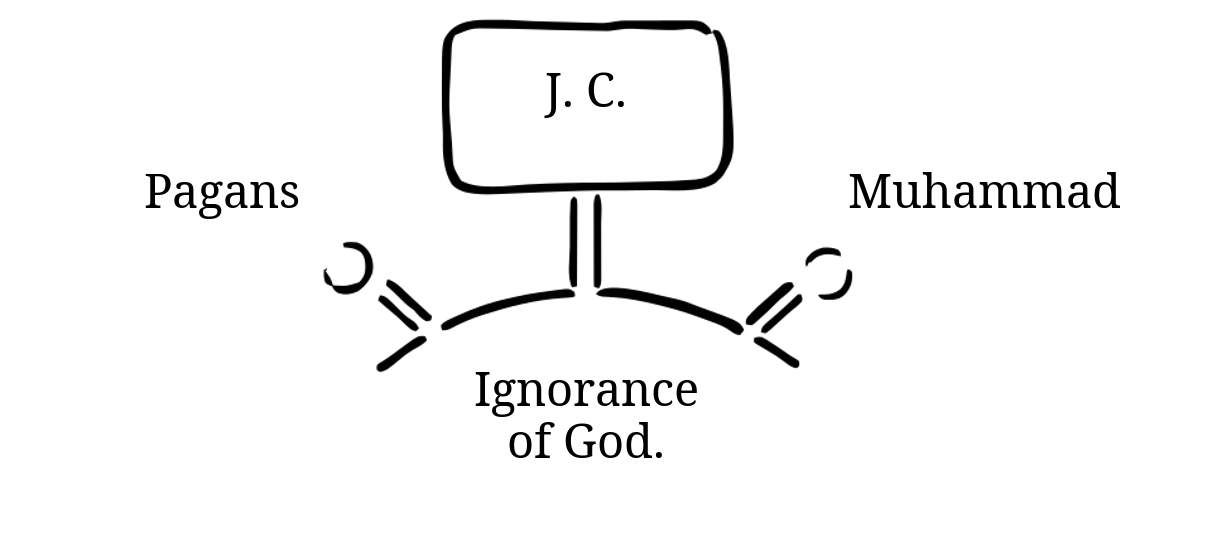
B592
Falsehood of the other religions.—They have no witnesses; these have them. God challenges the other religions to produce such signs: Isaiah 43:9; 44:8.
B593
History of China.—I believe only histories whose witnesses would let their throats be cut.
[Which is more credible, Moses or China?]
It is not a question of viewing this broadly; I tell you there is material both to blind and to enlighten.
With this single statement I overturn all your reasonings. But China obscures, you say; and I answer: China obscures, but there is clarity to be found; seek it.
Thus everything you say serves one of the purposes and nothing goes against the other. Thus it helps and does not harm.
We must therefore examine this in detail; we must put the papers on the table.
B594
Against the history of China.—The historians of Mexico, of the five suns, the last of which is only eight hundred years ago.
Difference between a book received by a people and one that forms a people.
B595
Muhammad, without authority. His reasons would therefore have to be very powerful, having only their own force.
What, then, does he say? That we must believe him.
B596
The psalms sung throughout the earth.
Who bears witness to Muhammad? Himself. Jesus Christ wills that his own testimony count for nothing.
The character of witnesses means they must be always and everywhere; and, wretched, he is alone.
B597
Against Muhammad.—The Qur’an’s attribution to Muhammad is no stronger than the Gospel’s to Saint Matthew, for the latter is cited by many authors from century to century; even its enemies, Celsus and Porphyry, never disavowed it.
The Qur’an says Saint Matthew was a good man. Therefore he was a false prophet, either in calling wicked people good, or in not agreeing with what they said about Jesus Christ.
B598
I want Muhammad judged not by what is obscure in him and can be passed off as a mysterious meaning, but by what is clear, by his paradise and the rest; that is where he is ridiculous. That is why it is not just to take his obscurities for mysteries, since his clarities are ridiculous.
It is not the same with Scripture. Grant that it contains obscurities as bizarre as Muhammad’s; but it contains admirable clarities and manifest, fulfilled prophecies. The contest is therefore unequal. We must not confuse and equate things that resemble one another only in obscurity and not in clarity, which deserves that we revere the obscurities.
B599
Difference between Jesus Christ and Muhammad.—Muhammad, not foretold; Jesus Christ, foretold.
Muhammad, by killing; Jesus Christ, by having his own put to death.
Muhammad, by forbidding reading; the apostles, by commanding reading.
In short, they are so opposed that, if Muhammad took the path of succeeding in human terms, Jesus Christ took the path of perishing in human terms. Instead of concluding that, since Muhammad succeeded, Jesus Christ could easily have succeeded, we must say that, since Muhammad succeeded, Jesus Christ ought to have perished.
B600
Anyone can do what Muhammad did, for he performed no miracles and was not foretold; no one can do what Jesus Christ did.