Tap the page, move to the top or bottom edge, swipe down, or press Tab to reveal reading controls. Use the arrow keys or swipe sideways to turn pages.
B350
Stoics.—They conclude that we can always do what we can sometimes do, and that, since the desire for glory enables those it possesses to accomplish something, others will surely be able to do it too.—These are feverish movements that health cannot imitate.
From the existence of steadfast Christians, Epictetus concludes that everyone can surely be steadfast.
B351
Those great efforts of mind that the soul sometimes reaches are places where it does not remain; it only leaps to them, not to stay forever as on a throne, but for a single instant.
B352
The capacity of a person’s virtue must be measured by ordinary conduct, not by exceptional efforts.
B353
I do not admire an excess of one virtue, such as courage, unless I see at the same time an excess of the opposite virtue, as in Epaminondas, who had extreme courage and extreme gentleness. Otherwise this is falling, not rising. We show our greatness not by standing at one extreme, but by touching both at once and filling all the space between them. Yet perhaps this is only a sudden movement of the soul from one of these extremes to the other, and in reality it is never at more than a single point, like a burning brand. Granted; but at least this shows the soul’s agility, if it does not show its breadth.
B354
Human nature does not move onward continually; it has its comings and goings.
Fever has its chills and its burning heat; the cold shows the intensity of the fever’s burning as well as the heat itself does.
Human inventions from century to century follow the same course. So do the goodness and wickedness of the world in general: Changes are usually welcome to princes.
B355
Unbroken eloquence is tiresome.
Princes and kings sometimes play; they are not always on their thrones, where they grow bored. Greatness needs to be left behind to be felt; continuity cloys in everything, and cold is pleasant for the sake of warming oneself.
Nature acts through advances, going and returning. It moves forward and comes back, then goes farther, then half as far, then farther than ever, and so on.
The sea’s tide moves this way; the sun seems to move this way:
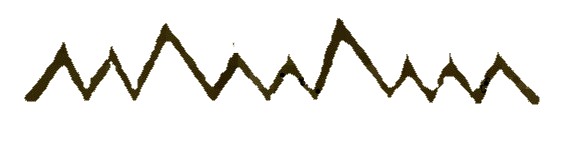
B356
The body is nourished little by little. An abundance of food and little substance.
B357
When we try to pursue virtues to their extremes on either side, vices appear that slip imperceptibly into them along their imperceptible paths, toward the infinitely small; and vices appear in crowds toward the infinitely large, so that we lose ourselves among the vices and no longer see the virtues. We become caught in perfection itself.
B358
The human being is neither angel nor beast, and unhappily whoever tries to play the angel plays the beast.
B359
We maintain ourselves in virtue not through our own strength, but through the counterweight of two opposed vices, as we remain standing between two contrary winds: remove one of these vices, and we fall into the other.
B360
What the Stoics propose is so difficult and so futile!
The Stoics maintain that all those who have not reached the highest degree of wisdom are equally foolish and vicious, like those who are two fingers deep in water.
B361
The highest good. Dispute about the highest good.—That you should be content with yourself and the goods arising from yourself. There is a contradiction, for in the end they advise killing oneself. Oh, what a happy life, from which one rids oneself as though it were the plague!