
Diotimos Library · Literary Fiction Collection · English Edition
Swipe or use the arrow keys.
English Edition · Branch 30 of 100
§ 6.—Of Recognition by Sight · Part 1
Flatland: A Romance of Many Dimensions
p. 30§ 6.—Of Recognition by Sight
I am about to appear very inconsistent. In previous sections I have said that all figures in Flatland present the appearance of a straight line; and it was added or implied, that it is consequently impossible to distinguish by the visual organ between individuals of different classes: yet now I am about to explain to my Spaceland Critics how we are able to recognize one another by the sense of sight.
If however the Reader will take the trouble to refer to the passage in which Recognition by Feeling is stated to be universal, he will find this qualification—“among the lower classes.” It is only among the higher classes and in our more temperate climates that Sight Recognition is practised.
That this power exists in any regions and for any classes, is the result of Fog; which prevails during the greater part of the year in all parts save the torrid zones. That which is with you in Spaceland an unmixed evil, blotting out the landscape, depressing the spirits, and enfeebling the health, is by us recognized as a blessing scarcely inferior to air itself, and as the Nurse of arts and Parent of sciences. But let me explain my meaning, without further eulogies on this beneficent Element.
If Fog were non-existent, all lines would appear equally and indistinguishably clear; and this is actually the case in those unhappy countries in which the atmosphere is perfectly dry and transparent. But wherever there is a rich supply of Fog, objects that are at a distance, say of three feet, are appreciably dimmer than those at a distance of two feet eleven inches; and the result is that by careful and constant experimental observation of comparative dimness and clearness, we are enabled to infer with great exactness the configuration of the object observed.
An instance will do more than a volume of generalities to make my meaning clear.
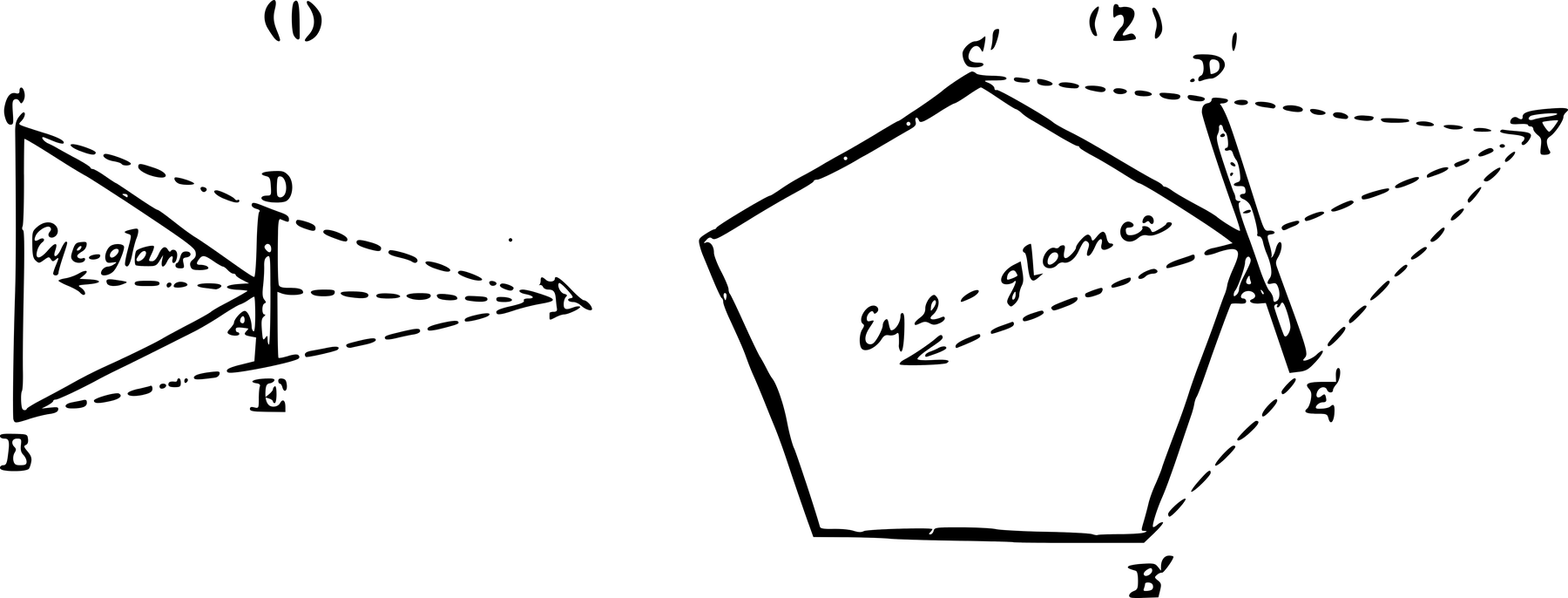
Suppose I see two individuals approaching whose rank I wish to ascertain. They are, we will suppose, a Merchant and a Physician, or in other words, an Equilateral Triangle and a Pentagon: how am I to distinguish them?
Socrates
Reading Flatland: A Romance of Many Dimensions · § 6.—Of Recognition by Sight · § 6.—Of Recognition by Sight · Part 1
Ask about a concept, passage, contradiction, or connection.
Socrates will begin with this book and its sources.About This Reading Edition
Edwin A. Abbott’s mathematical romance of a Square in a two-dimensional world, in the revised text of 1884, with an introduction, full notes and a chapter outline.
Historical Text
Edwin A. Abbott, Flatland: A Romance of Many Dimensions, first published by Seeley and Co., London, in 1884 under the pseudonym A Square. This supplied annotated edition follows the revised second edition of 1884, established from a modern transcription collated against that printing.
About This Edition
Revised second edition, Seeley and Co., London, 1884; supplied annotated Diotimos edition, 2026
Rights
Edwin A. Abbott’s historical text is in the public domain. Introduction, notes and apparatus © 2026 Diotimos Editions.