
Diotimos Library · Literary Fiction Collection · English Edition
Swipe or use the arrow keys.
English Edition · Branch 40 of 100
§ 9.—Of the Universal Colour Bill · Part 2
Flatland: A Romance of Many Dimensions
p. 40On the one hand the proposition was calculated to bring the Women in all classes over to the side of the Chromatic Innovation. For by assigning to the Women the same two colours as were assigned to the Priests, the Revolutionists thereby ensured that, in certain positions, every Woman would appear like a Priest, and be treated with corresponding respect and deference—a prospect that could not fail to attract the Female Sex in a mass.
But by some of my Readers the possibility of the identical appearance of Priests and Women, under the new Legislation, may not be recognized; if so, a word or two will make it obvious.
Imagine a woman duly decorated, according to the new Code; with the front half (i.e. the half containing eye and mouth) red, and with the hinder half green. Look at her from one side. Obviously you will see a straight line, half red, half green.
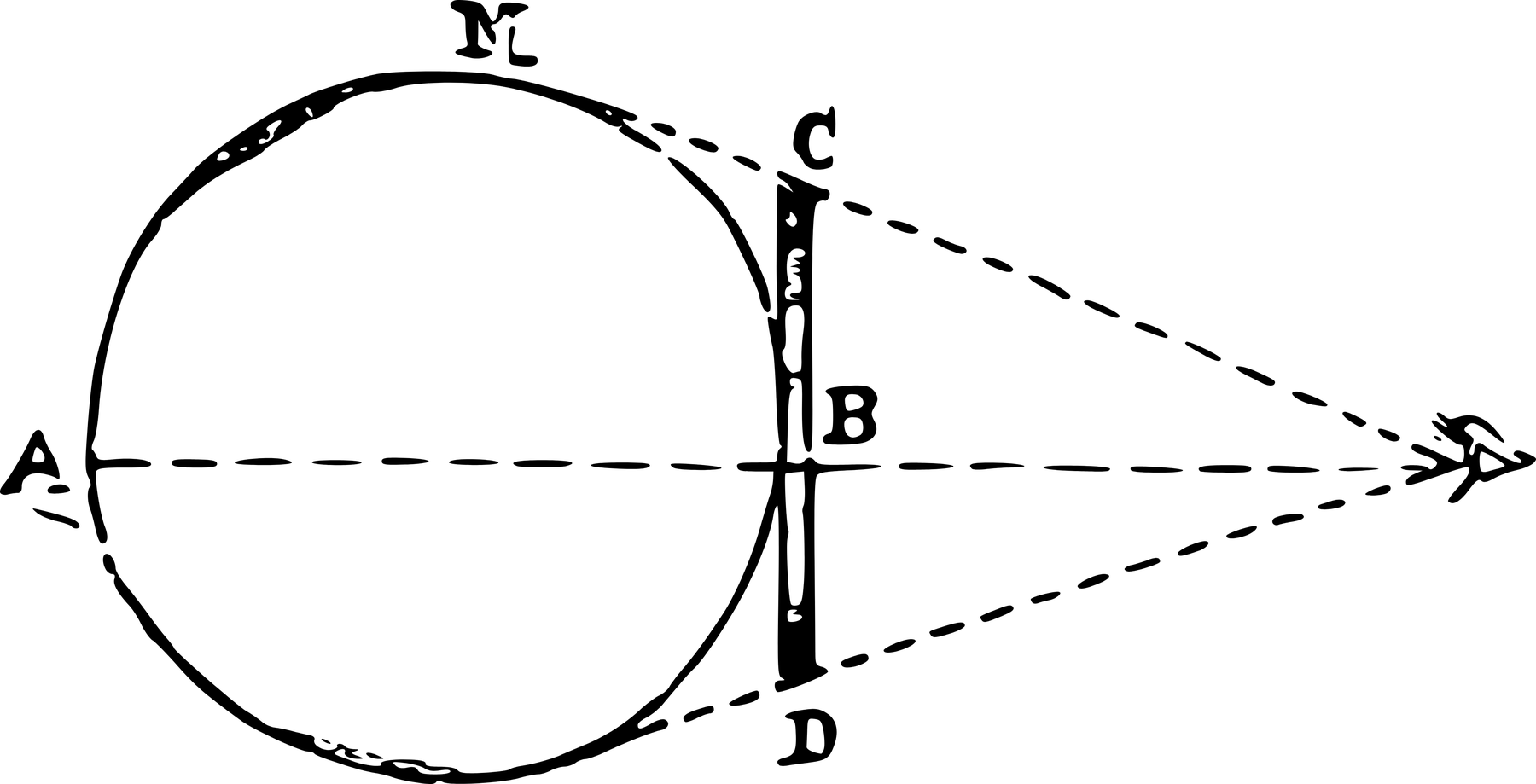
Now imagine a Priest, whose mouth is at M, and whose front semicircle (AMB) is consequently coloured red, while his hinder semicircle is green; so that the diameter AB divides the green from the red. If you contemplate the Great Man so as to have your eye in the same straight line as his dividing diameter (AB), what you will see will be a straight line (CBD), of which one half (CB) will be red, and the other (BD) green. The whole line (CD) will be rather shorter perhaps than that of a full-sized Woman, and will shade off more rapidly towards its extremities; but the identity of the colours would give you an immediate impression of identity of Class, making you neglectful of other details. Bear in mind the decay of Sight Recognition which threatened society at the time of the Colour Revolt; add too the certainty that Women would speedily learn to shade off their extremities so as to imitate the Circles; it must then be surely obvious to you, my dear Reader, that the Colour Bill placed us under a great danger of confounding a Priest with a young Woman.
Socrates
Reading Flatland: A Romance of Many Dimensions · § 9.—Of the Universal Colour Bill · § 9.—Of the Universal Colour Bill · Part 2
Ask about a concept, passage, contradiction, or connection.
Socrates will begin with this book and its sources.About This Reading Edition
Edwin A. Abbott’s mathematical romance of a Square in a two-dimensional world, in the revised text of 1884, with an introduction, full notes and a chapter outline.
Historical Text
Edwin A. Abbott, Flatland: A Romance of Many Dimensions, first published by Seeley and Co., London, in 1884 under the pseudonym A Square. This supplied annotated edition follows the revised second edition of 1884, established from a modern transcription collated against that printing.
About This Edition
Revised second edition, Seeley and Co., London, 1884; supplied annotated Diotimos edition, 2026
Rights
Edwin A. Abbott’s historical text is in the public domain. Introduction, notes and apparatus © 2026 Diotimos Editions.