
Book Reviews
The Polis Has Decided
On John Ma's Polis: A New History of the Ancient Greek City-State from the Early Iron Age to the End of Antiquity
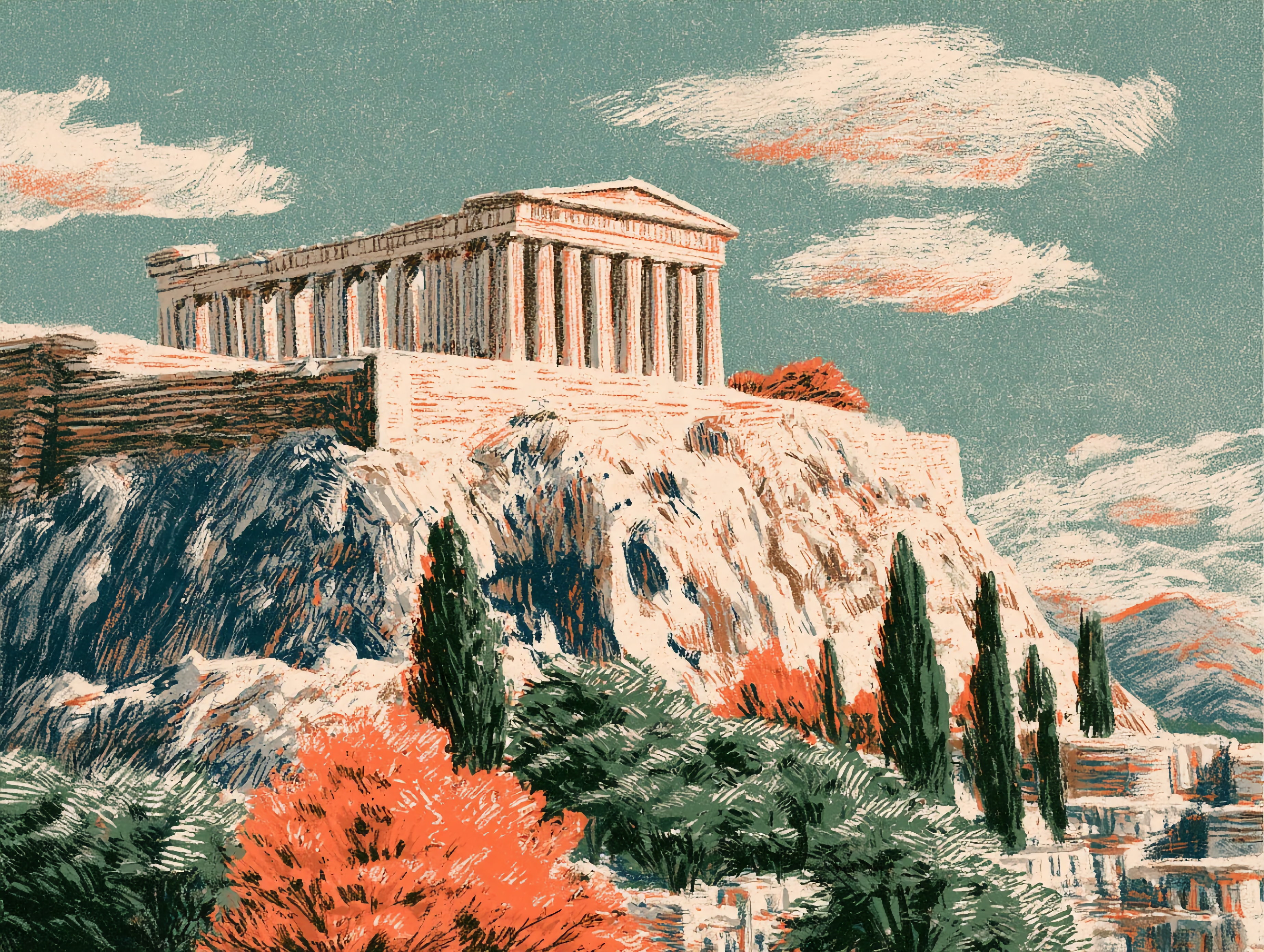
John Ma follows the Greek city-state across fifteen centuries and finds its prime not in the Athens of Pericles but in the centuries after about 350 BC. His history is learned, bold and hard going, and it sometimes takes the cities at their word.
John Ma, Polis: A New History of the Ancient Greek City-State from the Early Iron Age to the End of Antiquity. Princeton University Press, hardback 2024, paperback 2026. 713 pp., 71 illustrations, 16 maps. $29.95 / £25 (paperback).
Orientation
At a Glance
- The BookJohn Ma traces fifteen centuries of the Greek city-state, from its early beginnings to the end of civic self-government under Rome.
- The Central ArgumentThe polis reached its widest and most democratic form after about 350 BC, long after the supposed heyday of classical Athens.
- A New TimelineInscriptions and cities beyond Athens reveal a resilient civic culture that flourished alongside kings and empires.
- The VerdictAmbitious and demanding, the book redraws Greek history but sometimes leaves its key terms unclear. Readers new to the subject may prefer Hansen or Thonemann first.
Some time in the second half of the seventh century BC, the citizens of Dreros, a hill town in eastern Crete, had a law cut into stone. The blocks turned up in 1936 in a cistern dug centuries later, and they seem to have come from the wall of the town's temple of Apollo. After a heading that seems to invoke a god, the law declares, "The polis has decided", and what the polis decided was that no man who had served as its chief magistrate, the kosmos, might hold the office again within ten years. The oldest Greek law to survive on stone is a term limit. It is also, as John Ma points out, the first document in which the word polis appears (pp. 75–76). About AD 890, some fifteen centuries later, the Byzantine emperor Leo VI annulled a set of old laws on city councils "as having no legal force", since "all matters are entrusted to the care and administration of the Emperor". The councils had been hollow for centuries. The emperor was filing the death certificate.
Between those two documents lies the whole life of the Greek city-state, and the question of when it died has shaped the way its history is told. For a long time the answer was 338 BC, when Philip II of Macedon defeated Athens, Thebes and their allies at Chaironeia; after that, on the old view, the free city gave way to kings, and Greek history became a history of empires. In 1969 the French scholar of inscriptions Louis Robert objected that the Greek city "did not die at Chaironeia, nor under Alexander", nor at any point in the Hellenistic age that followed. The historians who have since worked through the thousands of inscriptions the cities left behind have largely come round to his view. Ma, professor of classics at Columbia, pushes Robert's objection to its limit.
His Polis does more than lengthen the city's life. It moves the city's prime from the Athens of Pericles and Thucydides to the two and a half centuries after about 350 BC, and it makes the case largely in the cities' own words, the decrees their citizens voted and set up in public. Ma reads those decrees with Aristotle at his elbow, treating the Politics not as a text from the twilight of the city-state but as "an invaluable witness situated at the start of the great convergence" (p. 217). The pairing is the book's great strength, since it lets Ma tell as one continuous story what others have told as several. It is also the source of its blind spots, because a historian who listens this closely to the cities will sometimes hear them as they wished to be heard. Ma knows it. He heads one section "Reading with the Grain of the Polis", calls the picture that emerges "a maximal account" (p. 251), and near the end of the book sets beside it a "bad polis" and a "worst polis", read against the grain. But in the narrative chapters, which carry the book's big claims, the cities' own words still do much of the work.
The Argument
Ma boils his story down to three moments (p. 407). The first is "the obscure leap to the state" in the seventh century BC, the second the Great Convergence of the late fourth century BC, and the third the long transformation of the polis from the fourth century AD. Within that span, he says, the six centuries between 300 BC and AD 300 are crucial. Filled out, the argument runs as follows. The Greek polis was not a brief classical miracle but a durable, adaptable way of governing that lasted more than a thousand years. It grew out of the Early Iron Age, when "community and would-be elite emerge at the same time" (p. 50), so that the tension between the few and the many was there from the start. In the fifth and early fourth centuries the great cities wore themselves out in a "Hundred Years' War" of empires and civil strife, and the polis's true classical age came afterwards. From about 350 BC, often with the backing of the Macedonian and Hellenistic kings, hundreds of cities settled on a common form built around autonomy and democracy, with councils, assemblies, public funds and a working bargain between the people and the rich. Under Rome it enjoyed an "Indian Summer" (150–86 BC) and then "a terrible first century BCE" (p. 269). Once the emperors ruled, it went on governing itself, and Rome, for reasons of its own, held the local rich to the old bargain, which kept them paying for public goods. The late Roman state then absorbed local government, and the polis ended, in Ma's words, "in two steps over 250 years (300–550 CE)" (p. 401). All along, the polis also shut people out — women, foreigners and slaves above all — and Ma insists that its achievements and its injustices belong to one story.
Introduction
The Book
Polis is a one-volume history of the Greek city-state across some fifteen hundred years, from the collapse of the Mycenaean palaces, the Bronze Age kingdoms of Greece, to the end of antiquity. It runs to 554 pages of text in seven parts and twenty chapters. Then come some sixty pages of endnotes, a chronology, a general map, a short index and a bibliography that Robin Rönnlund, reviewing the book for the American Journal of Archaeology, counted at 2,524 titles. Seventy-one illustrations and sixteen maps sit within the text. The evidence is above all epigraphic, meaning the decrees, laws, honours and letters that cities inscribed and set up in public. Archaeology is prominent in the early chapters, and literary witnesses appear throughout, from Homer and Hesiod to Aristotle, Polybios and the orator Dio of Prusa, whom Ma calls by his Roman name, Cocceianus Diōn.
Ma was born in New York to Chinese parents and grew up in Geneva, an old city-state in which he was, in his own phrase, "a metic of sorts", a resident foreigner (p. xv). The Preface draws two lessons from that childhood, the value of local history as an expression of autonomy and the "distorting effects" of difference and exclusion (p. xvi), and the book is built on both. He studied at Oxford, was a fellow of All Souls, taught at Princeton and spent some fifteen years at Corpus Christi College, Oxford, before moving to Columbia in 2015, where he chaired the classics department in 2024. His earlier books, Antiochos III and the Cities of Western Asia Minor (1999) and Statues and Cities (2013), study Hellenistic cities in their dealings with kings and benefactors, and Polis grows out of both.
The book began as the Eitner Lecture that Ma gave at Stanford in April 2011, under the title "Polis: The Greek City-State 800 BC–AD 600". The Preface traces the idea of a survey of civic culture "from soup to nuts" to conversations with the historian Josiah Ober, and Ma finished the manuscript on another visit to Stanford, in May 2023, at a conference in Ober's honour (p. xv). "It took me over 10 years to work those ideas out," he told Columbia News. He calls the result "a big neo-Aristotelian history based on a roster of detailed examples" and, more warmly, "a long love-letter to the discipline of ancient history" (p. xvii). The dedication reads simply "To Fergus", for the Roman historian Fergus Millar, who died in 2019 and whose work on empire and local communities runs through the book; it was the art historian Jaś Elsner who suggested it (p. xviii). "I wish I could have told him how much the book owes to him," Ma writes (p. xv).
Outline of the Book
The chapter titles and page ranges are the book's own.
Part I. in Search of Polis (Pp. 1–19)
Chapter 1. In Search of Polis (pp. 3–19). After an epigraph from Aristotle, the book opens with the goat decree of Herakleia, printed in Greek and in full translation. From it Ma draws the "three aspects" of the polis, as political form, social form and social relation, which "form the theme of the present book" (p. 8). Snapshots of Priene in 120 BC, Lete, Panopeus in AD 160 and Palmyra in AD 250 follow. Ma then builds his definition, from town to community to self-governing state (pp. 12–13), marks two disagreements with the Copenhagen Polis Centre, over autonomy and over time (p. 17), and states the thesis of a Great Convergence (p. 18).
Part II. Before the Polis: Possibilities, 1100–700 BCE (Pp. 21–68)
Part introduction (pp. 21–24). "'Beginnings' does not mean 'origins'" (p. 21). Ma sets aside the neat story of a proto-middle class present from the start, a story he thinks reflects its tellers' hopes. In its place he puts a "gradual, uncertain, obscure process" (p. 24) with two themes, integration at every level and the growth of elite and community together.
Chapter 2. To New Beginnings (pp. 25–50). From the Mycenaean palaces, the polis's first political Other, through their collapse to the Early Iron Age. The quiet Protogeometric period (about 1050–900 BC, named after its pottery) may have been "a bolt for freedom" (p. 30) that left elites weak and hierarchies shallow. Settlements were loose clustervilles led by competing Big Men, and after about 750 BC came growth, overseas contacts, temples staking out territory and the first communal takeovers of elite spaces (p. 49). The chapter ends on the claim that community and elite emerged together, each depending on the other (p. 50).
Chapter 3. Diversity and Community (pp. 51–68). Homer and Hesiod read as political texts. The epics show "a lordly society" beside "a very strong, explicit sense of community and public interests" (p. 51), the basileus, the local chief or "king", is a landowner rather than a feudal lord, and politics is "competitive conflict between Big Men" (p. 57). Ma's model is a "soft landing" after the palaces, leaving by 700 BC a "core geography" of perhaps 150 or more communities, each around a central site with rural shrines (p. 66). Yet he has "studiously avoided the word polis" (p. 68), since none of them had formal institutions of shared power.
Part III. Making the Polis: Coalescence, Community, and Justice, 675–450 BCE (Pp. 69–151)
Part introduction (pp. 69–74). A bronze law from Elis of about 500 BC, cut on the recycled support of an old tripod offering, stands for the move from tripod-dedicating chieftains to written law (p. 69). The central question is how, when and why the polis emerged (p. 72), and Ma warns against both teleology, the habit of reading history as a march towards a known end, and the "quaint" label "Archaic" (p. 72).
Chapter 4. Institutions, Community, Ideology: 1, 2, 3, Polis (pp. 75–99). An epigraph from Locke, "Government is everywhere antecedent to records", leads into the Dreros law, and Ma warns against "enthusiasm in seeing this document as the birth act of the polis" (p. 76), since a term limit implies rival and mistrustful elites. An archipelago of early institutions follows, from Mytilene and Ephesos to Athens and Sparta, whose Great Rhetra, the ordinance said to have founded its constitution, he calls a "retro-charter". Tribes and brotherhoods turn out to have been created with the polis, not inherited by it (p. 85), and communal dining and war helped to bind it together. The early polis, he argues, rested on three things, institutions and law, invented kinship, and images of unity (p. 94). Who the seventh-century polis was, a narrow urban elite or a wider body, remains unknown (p. 99).
Chapter 5. 600–450 BCE: Development, Complexification, and Citizenship (pp. 101–127). In the sixth century "the polis becomes much more visible" (p. 101). Stone temples, written laws, taxes and public goods, coinage, a sharper line between citizens and others, and networks of cities all show a state rather than a tribal society (p. 106). Aigina even paid a public doctor, Demokedes of Kroton, a talent a year (p. 111). Egalitarian norms tended towards forms "that could be called proto-democratic" (p. 124), and after Kleisthenes and ostracism the chapter asks, "A seventh century for the polis-hood, a sixth century for democracy?" (p. 126), before ending on what became of the old lords (p. 127).
Chapter 6. The Travails of Integration (pp. 128–151). Elites return to the story with their statues, drinking parties, feuds and tyrannies, from Alcaeus and Pittakos at Mytilene to the Peisistratids at Athens. "There was no aristocracy of birth," Ma insists (p. 132), only competing rich families. Integration raised the question of who the polis and its people were, and Ma sets out two answers, the closed polity and the open one (pp. 144–147), as "points on a continuum" (p. 149). Looking ahead, he writes, "the great question will be that of inclusion and exclusion" (p. 150).
Part IV. Framing the "Classical" Polis, 480–180 BCE (Pp. 153–257)
Part introduction (pp. 153–158). Two Lokrises open the part, the east dominated by Opous and its "Thousand", the west a web of small, equal poleis. "One of the models, the one represented by Western Lokris, won out" (p. 154), a pattern Ma credits to Adolf Wilhelm. He then names his two historical objects, a "Hundred Years' War" (c. 464–362 BC) and "a great convergence of polis forms" that produced a polis "centered around autonomy and democracy" (p. 157).
Chapter 7. Political History (1): Archē and Autonomia in the Hundred Years' War (pp. 159–178). An epigraph from Ober's Rise and Fall of Classical Greece sets the tone. Ma narrates the years 462–362 BC as one war for hegemony, in which the Athenian empire of the short fifth century was "a hyperpower with hegemonic ambitions" (p. 165) and the short fourth century saw Spartan, Athenian and Theban bids fail for lack of means. Against Hansen, who downgraded autonomy, Ma argues that "the whole tragic narrative of the Hundred Years proclaims its importance" (p. 176). The chapter ends with the economic boom that began in the mid-fourth century (p. 178).
Chapter 8. Political History (2): Politeia and Stasis (pp. 179–202). Inside the cities, beginning with the massacre of Corinth's peace party at a festival in 392 BC. Athenian democracy made a state that was "strong, but also thin" (p. 184), and democracy beyond Athens was common, with 109 democracies among 190 poleis by Hansen's count (pp. 189–190). Sparta's closed model shrank its citizen body, and classical oligarchy was "an explicit reaction to the self-aware practice of dēmokratia" (p. 198). Civil war raged at Corinth, Argos and Kerkyra, and democracy and oligarchy turn out to "belong to a same continuum of polis culture" (p. 200). The chapter ends with the temptation of tyranny.
Chapter 9. The Great Convergence (pp. 203–228). The heart of the book. An "infernal equation" of hegemony, autonomy and faction (p. 203) is broken by the Macedonian conquests of about 350–280 BC. Hegemony ends, oligarchy "died a double death" (p. 217), and democracy spreads with the kings' support, from Alexander's letter to Chios (p. 218) to the oath that bound Kalymna to Kos and its democracy (p. 221). Aristotle's Politics is read as a witness to the start of the process (p. 217). Ma grants that autonomy under the kings was often a legal fiction (p. 227) and closes by weighing the convergence's success against its cost (p. 228).
Chapter 10. The Qualities of the Polis (pp. 229–257). A portrait of the converged city in "the time of strong civic governance and agency" (p. 229), read with the grain. It covers myths of shared descent, public finance (including Teos's poll tax for a public doctor, p. 238), monthly assemblies in small places such as Iasos (p. 240) and pay for attending them (p. 243). It also covers the honorific decree with its "hortative clause", which urged others to imitate the honoured. Elites were checked by ideology, institutions and audit, and their giving belonged to the city's political economy, not to elite domination (pp. 249–250). Then Ma turns on his own picture, which he calls maximal (p. 251), with curse tablets, the unnamed "some men" who opposed decisions, and Herakleia's goat-raisers "cast beyond the pale" (p. 253). The chapter ends in Priene's agora.
Part v. Polis and Imperium, 180 BCE–400 CE (Pp. 259–402)
Part introduction (pp. 259–260). Idagras of Patara, honoured in the 30s BC as a model citizen, was also Marcus Antonius Idagras, a Roman citizen by grace of Mark Antony. If the polis did not end at Chaironeia, Ma asks, "what should we say of the battle of Aktion (31 BCE)" (p. 260)?
Chapter 11. The Indian Summer of the Polis (pp. 263–300). The chapter opens in 128/7 BC with a chorus of Athenian boys at Delphi praying for "the spear-crowned power of the Romans" (p. 263), then turns to Polybios, "contemporary, witness, and victim" of Rome's rise. Roman rule mixed violence, respect for the language of liberty and neglect, and neglect let civic life flourish in an Indian Summer of building, festivals, local wars and memory (p. 269). But freedom had become a status granted within Roman control, "a generalization of subordination, albeit masked by the vitality" of the cities (p. 294). Sulla's sack of Athens in 86 BC (p. 295) ended the ambiguity, and a harsh first century of tribute, moneylenders and dynasts' favourites followed.
Chapter 12. The Ends of Liberty (pp. 301–333). Under the emperors, from 31 BC to AD 284, the poleis remained real city-states, building, founding and governing themselves inside an empire of some sixty million people that co-opted them. Leagues became instruments of control, among them Hadrian's Panhellenion, "a peer-polity organization but on a vast scale" (p. 318). Cities bargained through petition and response (p. 325), sometimes "playing the emperor against the empire", as the Aphrodisians did (p. 331). Ma calls the result "a story of imperial power and local agency" (p. 333).
Chapter 13. Polis, People, and Power in the Roman Empire (pp. 334–367). Looking past what he calls "the glare of elitism", the forests of statues for senatorial benefactors, Ma argues "for taking constitutionalism seriously" (p. 334). Rome kept the cities' constitutions for three reasons (p. 361), and the local rich were caught in the tragedy of the elites. Dio of Prusa, read with the younger Pliny's letters, is the star witness (p. 362). Veyne's model of benefaction falls (p. 363), Herodes Atticus's grand giving is read as flight from civic pressure, and the chapter concludes that the colonnaded Roman city reflected a living democratic form, not a weak public sphere (p. 367).
Chapter 14. Cooptations, Prolongations, and Endings (pp. 368–402). "One did not need to be a Greek city to behave like one," runs the epigraph, from Lucinda Dirven, a scholar of the Roman Near East. In that region, at Kanatha, Gerasa and Palmyra, and in Roman Egypt, the polis spread as an instrument of Roman government, a "divine surprise" bought at the price of co-optation (p. 393). Then comes the end. The New Empire that followed the third-century crisis tightens its control, even as Orkistos in Phrygia petitions Constantine to be a polis again (p. 395). The assemblies fall silent by about 300, civic office vanishes in the fifth century (p. 396), and perhaps by the early sixth century the Late Roman city of councillors gives way to a Late Antique city of bishop, governor and "first men" (pp. 399–400). "The ancient city faded out of recognition" (p. 401), though Didyma became a polis under Justinian in 553 and Philadelpheia held out until 1390.
Part VI. Making Sense of Polis (Pp. 403–537)
Part introduction (pp. 403–408). A résumé of the whole narrative with its key terms in bold, "MY STORY for the polis looks like this" (p. 403), ending in the shortest version, three moments between 650 BC and AD 500 (p. 407). Ma calls his assumptions Aristotelian, defends them against newer views of the polis, and presents the next five chapters as "a set of rolling conclusions" (p. 408), each a different take on the same political form. The critical takes, he says, add up to "the costs of the Aristotelian polis" (p. 408).
Chapter 15. Polis as Society (pp. 409–437). Ma states his method, a narrative that assumes the unity of its subject and attends to "power, stateness, and institutions, on which other social phenomena are dependent" (p. 409). Pausanias on Panopeus is quoted in full (p. 410). The chapter's long argument is that subdivisions, rituals, performed identities, statuses and gender are functions of political institutions, metaphors for them rather than rivals (p. 432). Associations imitate civic forms, the polis produces civic capital, and the chapter ends by insisting that "we have never left the Aristotelian city of rich and poor" (p. 436).
Chapter 16. Polis as Ideals (pp. 439–458). The honours for Polemaios and Menippos at Klaros open a study of virtue politics (p. 439). Ma borrows John Rawls's terms for the polis's acceptable outcomes and Hannah Arendt's idea of power as collective action by consent (pp. 449–450), so that "We can speak of Arendtian politics on the island of Hērakleia" (p. 450). Castoriadis and Vernant, who saw in the polis the invention of politics, get a warier welcome, since Ma admires their idea of a self-instituting community but not their celebration of Greek uniqueness (pp. 452–453). Civic ideology, communitarian and often contradictory, mediates between unity and diversity but cannot abolish conflicts of interest (p. 458).
Chapter 17. Polis as Interests (pp. 459–479). "After a city of good intentions, we find ourselves in a city of interests" (p. 459), read with the tools of new institutional economics, the study of how rules shape choices. The polis regulates self-interested actors and solves problems of collective action, and Herakleia's goat ban becomes a textbook case (p. 462). Good institutions yield what Ober calls "Wealthy Hellas" (p. 469), and ideals and interests turn out to be "the same" (p. 478). The resulting picture looks, Ma admits, too good to be true (p. 479).
Chapter 18. Bad Polis: The Realities of Power (pp. 480–499). Under the heading "Forgetting 'Goldilocks'", Ma reads the polis against the grain for three "social bads", which are structural conflict and violence, power imbalances born of economic inequality, and exclusion (p. 480). He bids farewell to Aristotle's Politics for the moment, tests elite theory and Steven Lukes's three-dimensional view of power, and rejects "zombie oligarchism" (p. 489). The realist picture, he concludes, is a useful corrective that explains too little (p. 499).
Chapter 19. Worst Polis: Polis as Injustice (pp. 501–537). "La cité, ce mal nécessaire", the city, that necessary evil, wrote the historian Édouard Will to Philippe Gauthier in a letter that supplies the first epigraph (p. 501). The Herakleia decree returns as a document of exclusion, since only citizens decided for everyone on the island (p. 501). The chapter treats children first, among them the hundreds of infants whose remains were found in a well in the Athenian Agora (p. 502), then women, slaves, foreigners and the rural poor. It ends among the workshops at the foot of Priene's Teloneia cliff, which may have been a temporary labour zone or "a shadow of the polis", and with a restatement of the Aristotelian starting point (p. 537).
Part VII. Polis of Our Wishes (Pp. 539–554)
Chapter 20. Polis of Our Wishes (pp. 541–554). "How should we talk about the polis?" Ma's final picture is of a local community "organized as a republic with state-like powers", striving to keep its self-government, often at high cost to those outside it (p. 541). He sets it in world history, from Sumer to the medieval communes and Geneva, with "no direct link" to any of them (p. 545). Its reception runs from Hobbes to the American founders, who learned of the Lykian League through Montesquieu (p. 548), and to a French revolutionary's urgent request in 1793 for the laws of Minos (p. 549). Ma then reflects on his own place in the story, from 1989 to the United States after 2015 (pp. 550–551), and ends on a guarded sympathy for the polis (p. 552). After Volney's meditations at Palmyra, the book closes on the hill of Kastro on Irakleia, the site of ancient Herakleia, and on the words "political work" (p. 554).
The Case for and Against
The Case For
The book's reception since 2024 has been, for the most part, admiring, and it was one of History Today's books of the year and longlisted for the Runciman Award. Mischa Meier in Bryn Mawr Classical Review called it "a milestone" and one of the most important books in ancient history for years, and he traced its "enormous innovative power" not least to the new periodisation, its fresh division of Greek history into periods. Kostas Vlassopoulos, whose Unthinking the Greek Polis (2007) attacked polis-centred Greek history, called it in the American Historical Review "unquestionably the most significant contribution" to Greek history in two decades. Peter Thonemann's verdict in the TLS, as Princeton quotes it, was "history-writing at its very best".
Three achievements stand out, and the first is the periodisation. Michael Loy, in the Journal of Greek Archaeology, found the argument "convincing and well-argued, particularly in Ma's restructuring of fifth-century historical chronology". Fredrik Sixtensson, in the Swedish magazine Axess, found Ma entirely convincing on the point that, from the city-state's point of view, the classical age was really pre-classical. The second is the long view, in which Athens stops being the model, or as Victor Cojocaru put it in the Journal of Ancient History and Archaeology, the city "is never allowed to dominate the narrative as the normative model". The third is the book's honesty about its own subject. Meier counts the systematic Part VI as "one of the great strengths of the book", Woudhuysen praises "four disarmingly honest chapters", and Cojocaru notes that "coercion is not presented as an aberration, but as a structural feature of civic life". Beneath all three lies a mastery of the sources. "Ma really has mastered the voluminous evidence," wrote Woudhuysen, and a reader of the book soon sees why, since few pages pass without an inscription read closely and set in its place.
The reading for this guide bears the admirers out at the book's most original point. The tragedy of the elites turns a familiar picture on its head. Where Paul Veyne saw all-powerful benefactors giving on their own terms, Ma finds the rich of the Roman-era cities bound by the honours that legitimated them, policed by their rivals and shouted at by the assembly (pp. 361–365). Dio of Prusa, the grandest citizen of his town, was made to account for a building project by the governor, the younger Pliny, after Pliny had consulted the emperor (p. 363). Even Herodes Atticus, the richest Greek of his age, ended up answering the Athenians' charges before Marcus Aurelius (p. 366). The model explains what older accounts found puzzling, why councils and assemblies went on meeting and the rich went on paying through three centuries of monarchy.
The Case Against
The Oxford historian Rosalind Thomas reviewed the paperback in the London Review of Books (24 September 2026). She finds Ma's emphasis on statehood "compelling", but she also states the strongest objections most clearly, and she is not alone in making them. The first is that Ma never properly defines his two key words, autonomy and democracy, though he speaks, she grants, of the "ambiguities" of autonomy. Autonomy might mean anything from self-sufficiency, which she offers as a minimum, through living by one's own laws, to full sovereignty, and by the last standard, she observes, it is unclear that any Greek state apart from Athens or Macedon would qualify. Democracy might mean the radical Athenian kind or merely the machinery of council, assembly and courts. Sviatoslav Dmitriev in sehepunkte and Robin Rönnlund in the American Journal of Archaeology press the same complaint, Rönnlund confessing, "I fail to understand what Ma essentially means by democracy and democratic".
The documents show why the definitions matter, and Ma prints several of them himself. When Alexander wrote to Chios in 334 or 332 BC, he ordered that its government be a democracy, and the same letter, as Ma notes, imposed a garrison (p. 218), which the Chians were to pay for. In an oath that Ma cites three times (pp. 221, 228, 236), the citizens of Kos and of Kalymna, the island Kos had absorbed, swore to uphold the established democracy and, in the same breath, the friendship and alliance with King Ptolemy. Ma grants that such oaths "reflect the presence of royal power" (p. 228) and that autonomy under the kings was "often that of a legal fiction within the space of the kingdoms" (p. 227). What he does not quite say is what, on these terms, made a regime democratic. His gloss on autonomia, "self-government and determination—perhaps even republican government" (p. 176), shows the difficulty in a phrase, and his nearest thing to a criterion is the claim that the cities' institutions "prevented elite capture" and so protected "the democratic control and redistribution" (p. 251). The book says a great deal more about how Hellenistic democracy worked than about what made it democratic.
Thomas's second objection concerns the evidence itself. The inscriptions show what cities "wished to display", she writes, and they "surely masked the messy social and political manoeuvrings within the cities". A stone thanking a rich man for his devotion to the democracy will not show the favours he called in afterwards. Her own example, a list of donors to a grain fund at Iasos in Caria, repays a closer look. The donors gave, in her quotation, "wishing to increase the democracy as much as possible", which is Ma's translation (p. 251). Of that phrase, only the words for "wishing" and "democracy" can be read on the stone, and even they are broken. The words for "increase" and "further" are a restoration, an editor's informed guess at the missing letters, made by the Austrian epigraphist Adolf Wilhelm in 1932, and "as much as possible" stretches that "further" (epi pleion) a long way. Ma's text does not mark the gap. What survives is a subscription to pay for a grain distribution to all the citizens, a list of donors, and the word "democracy", which makes Thomas's point and Ma's at once. The rich paid, the people received, and the language of democracy framed the transaction.
Two further doubts run through Thomas's review. She thinks the Hellenistic peace overstated, since wars and imperial violence went on, though Ma's own claim is narrower, the end of "hegemony-centered big polis struggles" (p. 275). And she finds the leagues and federal states of the classical age undervalued, "for rather unclear reasons". Rönnlund's complaint is broader, for what strikes him most, he writes, is "how traditional it is", with an elite focus and a linear narrative inherited from the older histories.
Archaeologists, whose evidence does not depend on what the cities chose to say, press the point about decrees from another side. Even Loy, an admirer, grants that "material culture becomes more sidelined after chapter seven", and Rönnlund counts only three references to archaeological evidence in the Roman sections. His sharpest objection goes to the Indian Summer itself, which from an archaeological perspective, he writes, "was a period of rapid and dramatic urban and demographic decline". The coverage is uneven too. The western Greeks of Sicily and southern Italy, Ma concedes, drop out of his story after the third century BC, or at the latest the second (p. 368). Women's membership in the polis, in Rönnlund's account, is "reduced to the question of complementary priesthood and childbearing", though chapter 19 gives patriarchy a section of its own (p. 502). Late antiquity, as Meier observed, gets only a few pages, nine of them on the end itself (pp. 394–402).
Thomas's complaint about religion is the hardest to weigh. Missing from Ma's account, she writes, as from Aristotle's Politics, is "the vitality of cultural life and religious worship". None of the other reviews cited here makes the charge in those terms, though Arjan Zuiderhoek, in the journal Polis, asks whether the Aristotelian route is "the only imaginable route". The book does take in festivals, temple-building, ruler cult (the worship of kings as gods) and the religious life of the Indian Summer, so the charge is not one of neglect. It is one of rank, and there Ma is explicit. He defends his approach against newer views of the polis "as a religious commonwealth" (p. 407), and he treats the sacred itself as a metaphor for the community's interests (p. 432). It is a principled choice, and it buys the book its coherence. It also means that the gods appear chiefly as reflections and functions of civic life, which is not how most Greeks would have described them.
Then there is the prose, which Thomas calls "dense", with a jargon she calls "baroque". Woudhuysen counted three instances of "structuration" in one paragraph, and Paul Cartledge, in The New Criterion, admired "a meticulously researched, intensely reflexive, and engagingly written though hypertrophied tome" (Princeton's website quotes the praise and drops the tome). Woudhuysen, for one, also admires the close readings of inscriptions, in which "there is a lyricism to his descriptions of decrees". Several reviewers regret careless copy-editing, and a reader soon meets it, from the Copenhagen Inventory misnamed twice (pp. 17, 19) to the ecologist Garrett Hardin spelled "Garett" (p. 462). Even Ma's dates for his own periods wobble from chapter to chapter (see Notes on Sources). None of this touches the argument, but in a book so attentive to dates it jars.
Weighing the Two
Of all these objections, the one about definitions matters most, since the book's central claim depends on it. The objection about decrees is the price of a method that lets the cities speak for themselves, and Ma meets part of it himself. In chapter 18 he tests a realist history of elite power and finds it a useful "skeptical pause" but one with "poor explanatory power" as a whole account (p. 499), which makes his optimism argued rather than assumed. The objection about religion is answered only for readers who accept Ma's premise that politics comes first and religion expresses it, and the archaeological one lands hardest on the Roman chapters. The stylistic complaints are real but secondary, and coinages such as the Great Convergence and the Indian Summer look set to outlast the reviews that grumbled at them. Apart from Rönnlund, who doubts that a single history of "the polis" should be written at all and prefers "the poleis—in the plural", the critics argue on the ground Ma has marked out, which is itself a measure of what he has done.
Where the Book Sits
In some respects, as Thomas says, Polis is a monumental update of A. H. M. Jones's The Greek City from Alexander to Justinian (1940), which already refused to stop at Chaironeia. Half a century later Oswyn Murray and Simon Price edited The Greek City from Homer to Alexander (1990), whose contents included an essay by the historical sociologist W. G. Runciman titled "Doomed to Extinction: The Polis as an Evolutionary Dead-End". Ma covers both spans in one book, and his reply to Runciman is, in effect, that the dead end lasted more than a thousand years. His closest partner, and his sparring partner, is the Copenhagen Polis Centre, which gave the field its Inventory of Archaic and Classical Poleis (2004), and Mogens Herman Hansen's Polis (2006) remains the clearest short account of what a polis was. Ma's debt is larger than his disagreements suggest. The Preface offers "a unitary image of the polis similar to" Hansen's (p. xvii), the last chapter accepts Hansen's idea of a city-state culture (p. 543), and Ma describes his book as one that "largely responds to" the Copenhagen Centre (p. 551). What he adds, as Cojocaru put it, is a shift from what counted as a polis to "what the polis did over time". The book's nearest relative is Josiah Ober's The Rise and Fall of Classical Greece (2015), from the same publisher and quoted in the epigraph to chapter 7. The two make a good pair, one framed as a rise and fall, the other as a long life. For the world after Alexander, Thonemann's The Hellenistic Age (2016) and Angelos Chaniotis's Age of Conquests (2018) tell the political story that Ma's convergence assumes.
The book also takes sides in three running debates, and on autonomy it takes on the Copenhagen Centre directly. The Centre, which spent ten years (1993–2003) cataloguing 1,035 archaic and classical poleis, concluded that independence was not a defining feature, since many communities that Greeks called poleis were subject to Athens, Sparta, Persia or a league. Chaniotis summed up its thesis as the claim "that autonomia is not a requirement for polis-ness". Ma disagrees, and says so bluntly, writing at one point that Hansen "erroneously writes" (p. 212). He also quotes Cicero, who as governor of Cilicia mocked the Greeks' delight in judging their own cases, "Never mind—at least they think they have autonomia" (p. 298), and his book is in part an argument that they were not simply fooling themselves.
On Hellenistic democracy, Ma joins those who think it was real. Volker Grieb (2008) and Susanne Carlsson (2010) have argued as much, while a German volume of 2011 asked in its subtitle whether the rule of the people had given way to a rule of notables. Ma stands against the "death of democracy" after the classical age proposed by the Marxist historian G. E. M. de Ste. Croix and, more recently, by Paul Cartledge (p. 409), who reviewed Polis for The New Criterion.
On benefaction, he moves the argument on. Paul Veyne's Le pain et le cirque (Bread and Circuses, 1976) treated the giving of the rich as a system of government that ran around the city's institutions, and Philippe Gauthier (1985) replied that it became one only after about 150 BC. Ma would keep the word euergetism for the polis of the Roman Empire (p. 248), and even there he rejects Veyne's model, which "can no longer stand" (p. 363).
The City Laid Up in Heaven
What follows is this review's reflection, not Ma's argument. His guide is Aristotle rather than Plato, and the heavenly city lies outside his subject.
Ma's chronology nonetheless changes how the philosophers' city should be understood. A once-familiar story held that when the free city died at Chaironeia the Greeks turned inward, first to the consolations of philosophy and the citizenship of the world, then to a citizenship in heaven. If the polis flourished for centuries after 338, that story loses its premise. The cosmopolis, the Stoics' city of the world, and the heavenly city were not consolations for a lost home, since they were imagined by people who still lived in cities, voted in assemblies and paid for festivals. Zeno, who began teaching in Athens about 300 BC, dreamed in his Republic that people might live not in separate cities, each with its own rules of justice, but as members of one community (Plutarch, On the Fortune of Alexander 329a–b). He did so just as Ma's convergence was filling the Greek world with self-governing poleis.
Plato wrote the Republic in his middle years and the Laws at the end of his life, which ended in 348 or 347 BC, so that both were written among living cities, years before their supposed death at Chaironeia. At the close of Book IX of the Republic, Glaucon observes that the just city exists only in words and nowhere on earth. Socrates replies that "perhaps there is a pattern of it laid up in heaven" (592b, in Paul Shorey's translation), for anyone who wishes to see it and, seeing it, to settle himself there as its citizen. The verb for "laid up", anakeitai, is the ordinary word for an offering set up in a sanctuary, and the verb for that settling, katoikizein, belongs to the vocabulary of founding a colony. The Laws takes the thought to Crete, the island of the Dreros law. Its three old men walk from Knossos to the cave and temple of Zeus on a midsummer day, designing a colony of exactly 5,040 households, and the first word of the dialogue is theos, "god". "To whom do you ascribe the authorship of your legal arrangements, Strangers?" the Athenian asks. "To a god or to some man?" (624a, R. G. Bury's translation).
The Christians borrowed the city's own vocabulary. When Paul told the Christians of Philippi, a Roman colony, that "our conversation is in heaven" (Philippians 3:20, King James Version), the Greek noun was politeuma, which the Revised Standard Version renders "commonwealth" and the New Revised Standard Version "citizenship". It is the word Alexander used at Chios when he ordered that its politeuma should be a dēmos, and it could also mean a community of citizens living inside someone else's city, such as the Jews of Berenike in Cyrenaica, modern Benghazi. Hebrews says that Abraham "looked for a city which hath foundations, whose builder and maker is God" (11:10, King James Version). The Greek word for "maker", dēmiourgos, is Plato's word for the craftsman of the cosmos in the Timaeus, and in many Greek states it was also the title of a magistrate. An anonymous Christian writer of the second or third century put the paradox in one line. "They pass their days on earth, but they are citizens of heaven" (Epistle to Diognetus 5, in the Roberts–Donaldson translation).
Ma's fourteenth chapter, and the résumé that follows it, supply the institutional half of this story. The old polis's "close association with the pagan powers and the persecution of Christians", he writes, disqualified it in a Christian empire (p. 407). Yet Orkistos in Phrygia, pleading with Constantine to be a polis again, drew attention, in Ma's words, to "their fidelity to Christ" (p. 396), though the emperor's reply speaks only of "the most holy religion". By the sixth century the bishops "took over some of the roles of the civic elites", building from church funds for "the poor rather than the citizen body" (p. 400). Fergus Millar, for his part, found the old map of the poleis preserved in the lists of bishops at the church councils (p. 399). Outside Ma's pages, Aphrodisias, the city of Aphrodite in Caria, appears in the records by 680 as Stauropolis, the City of the Cross. Augustine, answering those who blamed the Christians for the Goths' sack of Rome in 410, gave the polis its last great theory. "Two cities have been formed by two loves," he wrote (City of God 14.28, in Marcus Dods's translation), the earthly city by love of self and the heavenly by love of God. Read beside Ma, the heavenly city looks less like an escape from the polis than its last colony.
Verdict
The Athenian of Plato's Laws asks whether a god or some man gave the Cretans their laws. Ma's answer is a third one, the polis itself, a community deciding for itself, and he defends it across fifteen centuries of evidence with a learning few historians could match. The Herakleiotes, he writes, did not call on an outside ruler to save their pasture, since "they were that sovereign" (p. 465). It is the right answer to the question he set himself, though the book never quite says what made that sovereign democratic, and that is the gap that matters most, since the Great Convergence is a convergence on democracy. The word carries the book. Even so, his Hundred Years' War, Great Convergence and Indian Summer will shape how Greek history is taught for a generation.
The book's second blind spot is where the cities put their decisions. The oldest surviving Greek law opens with what looks like an invocation of a god, and it probably stood on the wall of Apollo's temple. The book's own emblem, the goat decree, was sworn by a god whose name is mostly lost, Herakles in Ma's restoration and Zeus in the standard edition, and by "the other [gods] who hold sway over the island" (p. 4). It was inscribed by a sacred official and set up in the shrine of the Mother of the Gods. Ma notices all this, and he calls Herakles the island's tutelary deity (p. 230), but in his analysis the sacred serves the city, since "Sacrality is a metaphor for the interests of the community" (p. 432). The islanders might have put it the other way round. The polis decided, and it decided in the gods' house. Ma ends his book on the hill of Kastro above Irakleia's harbour, where no evening spectre came to lecture him, insisting that the meaning of the polis will be settled "not through revelation, illumination, or haunting, but through political work" (p. 554). A history that took the deciding and the gods' house equally seriously would be a different book. Until someone writes it, this is the history of the Greek city that every other will have to answer.
How to Read It
Readers new to Greek history should not start here, and Rönnlund's warning is fair, since the book, he writes, "largely reads like an introductory textbook", yet it demands "close intimacy with ancient geography, terminology, and history". David Stuttard, reviewing it for Classics for All, suggested that students and general classicists might wait for the thesis in "a more easily digestible form". Thonemann's short The Hellenistic Age or Hansen's Polis makes a better first step, and either can be read in a weekend.
For everyone else a selective route works, and Ma himself supplies the map. Read the Preface (pp. xv–xviii) for the book's origins and commitments, then the résumé that opens Part VI (pp. 403–407), which retells the whole story in five pages with its key terms in bold. Chapter 1 sets out the method through the goats of Herakleia and the snapshots of Priene, Panopeus and Palmyra. Chapter 9, "The Great Convergence", holds the central argument, chapter 10 the portrait of the converged city that the critics test, chapter 13 carries the argument into the Roman city, and the last nine pages of chapter 14 (pp. 394–402) tell the end. Chapters 18 and 19, on the bad and the worst polis, are the book's conscience, and the short final chapter shows what is at stake for the present. Parts II and III reward readers who enjoy archaeology, since the material evidence is richest there. Keep the chronology (pp. 623–626) and the general map to hand, and keep notes as you go, because the index is short.
Questions to Read With
- Was a Hellenistic "democracy" that paid for a king's garrison still a democracy, and what would count as evidence either way?
- Does calling the years 464–362 BC a "Hundred Years' War" clarify the classical age or flatten it?
- How much can decrees, which record what cities wished to display, tell us about how those cities really worked?
- When did the polis end, and does the answer depend on what one thinks a polis was?
- What did the polis owe its gods, and can religion be understood as a metaphor for civic interests?
- Is the polis a Greek invention, or one city-state culture among many?
- Were the polis's injustices, in Ma's own words, "a product of its setup, or part of the givens of the premodern world" (p. 542)?
Things You May Not Know
- Ma's emblematic city is known from one stone. The goat decree is "the only written artifact" from Herakleia (p. 8), and no remains of the shrine where it stood are known. The stone is now in the Archaeological Museum of Amorgos, and Giulia Nafissi published a revised text in 2025.
- Panopeus sits beside Chaironeia. Pausanias's famous doubt about what makes a polis concerns a town twenty stades, under four kilometres, from Chaironeia, whose battle was once supposed to have killed the polis.
- Most poleis were small. A quarter of them had territories of 25 km² or less, and about nine in ten of 500 km² or less (p. 13, drawing on Ober).
- The revolutionaries sent for Minos. On 7 June 1793 Hérault de Séchelles, charged with drafting a new French constitution, asked the Bibliothèque nationale to send him "the laws of Minos" at once. "Our need is urgent," he added (p. 549). Sviatoslav Dmitriev notes drily that Minos's laws were never polis regulations.
- The US House owes something to Lykia. Ma notes that proportional representation in the House of Representatives was inspired, by way of Montesquieu, by the Lykian League of the second century BC (p. 548), whose cities cast three, two or one votes according to their size (Strabo 14.3.3).
- Paros buried its war dead together. A mass grave of the late eighth century BC by the harbour of Paroikia held, in two pits, the cremated remains of a band of fighters. The counts vary. Ma gives 150 young men in as many amphoras (pp. 66–67), the LRB 120 men in 140 urns, and a later study of the bones about 118 people, aged roughly 16 to 60, one of them a woman. Ma calls the reading of the grave as proof of a proto-democratic ethos "overstated and teleological" (p. 67).
- Aphrodisias ended with a witness list. The last datable secular public inscription from the city, of about 641, is not a decree of council and people but a witness list to a legal process, probably over a will, confirmed by an imperial judge.
- Hadrian vouched for Naryka. A bronze letter of early AD 138, perhaps the emperor's last public letter and now in the Louvre, assures this small Lokrian town, which Ma calls Narykos (pp. 311, 395), that no one could dispute its standing as a polis. Its proofs include seats in the Amphictyony, the league that ran the sanctuary at Delphi, and in the Boeotian League, a council, magistrates, priests and Greek tribes, a delegate to Hadrian's Panhellenion, and poets who named heroes as setting out from the town.
- Ma's ideal dinner guests would be the historian Mikhail Rostovtzeff, the epigraphist Adolf Wilhelm and the archaeologist Fanette Laubenheimer, on whose excavation in southern France he volunteered as a teenager.
The Thesis and Its Claims
In a sentence, the thesis is that the polis was a durable political form whose prime came between about 350 and 100 BC rather than in the fifth century, and it rests on ten claims.
- One definition fits every polis. Ma argues "that the polis can be defined with a unitary definition" (pp. 12–13), one roomy enough to admit ambiguities. It starts from a town, "an urban settlement of contiguous habitations" (p. 13), adds a named community with its territory, and ends with self-government, since the difference between a polis and a village "was one of sovereignty, not of settlement size" (p. 13).
- A polis has three faces. It is a political form, made of decision-making, law and ideology, and a social form, a society of smallholders free of any landlord but bound by limits they set together. It is also a social relation, a community of adult male citizens set within a larger population of women, children, foreigners and slaves (p. 8). Of tiny Herakleia, the Cycladic island whose goat decree opens the book, he writes, "It regulates itself; it can take independent decisions in deliberative assembly" (p. 6).
- The polis took shape slowly. Ma separates beginnings from origins (p. 21). Elite and community grew up together in the Early Iron Age, and the leap to statehood came in the seventh century, perhaps "before the appearance of written law" (p. 79).
- The fifth century was an age of war. From about 464 to 362 BC Athens, Sparta and later Thebes fought abroad for hegemony, the leadership of other states, while factions at home fought for control of institutions, in what Ma calls "a total event" (p. 157) that ended "with confusion and exhaustion" (p. 160).
- The true classical polis came later. The Great Convergence, "starting ca. 350 BCE", produced "a relatively uniform, stable organism centered on communitarian, democratic forms" (p. 18). Its first stage ran from about 350 to 280 BC (p. 222), and the years 350–100 BC make up a "long classical" period (p. 18).
- Hellenistic democracy was real. The kings underwrote it rather than smothering it, in what Ma calls "royal support for democracy" (p. 219), and inside the cities "The ideological and institutional setup prevented elite capture" (p. 251).
- Autonomy belongs in the definition. Against the Copenhagen Polis Centre, Mogens Herman Hansen's great survey of the early city-states, the book "diverges from the Copenhagen version in placing autonomy at the heart of any definition" (p. 17), and it argues that "Aristotle was correct" to put it there (p. 208).
- Rome prolonged the polis. After the Indian Summer, Rome reduced almost every city to subordinate status (p. 295), yet it kept their constitutions alive for three reasons (p. 361). It liked to leave local polities alone as a condition of consent, it needed the local rich visible and taxable, and, decisively, it inherited "the democratic tendencies of the Roman Republic". The rich were caught in what Ma calls a "tragedy of the elites", since the very means by which they claimed power locked them into "constant contributions to public goods" (p. 361). The Roman-era city was therefore "a reflection of the continued vitality of the polis as democratic form" (p. 367).
- The end was administrative. The late Roman state took over local government. The last honorific decrees and assembly meetings "must have happened", Ma reckons, at the end of the third century AD, civic office vanished during the fifth (p. 396), and by the sixth century the citizen had given way to "a concept of mere inhabitant" (p. 400).
- The polis was also unjust. It was, he writes, "a patriarchy, an enslavement society, a nativist organization", and a polity haunted by the model of an urban aristocracy (p. 502). An honest history must hold its achievements and exclusions together, and at the end Ma allows himself only "a measure of cautious sympathy" for the forms of the polis (p. 552).
Other Core Ideas
- Stateness. Ma argues for "the centrality of stateness as a definitional characteristic of the polis" (p. 15), meaning institutions, law, public money and the power to compel. In the summary of the Romanian historian Victor Cojocaru, his polis is "an entity that legislates, judges, taxes, coerces, wages war, and claims legitimate authority".
- The few and the many. The relation between elites and everyone else is, in the phrase of the German historian Mischa Meier, "a leitmotif of the book". Ma calls it "the central question of my history" (p. 454), namely why the rich accepted the burdens of office and taxation, and he follows it from the "Big Men" of the Iron Age to the tragedy of the elites under Rome.
- Cities shaping cities. The converged polis spread through "peer-polity interaction", the "mutual recognition by actors in a system of poleis" (pp. 9–10), carried by envoys, festivals, arbitrations and grants of asylia, inviolability for a city or shrine.
- Lumping, not splitting. Ma calls his method "a work of 'lumping' rather than 'splitting'" (p. xvi), joining cases into one story rather than dividing them. His history is "narrative and descriptive" rather than driven by a model of explanation such as rational choice (p. 409), and its unit is the small case worked until it lights up a large question. He learned that, he says, from Robin Osborne's book on the Greek countryside, with its goats, and from Simon Hornblower's undergraduate class on the polis (p. xv).
- Aristotle as guide. "The assumptions in this book have been Aristotelian," Ma writes, "privileging questions of access to political power" (p. 407). His word for the converged polis, "communitarian", describes a civic life that treats public things as public and publicness as good in itself (p. 244).
- Religion and ritual as functions. In the analytical chapters Ma treats the city's tribes and other subdivisions, its rituals, the identities its citizens acted out and its rules of gender as functions of political institutions, and "these functions were metaphorical, and hence ideological" (p. 432). Ritual is the polis's "mirror image" (p. 436). Ma defends this approach against newer views of the polis "as a religious commonwealth" or a network of associations (p. 407).
- The polis inside empires. From Persia to Rome the polis almost always lived under a larger power. Ma adopts Fergus Millar's "petition-and-response" model of Roman government (p. 325), in which the cities, though co-opted, made themselves "the privileged interlocutor of the imperial state" (p. 406).
- Exclusion as a condition of membership. Citizenship defined itself against women, foreigners and slaves, and Ma treats exclusion as "one of the constitutive elements of membership" (p. 480).
- The polis in world history. Ma accepts that the poleis formed "a city-state culture or civilization, as defined by Hansen" (p. 543) and sets them beside Sumer, Phoenicia, early India and the medieval communes. Their history, he writes, is "a discovery (and consolidation) of democracy, not the discovery of democracy" (p. 544). George Woudhuysen, reviewing the book in The Critic, notes Ma's insistence that the polis's importance was "not distinctively Greek, let alone Western", and sees "a real tension" between that and Ma's wish to show the Greek city as distinctive.
Key Words, Figures and Parables
Key Words
- Polis (plural poleis). A self-governing Greek community, town and territory together, usually translated "city-state". The Cambridge historian Paul Cartledge prefers "citizen-state", since many poleis were barely urban.
- Archaic, classical, Hellenistic. The conventional periods of Greek history, roughly 750–480, 480–323 and 323–31 BC. Ma puts the labels in quotation marks and redraws them.
- Politēs, politeia, politeuma. A citizen; the constitution, or the body of citizens; and the governing body of a city, the word Alexander used when he told Chios that its government was to be a democracy.
- Dēmos, dēmokratia. The people, especially the citizens in assembly; and rule by the people. From the late fourth century BC dēmokratia became the standard name for a self-governing city, though whether it still meant rule by the people is disputed.
- Polis eleuthera kai dēmokratoumenē. "A free and democratically governed city", the norm of the Hellenistic centuries in Ma's account (pp. 222, 478).
- Boulē and ekklēsia. The council that prepared business and the assembly of citizens that voted on it.
- Psēphisma. A decree, literally a thing decided by pebble-vote. Most of Ma's evidence consists of decrees inscribed on stone.
- Koinon. "What is shared", meaning the community as a whole, or a league of communities.
- Archē. Rule or empire, as in the Athenian archē of the fifth century.
- Autonomia. Living by one's own laws. Ma glosses it as "self-government and determination—perhaps even republican government" (p. 176), and whether a polis needed it is one of the book's arguments.
- Autarkeia. Self-sufficiency, which for Aristotle is the goal the polis exists to reach, the state of having enough to live well. It should not be confused with autarchia, self-rule.
- Stasis. Civil strife between factions inside a city.
- Leitourgia. A "liturgy", a public service such as a festival chorus or a warship paid for by a rich citizen.
- Euergetism. From euergetēs, "benefactor". Historians' term for the giving of the rich to their cities and the honours they received in return.
- New Empire. Historians' name, which Ma adopts, for the late Roman state as reorganised after the crisis of the third century AD, whose reforms "tightened the Roman state's control over the local communities" (p. 395).
- Perioikoi and helots. The "dwellers around" Sparta, free but without Spartan citizenship; and the unfree population of Laconia and Messenia who worked Spartan land.
- Sympoliteia and homopoliteia. Unions of two or more communities into a single citizen body.
- Kosmos. The chief magistrate of a Cretan city, the office limited by the law of Dreros.
- Epigraphy. The study of inscriptions, the main evidence for most poleis.
Ma's Coinages
- Clustervilles. The loose groupings of small settlements with no clear centre in the Early Iron Age, out of which poleis grew (p. 32).
- Big Men. An anthropologists' term for leaders whose standing rests on wealth, feasting and followers rather than on office (p. 34). Ma's early Greece is a world of rival Big Men and weak hierarchies.
- The obscure leap to statehood. The move, around 675 BC, to institutions, written law and yearly magistrates (p. 403), a process that, Ma warns, "will always be very obscure" (p. 99).
- Closed and open polities. Ma's two archaic answers to the question of membership (p. 144). Closed polities, best known from Sparta and the Cretan cities, consolidated a small group of stakeholders, while open ones, such as Solon's Athens, took in the free population. Ma treats the two as ends of a range rather than boxes.
- Hundred Years' War. The century of hegemonic wars and civil strife from about 464 to 362 BC (p. 157), the age usually called classical, though Ma's own dates for it vary (see Notes on Sources). The name borrows the Anglo-French wars of the fourteenth and fifteenth centuries.
- The short fifth and short fourth centuries. Ma's two halves of that war, the Athenian century of 478–404 and the failed hegemonies of 404–362 (pp. 161, 167).
- The infernal equation. The loop of hegemony, autonomy and faction in which the desire for hegemony drew great powers into the politics of small cities (pp. 203–204).
- Great Convergence. The process, starting about 350 BC, by which poleis across the eastern Mediterranean came to share a democratic form (p. 18).
- Long classical period. The years 350–100 BC, when the converged polis was the normal form of political life (p. 18).
- End of history. A knowingly borrowed label for the stable world of the converged polis, "modeled, self-consciously and uneasily" on the political scientist Francis Fukuyama's claim that liberal democracy is the end point of political development (p. 454).
- Indian Summer. The late flowering of the poleis under a distant and often neglectful Rome, 150–86 BC (p. 269). The phrase means a warm spell after the first frosts, and the end date is the year Sulla sacked Athens (p. 295).
- The trap of Roman power. Freedom turned into a status granted within Roman control, "a generalization of subordination" (p. 294).
- Tragedy of the elites. The way the local rich were trapped by their own claims to status, bound to pay for public goods and to hold one another in check (pp. 361, 467). The phrase echoes the "tragedy of the commons", the ruin of a shared resource by users who each take too much, which Ma finds at Herakleia (p. 462).
- Leitourgical trap. The web of public duties that bound the rich to their cities. Lavish giving on the donor's own terms was an attempt at escape, but it never broke free of "the gravity of the polis model" (p. 364).
- Late Roman and Late Antique city. The first, run by councils of hereditary councillors, was the last stable form of the old bargains. Perhaps by the early sixth century it had given way to the second, run by "the bishop, the governor, and the 'first men'" (p. 400).
- Civic society and civil society. The first is the society of citizens organised around the dēmos, the second the wider web of people and associations within the polis's borders (p. 16).
- Civic capital. A loan-translation of "social capital", for the credibility and benefits that the polis's rituals and subdivisions gave its stakeholders (p. 433).
- Virtue politics. A politics centred, at least ostensibly, on morally approved actions and attitudes, the script of every honorific decree (p. 439).
- Goldilocks polis. The too-good-to-be-true picture of the polis as a "great society where everything is just right" (p. 479), which the last chapters put to the test.
- Zombie oligarchism. The claim, which Ma rejects, that elites "really" controlled everything behind a democratic facade (p. 489).
- Bad polis, worst polis. The polis as a structure of power, and as a structure of injustice (chapters 18 and 19).
- Polis of our wishes. The title of the last part and chapter, not a phrase Ma uses in his text. It names the idealised city that modern readers, Ma included, are tempted to project onto the ancient one, and he concedes that his own account may have slipped into "a wishful mode" (p. 550).
Figures
- Aristotle (384–322 BC). The book's guide. His definition of the human being as a creature of the citizen community supplies the first epigraph (p. 3), and Ma reads the Politics as the work of a witness to the Great Convergence.
- Louis Robert (1904–1985). The French epigraphist who wrote that the city did not die at Chaironeia, and whose article on the goats of Herakleia Ma calls "luminous" (p. 4).
- Adolf Wilhelm (1864–1950). The Austrian epigraphist who first saw the West Lokrian pattern that later spread across the Greek world (pp. 154–155), and whom the Preface pairs with Robert as the great epigraphists who showed what inscriptions could do for political and social history (p. xvi).
- Philippe Gauthier (1935–2013). The French historian of civic benefactors whose Les cités grecques et leurs bienfaiteurs (The Greek Cities and Their Benefactors, 1985) answered Paul Veyne, and whose teaching, Ma says, showed him the importance of the post-classical polis (pp. xv, 157).
- Fergus Millar (1935–2019). The historian of the Roman Empire to whom the book is dedicated, and whose "petition-and-response" model of imperial government Ma adopts (p. 325).
- Josiah Ober. The historian of Athenian democracy whose Mass and Elite in Democratic Athens (1989) has, Ma writes, "a fire of democratic confidence and optimism" at its heart (p. xv).
- Mogens Herman Hansen. Director of the Copenhagen Polis Centre. Ma shares his "unitary image of the polis" (p. xvii) and his idea of a city-state culture (p. 543), but not his view of autonomy (see Where the Book Sits).
- Homer, Hesiod, Alcaeus, Tyrtaios and Solon. The early poets, read as political witnesses to the making of the polis.
- Philip II and Alexander. The Macedonian conquerors. Ma treats the Macedonian conquests of about 350–280 BC, which ran on past Alexander's death, as "a major historical watershed" (p. 205) rather than an ending. Alexander's letter to Chios is one of the book's key documents.
- The Hellenistic kings. The Antigonid, Seleucid and Ptolemaic dynasties, whose power capped the ambitions of the great cities and, in Ma's account, made the convergence possible.
- Polybios (c. 200–c. 118 BC). The Greek historian of Rome's rise, who lived through the Roman takeover he described, and whose fears for Greek freedom Ma sees realised (p. 294).
- Dio of Prusa (Cocceianus Diōn). The orator of the late first and early second centuries AD, whose speeches, with the younger Pliny's letters, are "the most vivid confirmation" of the tragedy of the elites (p. 362). Ma reads him critically, as a benefactor who "proves averse to accountability" (p. 363).
- Herodes Atticus. The fabulously rich Athenian of the second century AD, whose building on his own terms Ma reads as "a flight mechanism" from civic pressure (p. 363).
- G. E. M. de Ste. Croix and Paul Veyne. Two great foils. The Marxist historian de Ste. Croix saw the "destruction of democracy" after the classical age (p. 334), and the French historian Veyne read benefaction as the free giving of all-powerful elites, a model Ma rejects (p. 363).
- Hannah Arendt and John Rawls. Modern theorists whom Ma borrows as lenses in chapter 16. "To use a concept defined by H. Arendt, the polis is based on power" (p. 450), and its choices "can be analyzed in the terms defined by J. Rawls" (p. 449).
- Cornelius Castoriadis and Jean-Pierre Vernant. Theorists of a Greek "invention of politics" (p. 452). Ma borrows Castoriadis's idea of the polis as a self-instituting community (pp. 13, 465) but distances himself from accounts "all too willing to celebrate, reflexively" the polis's uniqueness (pp. 551–552).
- The bishops. "The bishops took over some of the roles of the civic elites" (p. 400), from embassies to the emperor to building for the poor.
Places
- Herakleia (modern Irakleia). A tiny island in the Small Cyclades, south of Naxos, of 18 km² with one good spring (p. 8). Its decree banning goats, of about 270 BC, opens the book, and the hill of Kastro above its harbour, probably the site of the ancient town, closes it (p. 554).
- Dreros. The Cretan town whose law of the seventh century BC opens chapter 4.
- Priene. A planned city in western Asia Minor, rebuilt about 350 BC on a grid of 40 hectares, with a territory of some 450 km² (pp. 8–9). Ma calls its agora "a very Aristotelian statement" (p. 255) and notes the subordinate villagers of its plain (p. 502).
- Panopeus. A small town in Phokis, twenty stades (under four kilometres) from Chaironeia, whose status as a polis the travel writer Pausanias doubted in the second century AD.
- Lete. A Macedonian town that had become a polis, with a people, a council and an agora, by the late second century BC (pp. 10–11).
- Palmyra. The Syrian caravan city that became, under Rome, a polis with a council and assembly, and that shows for Ma "the normalcy, rather than hybridity, of the polis" in the Roman Near East (p. 406).
- Athens and Sparta. The famous pair, deliberately demoted. Athens is one democracy among many, and Sparta the best-known closed polity.
- Kolophon. An Ionian city whose honours for the benefactors Polemaios and Menippos, set up at the oracle of Klaros in the late second century BC, recur through the book (pp. 269, 294, 439).
- Teos. An Ionian city that taxed productive activity in its territory and levied a poll tax on all its inhabitants to pay for a public doctor (p. 238).
- Iasos. A Carian city whose assembly met monthly and, by the early third century BC, paid those who attended (pp. 240, 243).
- Chios. The island city to which Alexander wrote ordering a democracy and imposing a garrison (p. 218).
- Kos and Kalymna. Neighbouring islands united in a single citizen body. Ma cites their oath to the democracy three times (pp. 221, 228, 236), presenting it as the Kalymnians' oath on joining Kos under "an unequal alliance with Ptolemy II" (p. 228).
- Orkistos. A Phrygian town that in the 320s petitioned Constantine to be a polis again rather than a village of its neighbour (p. 395).
- Aphrodisias. The Carian city whose archive wall of imperial letters shows petition and response at work, and which knew how to play one Roman authority against another (p. 331).
- Kanatha and Gerasa. Cities of the Roman Near East, in modern Syria and Jordan, where Ma follows the polis model beyond the Greek world (pp. 368–381).
- Didyma and Philadelpheia. The first became a city, as Ioustinianoupolis, under Justinian in 553 (p. 401). The second, in Lydia, was "the last free city in Western Asia Minor" when it fell to the Ottomans in 1390 (p. 402).
Parables and Analogies
- The goats of Herakleia. The book's parable, retold in each of its last chapters. A small community of citizens meets, decides, swears an oath and pledges to enforce its decision, and everyone else on the island — women, children, foreigners and slaves — lives under it. Ma reads it in turn as power exercised by consent (p. 450) and as "literally a textbook case of the 'tragedy of the commons'" (p. 462). It then becomes a community acting as its own sovereign (p. 465), a process in the hands of one group of stakeholders (p. 481), and a fiction of solidarity that covers exclusion (p. 502).
- Pausanias at Panopeus. Pausanias wondered whether a town could be called a city when it had "no government offices, no gymnasium, no theater, no market-place, no water descending to a fountain" and its people lived in shelters like mountain cabins. Yet, he conceded, "they have boundaries with their neighbors, and even send delegates to the Phocian assembly" (10.4.1, W. H. S. Jones's translation). Ma quotes the passage in full (p. 410) as a warning against treating polis-hood as a checklist of buildings, since the concession makes the polis a political status that its peers recognise.
- The Hundred Years' War. Ma's analogy is exact enough to cast. Athens and Sparta play the English and French royal houses, the Plantagenets and the Valois; Thebes, Arkadia and Thessaly play Burgundy, Brittany and Spain; and the lesson is "the temptation of empire and its costs in an age of world war" (p. 160).
- Volney's ghost. The French traveller Volney (1757–1820) opens Les Ruines (The Ruins, 1791) at sunset among the columns of Palmyra, where a spectre lectures him on the rise and fall of nations (pp. 552–553). Ma, who admits ("alas") that his pages on Palmyra rest on no visit to the site, reports that "no evening specter came to lecture me" (p. 554), and ends instead on political work.
Further Reading
- Mogens Herman Hansen, Polis: An Introduction to the Ancient Greek City-State (Oxford, 2006). The Copenhagen Centre's findings in brief, and the best place to start.
- Peter Thonemann, The Hellenistic Age (Oxford, 2016). A short, lively introduction to the world of Ma's convergence, with Priene as a case study.
- Angelos Chaniotis, Age of Conquests: The Greek World from Alexander to Hadrian (Harvard, 2018). A narrative of the "long Hellenistic Age" that, like Ma, refuses to stop at 31 BC.
- Josiah Ober, The Rise and Fall of Classical Greece (Princeton, 2015). The economic case for classical Greece's flourishing, and Ma's natural companion and foil.
- Kostas Vlassopoulos, Unthinking the Greek Polis (Cambridge, 2007). The case against writing Greek history around the polis.
- Fergus Millar, The Emperor in the Roman World (London, 1977). The source of the petition-and-response model that shapes Ma's Roman chapters, and, in Ma's words, "also an essay on the Greek city" (p. 325).
- A. H. M. Jones, The Greek City from Alexander to Justinian (Oxford, 1940). The book Polis most resembles, from an earlier age of scholarship.
- J. H. W. G. Liebeschuetz, The Decline and Fall of the Roman City (Oxford, 2001). What happened to the cities between AD 400 and 750.
- Peter Brown, Power and Persuasion in Late Antiquity (Wisconsin, 1992). How bishops took over from philosophers as the conscience of the late Roman city.
- John Ma, Statues and Cities (Oxford, 2013). Ma's earlier book on honorific statues and the civic self-image.
- Rosalind Thomas, "After Chaironeia", London Review of Books 48.17 (24 September 2026). The sharpest short critique of the book.
Source ApparatusNotes
Notes on Sources
How this guide was written. The guide rests on a reading of the book itself in the Kindle edition, read on screen and selectively rather than cover to cover. The Preface, chapter 1, the part introductions, the last nine pages of chapter 14 (pp. 394–402) and all of chapter 20 were read in full. So were the opening and closing pages of every other chapter and a number of key pages elsewhere, among them pp. 66–67, 79, 217–222, 227–228, 238, 250–251, 294–295, 361–363, 395–396, 432, 449–454 and 462. About ninety searches of the text checked names, phrases and page numbers, and a second round of checks after drafting confirmed the passages on which the guide's criticisms rest. The middles of several chapters were only skimmed, and the endnotes were not read. Page numbers are the print pages that the Kindle edition displays, and reviewers' page references to the 2024 hardback match them. Quotations of Ma are short and verbatim, and everything else about the book is paraphrase. Reviews are cited for their own judgments, from Mischa Meier (BMCR), Sviatoslav Dmitriev (sehepunkte), Robin Rönnlund (AJA), Arjan Zuiderhoek (Polis), Michael Loy (Journal of Greek Archaeology) and the others listed below.
Translations. The Dreros law is quoted in Michael Gagarin and Paula Perlman's translation, and Leo VI's novel in S. P. Scott's. The quotation from Louis Robert is translated from his French (Comptes rendus de l'Académie des Inscriptions, 1969, p. 42, as quoted by Christian Mann). The Kos oath, the Iasos inscription, Zeno's Republic as Plutarch reports it, and Sixtensson's Swedish are paraphrased for this guide. The Herakleia oath and Cicero's remark (To Atticus 6.1.15) are quoted in Ma's own translations. Other translations are named where they are quoted.
Notes on the LRB review and on the book.
- The author of The Greek City (1940) is A. H. M. Jones, not "A.M.H." Jones.
- Thomas writes autarchia, which means self-rule; Aristotle's word for self-sufficiency is autarkeia. Her gloss is fair, since Aristotle wanted a territory that "bears every sort of produce" (Politics 1326b), though he also called imports and exports "indispensable" (1327a, both in Rackham's translation).
- The Iasos phrase "wishing to increase the democracy as much as possible" is Ma's translation (p. 251), which Thomas quotes faithfully. It renders a restored phrase, epi pleion auxein, "to increase further", supplied by Adolf Wilhelm in 1932, and the book's text does not mark the restoration.
- The review's account of the Kos–Kalymna oath follows the book, which presents it as the oath of the Kalymnians on joining Kos (pp. 221, 228, 236) and ties it to "an unequal alliance with Ptolemy II" (p. 228). The inscription itself (IG XII 4, 1, 152) is dated by its latest editors to about 208 BC, when the king would have been Ptolemy IV. It concerns the restoration of an existing union, and all the citizens swore it, those on Kos and those on Kalymna.
Reviewers corrected by the book. David Stuttard reports that Teos imposed a poll tax "thanks to which all citizens had access to a doctor". The book says that all inhabitants, not only citizens, paid a poll tax that financed a public doctor (p. 238), which is not quite the same thing. Dmitriev says that the drafters of the French constitution of 1793 tried to use the laws of Minos. The book reports a request for them (p. 549), not their use.
The book's own inconsistencies. The Hundred Years' War is dated c. 464–362 (p. 157), 462–362 "or 357, or 355" (p. 160), 464–355 (p. 405) and 460–360 (p. 467, with "a tragic century or so" of the same dates on p. 409). The "long classical" period is 350 BC–AD 300 in the Preface (p. xvi) but 350–100 BC in chapter 1 (p. 18). The Herakleia decree is dated c. 270 BC (p. 3) and c. 250 BC (p. 409). The end of the polis comes in "two steps over 250 years (300–550 CE)" (p. 401), while the résumé ends the story in the late seventh century and gives its span as 650 BC to AD 500 (p. 407). Smaller slips include the Inventory of Archaic and Greek Poleis for Archaic and Classical (pp. 17, 19), "Garett" Hardin (p. 462) and "M. Putnam" (p. 433) beside the correct "R. Putnam" (p. 471). Engels's Origin of the Family is dated 1881 instead of 1884 (p. 501), a cross-reference to "chapter 15" should read 14 (p. 260), and the Milesian notable who led resistance in the third-century crisis is Markianos on p. 333 but apparently Makarios on p. 395.
Open questions. Ma credits the Copenhagen Inventory with 1,284 examples of the polis (p. 17), while the LRB, like the Inventory's reviewers, speaks of 1,035; the two figures may count different things. It is not known whether the 2026 paperback corrects the slips listed above.
Editions. Hardback, June 2024 (US) and July 2024 (UK), ISBN 978-0-691-15538-8. Paperback, 28 April 2026, ISBN 978-0-691-26003-7. Ebook ISBN 978-0-691-25548-4.
Sources
- John Ma, Polis (Princeton University Press, 2024), Kindle edition, read for this guide
- Princeton University Press, Polis (paperback page)
- Princeton University Press, free sample (contents, chapter 1, index)
- Project MUSE, Polis table of contents
- Columbia News, "Q&A with John Ma on 'Polis'" (23 October 2024)
- Stanford Classics, John Ma, "Polis: The Greek City-State 800 BC–AD 600" (2011)
- Rosalind Thomas, "After Chaironeia", London Review of Books 48.17 (24 September 2026)
- Mischa Meier, Bryn Mawr Classical Review 2025.04.03
- Sviatoslav Dmitriev, sehepunkte 25 (2025), no. 9
- Robin Rönnlund, American Journal of Archaeology 129.3 (2025)
- Michael Loy, Journal of Greek Archaeology 10 (2025)
- George Woudhuysen, "The monumental cradles of democracy", The Critic (November 2024)
- Paul Cartledge, "Polite society", The New Criterion (January 2025)
- Kostas Vlassopoulos, American Historical Review 130.3 (2025)
- Mirela Ivanova, History Today, Books of the Year 2024
- David Stuttard, Classics for All review
- Arjan Zuiderhoek, "Poleis of Our Wishes", Polis 42 (2025)
- Victor Cojocaru, Journal of Ancient History and Archaeology 12.4 (2025)
- Fredrik Sixtensson, "Mest jämlika var stadsstaterna", Axess (February 2025)
- The Dreros law (Wikipedia) and Mirko Canevaro, "The Rule of Law as the Measure of Political Legitimacy", with the Gagarin–Perlman translation
- Leo VI, Novel 46, S. P. Scott's translation
- Christian Mann, Klio 100 (2018), quoting Louis Robert
- The Herakleia goat decree, IG XII 7, 509 (PHI Greek Inscriptions) and Giulia Nafissi, "Revisione di IG XII 7, 509" (2025)
- Pausanias 10.4.1 on Panopeus (W. H. S. Jones, theoi.com)
- Alexander's letter to the Chians, Bagnall and Derow's translation
- The Kos–Kalymna oath, IG XII 4, 1, 152 (PHI)
- The Iasos grain-fund subscription, I.Iasos 244 (PHI)
- Cicero, To Atticus 6 (The Latin Library)
- The Orcistus dossier, CIL III 352 (Judaism and Rome)
- Hadrian's letter to Naryka (Louvre)
- Aphrodisias in Late Antiquity, section VI (Roueché)
- Frederick Naerebout on the Copenhagen Inventory, BMCR 2005.02.29, Angelos Chaniotis, BMCR 1997.07.16 and Martin Schmidt on Hansen's Polis, BMCR 2008.01.41
- Sara Saba on Grieb, BMCR 2008.12.27, Eric Robinson on Carlsson, BMCR 2011.01.40 and Noah Kaye on Mann and Scholz, BMCR 2013.04.42
- Christel Müller on Veyne and Gauthier, REA 113 (2011)
- Plato, Republic (Shorey, Perseus) and Laws (Bury, Perseus)
- Aristotle, Politics (Rackham, Perseus)
- Strabo, Geography 14.3.3 on the Lykian League (Hamilton and Falconer, Perseus)
- Plutarch, On the Fortune of Alexander 329a–b, on Zeno's Republic (Babbitt, LacusCurtius)
- Epistle to Diognetus (Roberts–Donaldson, New Advent)
- Augustine, City of God 14.28 (Dods, CCEL)
- The Paros polyandrion, bone study reviewed in AJA (2018)
Test your understanding
Question 1 of 3
Why does the article describe Ma’s use of civic decrees as both a strength and a source of blind spots?
Guided Inquiry
Questions for Socrates
Explore these questions with Socrates, with this Book Review as your reading context.
- If a city possesses councils, assemblies, courts, and its own laws but must obey a king and pay for his garrison, what further evidence would you require before calling it democratic or autonomous? Why?→
- How should historians read honorific decrees that show wealthy citizens funding public goods while also presenting an idealized image of civic harmony? What can such inscriptions establish, and what must remain uncertain?→
- Ma treats the polis’s achievements and exclusions as parts of a single political structure. Does this approach strengthen the case for “cautious sympathy,” or do exclusions from citizenship fundamentally change how its democratic achievements should be judged?→