
The Sophist (216C-217E)
Photos

Swipe the photographed pages or use the controls to move through them in order.
Summary
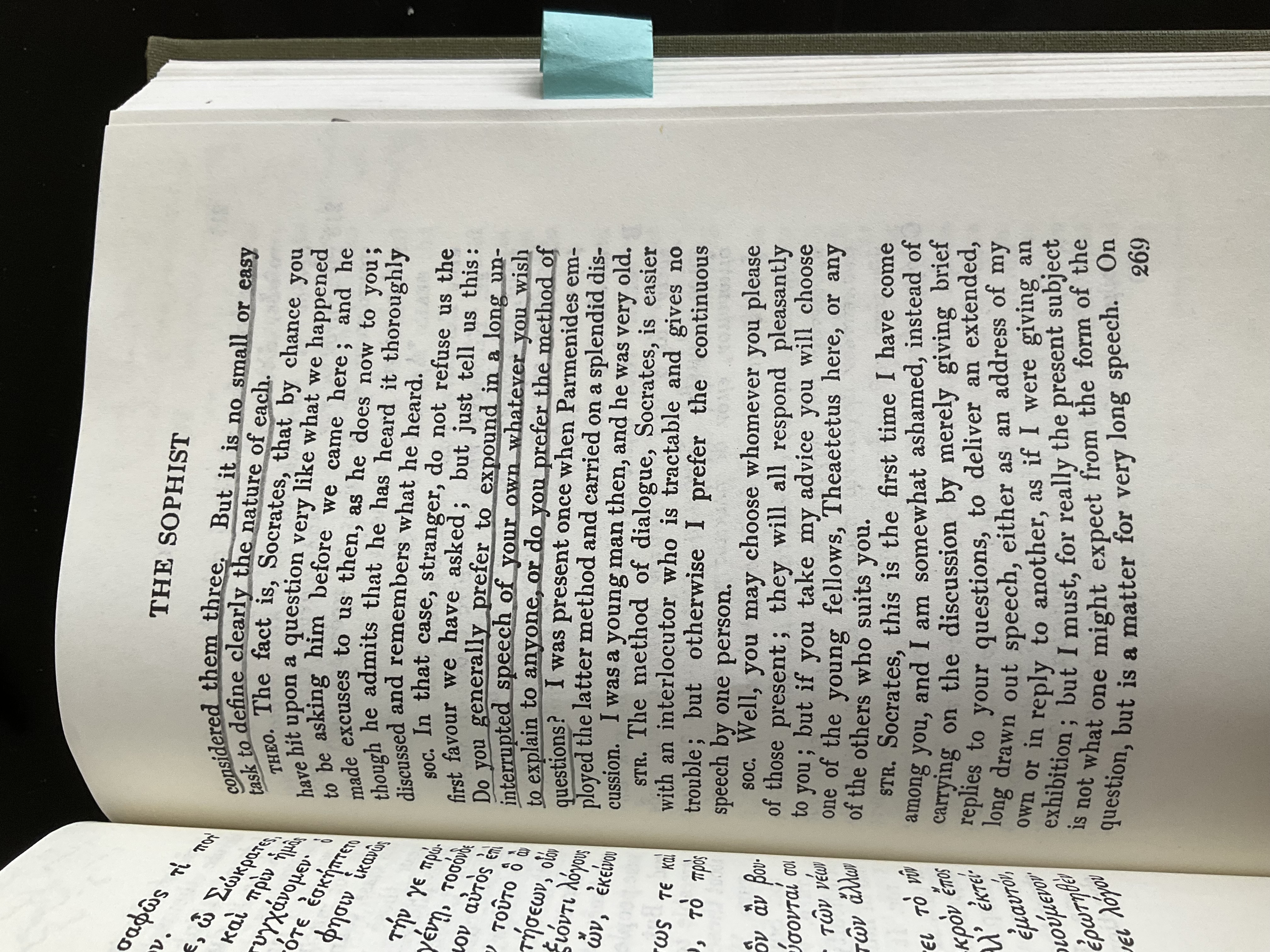
The distinction among sophist, statesman, and philosopher is posed as a threefold classification whose members, the Stranger maintains, are difficult to define clearly. Socrates first portrays genuine philosophers as assuming many apparent forms because most people fail to recognize them: as they observe life in different cities, they may be judged worthless or supremely valuable and may be mistaken for statesmen, sophists, or even madmen. He therefore asks whether the Stranger’s country treats these three names as designating one, two, or three classes; the Stranger answers that they are three, while stressing that determining the nature of each is no small or easy task. When Theodorus notes that the question resembles one previously put to the Stranger, Socrates asks whether he prefers a continuous exposition or a question-and-answer exchange, recalling Parmenides’ use of the latter method. The Stranger says dialogue is easier with a cooperative interlocutor but otherwise favors an uninterrupted speech, and Socrates invites him to choose the young Theaetetus or another participant. Although initially embarrassed to deliver a long address on his first visit, the Stranger indicates that the subject cannot be handled through brief replies and will require an extended speech.
Highlights
- “And though I do not think he is a god at all, I certainly do think he is divine, for I give that epithet to all philosophers.”
- For these men—I mean those who are not feignedly but really philosophers—appear disguised in all sorts of shapes,¹ thanks to the ignorance of the rest of mankind, and “visit the cities,” beholding from above the life of those below, and they seem to some to be of no worth and to others to be worth everything.
- Sophist, statesman, philosopher.
- Did they consider all these one, or two, or, as there are three names, did they divide them into three classes and ascribe to each a class, corresponding to a single name?
- it is not difficult to say that they
- considered them three. But it is no small or easy task to define clearly the nature of each.
- Do you generally prefer to expound in a long un- interrupted speech of your own whatever you wish to explain to anyone, or do you prefer the method of questions?